
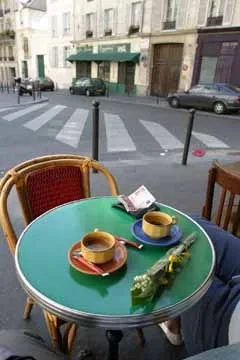
If just a couple of years ago tables in all decent Parisian eateries were already occupied by 12:30 (the time when residents of the French capital traditionally start lunch), and latecomers had to wait in line or, contrary to all traditions, choke down a sandwich at the workplace, now everything is different. The bankruptcy rate among famous restaurants this year has reached astronomical heights.
The insurance company Euler Hermes conducted a serious study of the country's restaurant business and published its results in the Parisian Figaro. Statistics show that in just the first half of this year, about three thousand catering establishments closed in France. Of these, 1,782 were traditional restaurants (mostly small and medium), with bankruptcies rising 25% compared to last year; 530 fast-food outlets (bankruptcies up 19%); and 610 cafes and bars (bankruptcies up 56%). 'It should be noted that these are only direct bankruptcies,' explained Marie-Christine Schmitt, one of the authors of this publication, in her comments. 'Many restaurants are abandoning the seven-day work week and closing earlier. Quite a few restaurateurs are selling their businesses.'
Then the vice-president of the union of hotel and restaurant owners, Daniel Delaval, spoke in the media. According to him, 'the number of restaurant visitors has fallen by 20% since the beginning of this year, and there can be no talk of any improvement in the situation yet.'
A well-known researcher of the French restaurant business, creator of the popular blog Simon-Says, François Simon, cites several reasons for the current crisis. First, a change in mentality, expressed in the fact that, despite all the mockery of Americans, fast food has become an integral norm of life for many French people. Suffice it to say that in Paris alone there are already more than 60 McDonald's. The menu of the large steakhouse chain Chez Hippopotamus now has ten different types of hamburgers, whereas just six months ago there was only one.
Second, the restaurant industry was hit hard by the smoking ban in bars and restaurants, which came into effect on February 1, 2008. Many customers prefer the freedom of home to a 'smoke-free' lunch in restaurants, where they can smoke and watch TV.
Another factor is the fall in the dollar exchange rate and the strengthening of the euro. The number of tourists from the USA, Great Britain and Japan has sharply decreased, and those who do come spend much less on getting acquainted with famous French cuisine than before. Moreover, the decline (more than 10%) is observed not only in Paris and other large cities, but also on the Riviera, a favorite vacation spot for foreigners.
But the main cause of all troubles is, of course, the financial difficulties of the French themselves. With the fall in purchasing power of the vast majority of families, caused by the rise in food prices, going to cafes and restaurants is becoming an unaffordable luxury for many. 'The economic crisis, after construction and real estate, has particularly affected the restaurant business. People save on aperitifs, coffee, desserts and everything else. Some may think the shift from mineral water to ordinary tap water is a trifle, but for restaurateurs it is almost a catastrophe,' François Simon is convinced.
Those who have been to Paris know that previously in cafes and restaurants, a bottle of wine and coffee with dessert were always ordered with the main course. Now in most cases, it's just plain water. And in general, restaurateurs have to resort to various tricks. For example, at the Parisian restaurant Aux Lyonnais, waiters, on the orders of the owner, the famous chef Alain Ducasse, warn customers that ordering only one main course increases its cooking time. Thus, Parisians are actively discussing a previously simply unthinkable incident that occurred recently at the capital's restaurant Au Quincy. The owner showed the door to two couples who had ordered only one main course each. 'And how am I supposed to live?' he explained his action with heartfelt anger to the surprised and offended customers.
Owners of cafes, restaurants and bars are asking the government to fulfill its promise and convince the EU to allow France to reduce the value-added tax for their establishments. Jacques Chirac promised six years ago to reduce it from 19.6% to 5.5%. Nicolas Sarkozy took up the baton, but so far all his efforts are being blocked by Germany, which fears that German restaurateurs will make similar demands.