
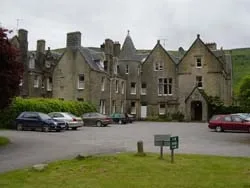
Most castles were built in Europe in the 13th-16th centuries, when walls could still protect against enemy raids. They built thick, anticipating sieges and battering ram devices: stone blocks were laid on the foundation, forming three- to five-meter walls, with watchtowers rising at the corners. In castles, little space was allotted for living quarters; most of the premises were occupied by garrison rooms and great halls for feasts. Cold walls were decorated with tapestries not so much for beauty as for preserving the heat that the massive open fireplaces could not retain. Fat lamps mounted on chandeliers dripped their burnt remains down the collars of feasters. It was smoky, sooty, crudely romantic...
In the 17th century, life changed - largely thanks to the invention of gunpowder. Gunpowder charges placed in a mine under the foundation brought down even the thickest walls. Modern cannons did not fit through the old arrow slits that were suitable for archers. There were also fewer wars.
Castles change too. They less and less resemble military fortifications and more and more resemble the prestigious dwelling of a nobleman. The number of bedrooms for the family and guests grows; in addition to the great hall, small ones appear - for private audiences; libraries and rooms for morning studies emerge. Halls are covered with false ceilings - for comfort; walls are finished with carved wooden panels or silk. Castles are surrounded by gardens and entrance alleys, park sculptures, and fountains.
By the 18th century, castles generally become a thing of the past, and estates - large comfortable houses - take their place. Walls are replaced by lace grilles, furniture becomes exquisite and refined, with more and more porcelain, gilding, lace... Perhaps this was the most luxurious century in history...
Feudalism died, and with it easy money, and in the 19th century castles begin to fall into decay, structures deteriorate. For about a hundred years the European aristocracy still struggled, maintaining the ancient splendor, but they no longer had the strength to repair the sewerage, re-lay oak parquet floors, install roofing, pay taxes, pay taxes, pay taxes, pay taxes... And even before the 20th century, the most practical castle owners began letting paying guests into their homes (then they were not yet called tourists).
And at the beginning of the last century, the formula "castle-hotel" no longer sounded strange. It was invented by the French. The chain of Grandes Etapes Francaises, which includes ten luxurious mansions surrounded by gardens, became the first swallow in the field of elite castle tourism.
Where they are
Both Eastern and Western Europe are full of castles. The most promoted are French castle-hotels, but you can find worthy holiday options in Great Britain, Germany, Austria, Hungary, Slovenia, Switzerland, Spain, Italy, the Czech Republic, Poland, and the Baltics...
Very often castles merge into chains, the most famous of which are Grandes Etapes Francaises and Relais & Chateaux (long ago became international and unites 440 exquisite restaurants and hotels), Pride of Britain - in Britain, Spain Paradores - in Spain, Pousadas de Portugal - in Portugal, etc. The only thing is that there are no castles in Russia. Russia managed with kremlins.
What to expect from them
The charm of castles is that they are all different, often unpredictable. The owners of these treasures strive to win guests' favor not with refined furnishings but with stories that capture the imagination. One of the most striking examples is Borthwick Castle in Scotland, quite close to Edinburgh. The bedroom with whitewashed stone walls is spacious but a bit damp; the vaulted ceiling seems too high; a tiny bathroom is built into a thick niche in the wall. The canopied bed seems like the only pocket of warmth... But here, in this very room, Mary, Queen of Scots, spent her last three weeks of freedom...
If you are not faint-hearted and also speak English, beware: a variety of horrifying stories will be showered upon you about how Queen Mary bowed her head before the rebel lords, and her husband, Lord Bothwell, mounted a horse and galloped off to who knows where. You will also be shown a small room where in the 18th century they hid the corpses of people who died from tuberculosis. And they will also warn you that sometimes a ghost emerges from the fireplace in the next room, but it is harmless, does not scream, and does not disturb guests. What is so strange - a castle without a ghost is like an opera without a prima donna.
It would seem, you'd have to be a fool to stay in such a place. But from experience I can say that it is precisely such castles that attract tourists, and they fill their souls with mystical delight and memories for a lifetime.
The later the castle's character was formed, the more comfortable your bedroom will be. The windows will be larger, the room more cheerful, filled with odd little trinkets, all with diminutive endings: a little glass, a little vase, a little picture...
The younger the castle, the larger, as a rule, it is in size, but the fewer vast halls. Small rooms with an intimate atmosphere predominate. Take, for example, the French castle of Chambord, not far from Paris - 440 rooms and not a single state room, no truly enormous room! A spiral staircase leads to the roof of the castle, where you can walk among a multitude of turrets and chimney stacks decorated with sculptures. And what a park - 400 hectares of formal garden, with fountains, semicircles of neat bushes, straight paths...
Of course, the "nationality" of the castle leaves no less an imprint on its appearance than the time of creation. For example, the palace in Paszkówka, Poland, from the second half of the 19th century. It is entirely furnished with massive oak furniture: sofas, armchairs, writing desks, cabinets, wardrobes. That self-assured, ponderous style would surely have enraged refined Frenchmen, but here this furniture looks natural.
How they differ
Castles, like hotels, are differentiated by star rating. Some bear the proud title of De Luxe, but there are also pleasant "fours" and unpretentious "threes". What's more, the British castle Carbisdale even houses a youth hostel! Walls, as it turns out, are not binding; the level of a castle hotel depends on the wealth and tastes of its owner.
Castles differ not only among themselves; all the rooms inside each of them also differ. When describing castles in catalogs, tour operators try to avoid detailed descriptions of bedrooms, because you will not find two rooms in a castle that are absolutely identical in layout and furnishing. After all, when these buildings were erected, there was no talk of standards—they built as they saw fit or as it turned out. And it largely depends on luck whether you get a spacious room with a canopied bed but a small bathroom, or, conversely, a small bedroom but with a separate corridor and a stunning view from the toilet. This is called a "boutique hotel," and choosing a room, if you are given the chance, becomes a most entertaining game.
However, do not expect to bask in luxury after paying for the cheapest room in a castle. Standard double rooms, which exist even in five-star castle hotels, can be quite modest. A small bedroom, a bed, a dressing table, a wardrobe—everything will be cute and elegant, but by no means chic. Moreover, the least expensive rooms are sometimes located not in the main building itself, but in an adjoining house, or in a recently built guest wing, or even in a former gardener's cottage. Therefore, when booking, you must be sure to clarify where the bedroom is located, lest, dreaming of a princess's canopy, you end up in a gatehouse!
True luxury reigns in suites—enormous rooms whose cost starts from €500 per night. Here you will find a canopied bed, certainly a living area, and a bathroom that will astonish even an experienced traveler with its size. A smile will be evoked by many strange but touching details—for example, a toilet hidden under a polished bench and covered with a canopy, a porcelain wash jug, a jewel box... But there will surely also be a TV with DVD and satellite dish, Internet access, and all the other details without which we can no longer imagine a modern vacation.
Daily routine
Morning at a castle begins with you stretching sweetly, still too lazy to open your eyes and trying to hear the coming day. And... silence. Not a hint of traffic outside the window. Thick walls do not let in sounds from neighboring rooms. Only birds, the noise of the wind in the branches...
After taking a shower and getting dressed at a leisurely pace, you will go down to breakfast. It will, of course, be hot, but no mile-long buffet. There is no need to rush; ahead is a free, completely free day. Slowly spreading jam on a crispy croissant, sipping coffee from a finest cup, you ponder—whether to stroll through the park, sit in one of the many living rooms with a book, or head off in search of adventure?
In most castles, you will not find a long list of entertainment. Horseback riding, billiards, walks—that is about all that usually makes up a castle's "standard daily ration." An overly active person may find this boring, especially since castles are usually located away from villages and main roads, and one can get out of there only by taxi.
The rest—for example, hunting, golf, cricket, target shooting, jeep safaris in the mountains, fishing, excursions, lessons in national cuisine or batik, and so on—all these high-society amusements are arranged on special order and are paid separately. And at a high price. Sometimes castles choose a "specialization": for example, they keep an exceptional pack of dogs and organize fox hunts, or open a shooting school, or arrange golf tournaments. In this case, such services are cheaper for guests, the fun is organized regularly, and the guests who gather are correspondingly united by a common interest.
In recent years, many castles have added spa complexes and offer guests entire self-care programs. But here is an interesting thing: as soon as a spa complex appears in a castle, it seems to fill with people, bustling activity, some sort of purpose, and the half-asleep charm characteristic of small aristocratic estates disappears.
The main event at a castle is, of course, dinner. Guests come down in evening attire, order a glass of wine or a wee dram of whiskey, and engage in casual conversation about travel and drinks. Meanwhile, wizard-like waiters bring dishes—in strict sequence, allowing guests to slowly savor the exquisite taste, serving a bowl of sherbet after appetizers (to refresh the palate before the main course), changing endless differently pronged forks and curved knives. These stylish dinners last about two hours, by candlelight, with a lit fireplace, and live music. By the way, dinners are usually not included in the price of accommodation; this is a separate and substantial expense item.
After eating, everyone smoothly moves to the library, billiard room, or living room; or, if, for example, a wine tasting is planned (as often happens in Italy and France), they are invited to the bar or library.
Can you guess what will make you feel uncomfortable at such evenings? Of course, without knowing the language! Foreigners are, on the whole, friendly and always try to support a person who is clearly lame in this regard, but without a vocabulary of at least twenty English words, a castle holiday will seem boring and lonely to you.