
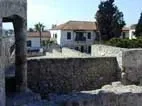
However, as Izvestia.RU writes, far more emotions are evoked by another story - and by no means an invented one, but a most contemporary one - about the division of the island into two parts, Turkish and Greek.
The fact that the island is divided can be felt immediately, even before descending the airplane steps. The trip to Larnaca can take three or four hours, and it is not at all a matter of the pilot's skill or speed, but of which airline you take to get to the island. Cyprus Airways planes fly around Turkey - there are no diplomatic relations between the countries: in 1974, Turkish troops invaded Cyprus and seized its northern part. To this day, 38% of the territory is not controlled by Cypriots - the Turkish Republic of Northern Cyprus was created there. In principle, anyone can enter this "republic," recognized by only one country in the world - Turkey - simply by presenting a passport at the checkpoint. Only in Nicosia (Cypriots call their capital Lefkosia) do eight thousand people cross the border daily, though mostly Turkish Cypriots. In the morning - to work, in the evening - from work. On the other side of the border it is much easier to find a job, and salaries are higher. And in general, the levels of economic development of Cyprus and the Turkish Republic of Northern Cyprus are incomparable.
One of the main sources of income for Cyprus is tourism. Every year it brings $2.5 billion to the country's treasury. The government tries in every available way to support "its own" in this sphere - only locals have the right to work as guides. Therefore, even though in recent years thousands of people from former USSR countries work in very different fields in Cyprus, it is impossible to find a Russian guide. And if you do find one, you can be sure - something is not right. Russian guides almost certainly work without a license.
Safari without safari
Of course, you can do without a guide: rent a car for 9 pounds ($18) and drive along Cyprus's quite good roads. No deposit is required. But there is a problem - traffic is left-hand.
There are other modes of transport. Intercity buses are not an option. They run quite rarely - as a rule, two trips a day. On Sundays there are no trips. But you can save money - because of the short distances, a trip to any end of the island costs only a few pounds. Minibuses run between cities continuously (from six in the morning to seven in the evening) and cost not much more. A taxi in Cyprus, however, is not a cheap pleasure, about ten times more expensive than minibuses. There are two rates - daytime and evening. The evening rate, of course, is more expensive.
For the jeeps that offer tours of the island under the loud name "safari" (despite the fact that there are no exotic animals in Cyprus), special roads have been built. But the jeeps, locals complain, for some reason also drive on ordinary roads. There are also roads with special markings - this is the territory where British military bases are located (only 4% of the island's territory). You can drive on them without any restrictions.
These Strange Russians
The question is where to go? "Russians are strange people," admits a hotel manager. "For some reason they come only to lie on the beach. But we have so many interesting things." The interesting had somewhere to come from - the history of Cyprus spans 10,000 years. Already in the 8th millennium BC, the island was inhabited by Neolithic communities. Its further fate was determined by its geographical position: located at the crossroads of three continents - Europe, Asia, and Africa - it was extremely attractive to conquerors. In different eras, Cyprus was under the rule of the Egyptians, Assyrians, Persians, the heirs of Alexander the Great, and the Roman Empire, then became part of the Byzantine Empire. Crusaders, Turks, and Brits visited the island. All this knowledge can be tested on the "Time Machine" attraction in Limassol (something like "Who Wants to Be a Millionaire?" - except that no one promises you a million). First, nine questions are asked on knowledge of Cyprus's history and culture, and then you are invited to take part in a film-attraction that tells you everything or almost everything about Cyprus. True, if you have problems with your heart or vestibular system, it is better not to get into the "Time Machine" - the attraction is not for the faint of heart.
In Cyprus, besides Greek Cypriots (83.5% - Greek culture and language appeared three thousand years ago) and Turkish Cypriots (12.5%), there are representatives of national minorities - Armenians who settled here at the turn of the 19th and 20th centuries, and Arabs who sought refuge in Cyprus from the Middle East conflict. The rest are foreigners, mainly Britons (Cyprus is a former British colony that gained independence only in 1960). And in recent years, a large Russian community has appeared.
Russians are loved on the island. "You are on our side," Cypriots say, referring primarily to the position on the Turkish-Cypriot settlement. And also, Russians have money. In terms of the amount of money left on the island, Russians have always occupied first place. Although by the number of tourists coming to the country, they are third, and now either third or fourth. Hence the reciprocal love, expressed in the fact that menus in restaurants are in Russian, large hotels always have Russian-speaking staff, and in real estate advertisements, apart from Greek and English, "apartments and houses at low prices" are often listed in Russian. Every self-respecting hotel has a Russian-language channel. Four Russian-language newspapers are published on the island, in which you can not only track the news, but also find out from advertisements the addresses of Russian-speaking doctors, sell or buy a house, give a cat away to good hands, or find your family happiness.
But there is also a flip side of the coin: as one of the hotel managers admitted, he has two categories of rates: one for Russians, the other for everyone else. For Russians, of course, it is more expensive. On the other hand, why be surprised if in almost all the most elite hotels the “presidential apartments” are rented by Russians – not for a day or two, but sometimes for a month. The cost is $1.5–2.5 thousand per night.
Apart from lying on the beach (which, in principle, can be done in any other country with access to the sea) and sightseeing (this is already exclusive), many people go to Cyprus with a very specific purpose. The latest fashion of local hotels is to build churches on their grounds and hold weddings there. Religion does not matter – the hotel manager will find you a Catholic, an Orthodox, and a Protestant priest, a rabbi, and a mufti. The ceremony may, of course, not look as exotic as, say, a wedding in the Dominican Republic, but the chances that the marriage will be happy, the Cypriots claim, are much greater. And they give an argument that no one would dare to object to: Cyprus is the birthplace of the goddess of love.
Don’t mistake the stone
The exact place where Aphrodite was born is also reliably known. It is located not far from Paphos, at the rock “Petra tou Romiou”. The main thing is not to mix up which stone Aphrodite emerged from the sea. They say that you need to swim around this stone three times (according to another version, seven), and then happiness will come to you. People believe in fairy tales – all the trees around the birthplace of Aphrodite are hung with some semblance of ribbons (tie a ribbon – your wish will come true). As a rule, tourists do not carry ribbons with them and use whatever is at hand – napkins, so these trees look rather strange. Another place of tourist worship of Aphrodite is the “Bath of Aphrodite” in Polis.
When it snows in Cyprus
Paradoxically, at the same time in Cyprus you can go water skiing and mountain skiing. And all thanks to the mild Mediterranean climate. The Troodos mountain range lies in the west. This is where you can do winter sports – winter resorts operate near Mount Olympus from January to March. But, as the Cypriots themselves admit, you can never guess whether there will be snow or not. But even if, having gone to the mountains, you don’t find snow there, you won’t regret it. This is where you can see the real, village Cyprus. Lania, Omodos, Louvaras, Palechori, Pelendri...
In every village there is a church with the Greek flag flying over it (the Greek Orthodox Church appeared in Cyprus in the 1st century AD; the first city in the world to officially recognize Christianity was Paphos; this happened in 45 AD). Nine Byzantine churches of Troodos are included in the UNESCO list “Treasures of World Civilization”. There are also three famous monasteries here: Trooditissa, founded in the 13th century, the abandoned monastery of Mesa Potamos, and the most famous and richest monastery in Cyprus, Kykkos, founded in 1100. It houses the golden icon of the Virgin Mary, according to legend written by Saint Luke. The first president of Cyprus, Archbishop Makarios III, was a novice here.
Narrow cobbled streets, cafes where from morning to evening exclusively men sit sipping wine (by the way, women can also go into such “men’s” cafes, no one will say anything to them), women weaving traditional lace (“levkaritika” in its time, they say, amazed Leonardo himself). And pottery, lace, and painted glassware can be bought right here. True, it is worth bargaining – Eastern traditions are alive even in European Cyprus. As a result, the price can be cut by half. The main thing is not to make a mistake in your choice: sometimes local products are adjacent to similar Chinese goods, which are, of course, several times cheaper. The only thing you will never get a discount on is wine.
What the Crusaders drank
“This is my father,” explains a seller in one of the shops. On a bottle of zivania (a traditional Cypriot grape vodka) there is a photograph of a man. The photo was taken in the 1960s. By the way, homemade zivania tastes no worse than that produced at the largest winemaking enterprises KEO, ETKO, LOEL, SODAP.
The most famous Cypriot wine, made according to the oldest recipe, is “Commandaria”. They say that the name for this sweet drink was given by the knights of Richard the Lionheart and the Crusaders. You can taste almost all varieties of Cypriot wine – and almost for free – in September at the wine festival in Limassol. In 12 days, the festival is visited by more than a hundred thousand people.
But what is wine without a good snack? In Cyprus, they know a lot about food. The central market of Nicosia can shock: cabbage is three or four times (without exaggeration) larger than that sold at domestic markets, potatoes are harvested four times a year, churchkhela is a meter and a half long.
You can also go to a tavern (cheaper than restaurants and the food is better) and order meze - a lunch of 10-15 dishes that are served one by one to the common table. It's better not to go into taverns that offer seafood. There is almost no seafood off the coast of Cyprus - everything is exported, and therefore prices are correspondingly high. Much better is meat meze, when you are brought several kinds of meat cooked in different ways. For dessert - “oriental sweets” and famous Cypriot honey. And, of course, coffee. It even has a special smell, unlike any other in Europe. It's not for nothing that Cypriots, when they come to us, complain: it's impossible to drink coffee here. If you repeat the experiment of going to taverns several times during a trip, then a few extra kilograms upon return are guaranteed.
Moreover, it's better to go to taverns not in tourist areas, but to those that the Cypriots themselves visit. Apart from being a guarantee of quality, here you can meet a lot of interesting people: TV stars, famous singers and actors. They sit at tables like ordinary visitors, and no one rushes to them for autographs. Once, one of the residents of Nicosia told, he witnessed how the President of Cyprus casually approached tourists from Germany and asked if they liked Cyprus. Well, how can you not like a country whose president sits down at your table with such a question?