
Photo epa
Refereeing lessons
Addressing the referees currently working on the football pitches of the World Cup and who will ultimately officiate 64 matches, FIFA President Sepp Blatter reminded them that refereeing at the 2002 World Cup was "a catastrophe" - they had to fend off accusations of bias and artificially eliminating some teams from the tournament for quite a while. Given the mass of criticism directed at referees at the previous championship, FIFA introduced the Re-ferees Project: for 18 months before the tournament, referees potentially vying for a place in the World Cup refereeing team underwent intensive physical and tactical training. They were instilled with: you must referee as if "there will be no second chance." Theoretical classes, besides studying the rules, included special lectures aimed at increasing responsibility: referees were reminded that the total television audience for the month of the championship would be 30 billion (!). Such heightened motivation - "all of humanity is watching you" - became the leitmotif of the theoretical classes, and "reminders" such as observing the principles of fair play and special vigilance over the best players ("otherwise our television audience will sharply decrease") were scattered like beads throughout the entire preparatory course.
Practical sessions were mainly structured to improve the referees' physical readiness and, as they say, to drill them in passing general physical fitness tests. For example, doing 20 abdominal crunches (sit-ups from a lying position) in 60 seconds. Good times also had to be shown in short sprints and endurance tests. For instance, 44-year-old Frenchwoman Nelly Viennot did not pass the sprint test and could not become the first female referee at a World Cup.
Psychological preparation was also important: how to react in stressful situations, not to succumb to provocations (you may be insulted in the heat of emotions), how to keep a cool head in a heated game... At the end of the course, referees were also tested, and according to Russian referee Valentin Ivanov, "during the computer test, they asked us to answer 180 (!) some incomprehensible questions." For example, you had to share your food preferences or whether you would rather be a boss or a subordinate. It's good that three answer options were offered. "Probably, FIFA representatives were just checking how sane the referees are," joked Valentin Ivanov.
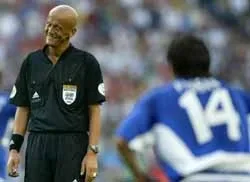
In the end, 21 referees were entrusted with officiating the World Cup in Germany. Nine of them represent Europe, five - South America, three - Asia and Australia, two - Africa, and the same number - North America. These "men in black" became as full-fledged participants in the football show as the footballers themselves.
Strict and principled
It is worth noting that several new approaches have appeared in refereeing at this World Cup. For the first time, referee teams made up of officials from the same country are working on the field. Previously, a referee could be, say, from Italy, and his assistants from Paraguay and Colombia. Now a team of compatriots is preferable. It is assumed that a team selected on a national basis will work more cohesively. If a Russian, Ivanov, takes the field, it means that Nikolai Golubev and Evgeny Volnin, selected for the first time for such a prestigious tournament, will work with him. By the way, one of the pitfalls was an English language exam - 40 questions on football rules that had to be answered in writing!
For the first time at this championship, referees on the field communicate via radio. José-María García-Aranda, head of FIFA's refereeing committee, however, significantly remarked: "The main thing is that we are not eavesdropped on," which led experts to deep reflection. What could the esteemed referees possibly have to discuss? Nothing is known yet about a system to protect against eavesdropping at World Cup venues, but in some professional leagues such radio communication has long been successfully used. So FIFA's good intentions - to minimize refereeing errors - may perhaps be fulfilled thanks to the referees' on-field consultations over the air.
But the main thing is that at this championship, FIFA for the first time punishes teams for delaying the game. Everyone remembers the "glorious" moments when the score has been made and a team shamelessly plays to hold the result, passing the ball from one player to another, or periodically back to the goalkeeper... Blatter promised that no one would be allowed to do this in Germany. Nor will such a well-tested method of time-wasting by those who like to delay the game pass, as taking a free kick from a deliberately incorrect position to force the referee to order the kick to be retaken. It is not allowed to show readiness to take a throw-in from the sideline and then pass the ball to a teammate. Kicking the ball out of bounds after the game has been stopped is also punished. It is forbidden to waste time during substitutions, pretending that you suddenly forgot something on the field. It is unacceptable to provoke a conflict with the referee by touching the ball after the game has been stopped. In addition to punishments for time-wasting, now also punished are playing with elbows, reckless pursuit of a player on the field (essentially settling scores), holding up attacks when opponents roughly grab a footballer by the shirt, slide tackles, inappropriate behavior in the "wall" when taking set pieces, wearing jewelry on the field (at every game there is even a machine for cutting off rings that are too tightly stuck on fingers), and speaking out against officials, that is, "attacks" on referees.
Blatter spoke of rough play as a real problem. Therefore, now if elbows are used, a yellow card is shown immediately. If hands are waved on the field too actively - a red card! "We must keep the stars safe and sound until the end of the championship. Recently, everyone saw in a television broadcast of a European league match how a footballer lost two teeth in a game - they were knocked out by an elbow. But we don't have a boxing arena here," the FIFA president reasonably notes.
In addition to the already mentioned features of modern football, referees must also fight vigorously against simulation on the field. Theatrical performances like a player rolling in pain, who a moment later calmly gets up and walks away, must now also be punished. A yellow card is indispensable here. True, similar cases have already occurred, and some went unpunished (in the match Italy - Ghana, Italian Iaquinta got off with a warning). However, according to the rules, the referee must be completely sure that the player is putting on a drama, not actually writhing in pain. But how can one be sure of that? It seems Blatter demands almost extrasensory abilities from referees. Although now it will be possible to consult with a colleague via radio: 'Did you see, was he really hit?'
People in black
Given that behind each team stand numerous sponsors, and what money can fall to the players in case of successfully passing the next round, the price of a refereeing error increases immeasurably. To protect referees from the pressure of circumstances, during the World Cup all referees were placed in strict isolation at the tournament headquarters near Frankfurt. Here they will not be pursued with questions... Actually, any interviews during the championship are forbidden for referees. They also cannot communicate with team representatives and players.
Referees need to train every day to remain in excellent physical condition. After all, at any moment they can receive an appointment to officiate. At the referees' disposal is a support group consisting of physiotherapists, massage therapists, psychotherapists; all together they will help the referees reach peak form. It remains to add that the referees endure all the hardships not only for the high goal of officiating the World Cup, but also for the $40,000 due for a month of work at the World Cup. Considering that many referees are also engaged in their main work, the extra income is not bad. For example, the experienced Argentine referee Horacio Elizondo, who officiated the opening match Germany - Costa Rica, in 'civilian life' works as a physical training instructor.
Working at the World Cup certainly changes referees' self-esteem. Just one dubious free kick at the end of a game between equal teams can decide the fate of the entire championship. The referees themselves, it seems, do not feel too sorry for those they send off and show their cards to. As a rule, at best, relations between referees and players remain in a cold war. We could observe the mechanics of how the game is rigged at the last World Cup. Even then, from the very first matches, rumors circulated that Sepp Blatter himself influenced the outcomes of games. Behind-the-scenes manipulators took into account the interests of sponsors who counted on Asian and especially Japanese fans not leaving their televisions. Desperate efforts were made to bring the England team, extremely popular in Japan, Korea, and China, into the playoffs. At the same time, it was necessary to knock out the main competitors, which was demonstrated, for example, in the match between Italy and Croatia. And in general, to overcome refereeing trips, one must be a head above the opponent.
The main problem of refereeing at such planetary tournaments is not even Blatter, but the global system of football commerce. After all, the same thing was repeated at the 2004 European Football Championship in Portugal. A number of experts note that at the European Championship a well-established system was used to bring the host country's team into the final stage. Thus, the Portuguese national team was kept in the tournament, whose elimination from the tournament would have meant huge losses for both the organizers and European football bosses. To change the outcome of games, very little was needed then - to slightly tighten refereeing in the games of rival teams.
Considering possible refereeing scenarios at the current World Cup, football analysts agree that the German team will be brought to the final at all costs. It simply cannot afford to lose earlier! The local fans would not understand, and the World Cup would lose part of its audience. The main question: who will be the opponent of the German team in the final? It is logical to assume that it will be the Brazil team. But for that, the Brazilians will have to perform miracles and, most likely, overcome the strongest refereeing resistance in the history of World Cups. Of course, the Germans would prefer to play against a team closer to them in strength.
Experts are also concerned about the choice of referee for the final match. The last time such a match was officiated by Italian Pierluigi Collina. Until 1982, Europeans dominated among the main referees of the final match, but after that only two of the six main referees represented the Old World. Once an African officiated the final (in 1998, Said Belqola from Morocco). Referees from Asia and Australia have never been called for such work, nor have referees from the host country been invited. Some jokers predict that this year the decisive match will be officiated by Australian Mark Shield, but that seems too fantastic an option.
Part of the championship is still ahead, so the FIFA refereeing committee will have time to solve this most difficult task. One thing is clear: no one will be able to avoid refereeing errors at this tournament either - the human factor is too strong. Despite all instructions - secret or overt - good wishes and reports of successfully done work, referees will judge as FIFA tells them. And no isolation will still allow referees to be one hundred percent objective and free from the aspirations and wishes of the football community. That is why those who take the field for the next match are called 'people in black' desperate guys.