
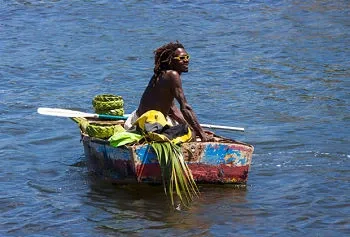
Once upon a time, pirate ships plowed the waves of the Caribbean Sea
This hypothetical island first appears in the mind at about age ten – after reading the novels of Stevenson and Sabatini. Later, James Bond films add fuel to the fire of imagination. And there it is – the image of a dream island somewhere in the middle of the Caribbean Sea. A place where a pirate treasure is buried under every palm tree, lobsters jump out of the water straight onto the plate, everyone wears dreadlocks, and Bob Marley is broadcast around the clock on the radio. Let's try to sort it all out. And we'll start, of course, with pirates.
For a long time, Europe did not even suspect the existence of the Caribbean islands. About three hundred years before their discovery by Europeans, Arawak Indians migrated from Central America to the Caribbean. Peaceful and hardworking, they grew maize and sugar cane. About a century and a half later, they were attacked by Carib Indians, who killed all Arawak men and took the women not only as deserved war trophies but also as keepers of pottery art.
Who knows what would have happened next, but in 1453 the Turks captured Constantinople and cut off European trade routes to Asia. This event ultimately served as one of the causes of the so-called Great Geographic Discoveries. After all, the rapidly developing economy of Europe needed more and more resources like air, and they were located mainly in Asia. The search for new trade routes bypassing the 'Ottoman bottleneck' was undertaken primarily by the Spanish and Portuguese.
The Portuguese Vasco da Gama charted a route around Africa. The Genoese Christopher Columbus, under the Spanish flag, set off westward across the Atlantic. He crossed the ocean on the trade winds and discovered the Caribbean islands, almost all of them. Columbus found neither gold nor spices there, but until the end of his life he was sure he had reached India. Some time later, one of his followers, Amerigo Vespucci, sailing another thousand miles, reached the coast of Central America and founded several colonies there.
The Spaniards mercilessly killed and robbed the Indians, sending dozens of galleons laden with gold to Europe. The sea route passed right through the Caribbean. Unsurprisingly, colonies of rival countries – British, French, Dutch – were quickly established on the islands. Brave sailors received overt and covert permission from their governments to rob the Spaniards in the Caribbean Sea, on condition of paying a portion of the loot into the state treasury. That's how pirates appeared in the Caribbean.
For several centuries, Britain, France and the Netherlands divided the islands. The struggle was desperate. The island of St. Martin still belongs to both the Dutch and the French. Almost all the islands of the Caribbean archipelago gained independence in the second half of the 20th century. But traces of the colonial past are still visible literally everywhere.
In addition to the British, French and Dutch islands, there are also American ones. The same Bahamas, so beloved by James Bond, as well as Cuba and part of the Virgin Islands. The French-Dutch group includes St. Martin, St. Barts, Saba, Curacao, Margarita. Britain left its mark on all the rest.
Which islands of the Caribbean archipelago, besides Cuba, are the easiest and most convenient to visit in winter? For the azure sea and white sand, one should fly to the Virgin Islands, Bahamas, St. Martin, Antigua, Grenada and the Grenadines. If we take into account factors such as airfare costs and visa difficulties, the choice becomes even smaller: St. Martin, Antigua, and the Grenadines with Grenada island.
Antigua (together with neighboring Barbuda) is famous for its endless beaches, excellent marinas and the mighty English Harbour fortress built by Admiral Nelson. St. Martin is for those who crave lively club parties. St. Barts, on the contrary, is distinguished by its respectability. It's no wonder that world celebrities and the richest people on the planet prefer to vacation here. As for Grenada and the Grenadines, these are the real 'islands of dreams.' By the way, it was here that 'Pirates of the Caribbean' was filmed.
Here is located the small archipelago of Tobago Cays. Sandy atolls are washed by azure waves, leaving intricate patterns on the white sand. There are no people, only monitor lizards. But the coastal waters are full of sea turtles, coral fish, and lobsters.
Another pearl of the Caribbean is Union Island with its picturesque lagoon. It is often included in the routes of Caribbean regattas. Dropping anchor nearby, you can sunbathe on the beach, swim in the azure waters, watch the life of the coral reef inhabitants. For regatta participants, a day on the island ends with a lively party with lobsters, and after dinner – swimming in the ocean by moonlight.
A week-long trip through the Grenadines, considering the low cost of winter flights and food prices, can be considered a quite anti-crisis vacation on the islands of dreams.
Mikhail SAVELYEV.
«Lenta.ru»