
In the courtyard of the small temple Templete, which stands between Havana's first square Plaza De Armas and Havana Bay, grows an old ceiba tree. In mid-November crowds flock to it. The ceiba is considered sacred, and whoever walks around it three times has a chance of having their most cherished wish fulfilled. In early January 2004, tourists wandering around Plaza De Armas were told meaningfully, pointing at the old tree: "A month ago it withered. That has never happened before. Something is bound to happen." What exactly was not specified; it was unnecessary.
For the truly slow-witted, the guides had another topical story in reserve. About the prediction of Santeria priests (Santeria is a religious product of multinational Cuba, a strange blend of Catholicism and African beliefs): "This year we will be left without Fidel."
We later saw many old withered ceibas all over Havana. And so we cynically decided that the story about the tree and Santeria was invented specifically for tourists.
However, the fact remains: Doctor Fidel Castro Ruz, the man by whose will one of the last socialist reserves in the world is held together, is, to put it mildly, not young. Fidel himself, of course, never tires of delivering multi-hour speeches to Cubans (and to the whole world as well), speaking not only about the latest achievements of the revolution on the Island of Freedom, but also about his healthy lifestyle and excellent health. But this does not stop Cuban emigrants in Miami from packing their suitcases in the hope of regaining their homeland and family assets lost in the early 1960s, people with big money in the States from looking for places to invest in the Cuban economy, and ordinary Cubans from waiting with hope and fear for the coming changes. Hope that without socialism the country will cease to be poor, and fear that the inevitable redistribution of property could lead to civil war.
Fidel's state of health also affects the domestic tourism business. Cuba is experiencing a rise in interest from former Soviet citizens. Last November, it was not easy to buy plane tickets from Moscow to Havana for the beginning of January. In the most convenient place for this, the Cubana Air office (they sell seats on Aeroflot planes, but at prices lower than Aeroflot's), it was already impossible to do so. And the travel agency used by a good half of the editorial staff of "Russky Fokus" after the January holidays even decided to include the Cuban destination in its permanent program. No joke, the main argument in favor of a trip to Cuba for me and many of my acquaintances was: "We'll always have time for other places, but there..."
"I close my eyes and see the golden sand of Varadero..."
You can travel around Cuba in different ways. You can blindly trust a travel agency and, enjoying the corrupting delights of the all-inclusive system, lie around on the famous sands of the Independent Republic of Varadero (that's what cheerful Cubans call this oasis for foreign tourists) or on the Caribbean island of Cayo Largo. In this case, I advise choosing hotels with Spanish participation; there will be decent food and normal service. If you wish, you can escape from the lazy four-star paradise on excursions to different parts of the country on "air taxis" - the crop-duster planes An-2 (which fly and don't fall - what a miracle!).
Or you can live in different parts of the island, traveling on domestic airline planes (mostly - another legacy of the Soviet aviation industry - the An-24). In this case, you need to be prepared in advance for long waits at airports and confusion with flights.
You can avoid hotels altogether and, renting a car, travel around the country on your own, staying in particulares - private homes where the owners rent out rooms. Eating there as well, and getting the thirty-three pleasures that foreigners come to Cuba for.
You could even try hitchhiking across the country. That's where you'll get a complete immersion into revolutionary Cuban reality: the whole country travels this way, where, as you understand, both private cars and public transport are in very bad shape.
We are cowardly tourists, and therefore preferred the comfortable and safe option: a week of lazy paradise in Varadero (with airplane excursions to the colonial museum city of Trinidad and to the Caribbean island of Cayo Largo) and a few days in Havana.
Hasta Siempre, Comandante
I don't know about others, but for me the first three days in Cuba were somehow awkward: the former Soviet pioneer in me woke up, raised on romantic films about Fidel's detachments escaping pursuit into the sugar cane thickets. Where is he, the new man that Fidel has raised over the last forty years? According to stories from former Soviet specialists, Castro bet on children when he came to power, waving his hand at adults who were used to thinking that work is unnecessary if you can just ask a fat Yankee for a dollar? This was especially easy to ponder at the bar counter over another glass of piña colada. Well yes, everything is clear: the blockade, the lack of support from the USSR, poverty, 18 years of focusing on the tourism sector as the main one (due to the lack of opportunity to develop anything else). And everything returned to square one (if it ever left it). Cubans cheerfully and inspirationally entertain tourists, among whom - the only change - now it's not Yankees but Canadians that predominate. At first it was somehow unpleasant to watch these people bending over backwards hoping to earn an extra dollar. And why did they need all those revolutions? Except to give the world a beautiful legend and give fans the opportunity to buy T-shirts with the portrait of the handsome Argentine Che. Which, in essence, is also not bad. After all, everyone should do what they like. The calling of Cubans is show business. After three days the attack of pioneer hypocrisy passes, and I relax completely and irrevocably.
And the Cubans exploit their legend in a purely Cuban way. In the repertoire of any musician performing before tourists, there is a mandatory item (apart from the famous song about the peasant woman from Guantánamo, the guantanamera). It is a ballad beautiful to tears (when performed properly) about comandante Che Guevara, Hasta siempre. They sing it before the island's guests, who are eating black beans with pork in a restaurant; they sing it as a warm-up before some evening show at the hotel. It is joyfully picked up by a nimble Havana local who tries to attach himself to us as a guide on the Malecón (the famous Havana promenade) when I start humming this song to myself. They love it here. Can you imagine someone in Russia performing a song about Chapaev in a tavern (seriously)?.. And in Cuba all this happens quite organically. “Cubans love to express their love of labor in songs and dances,” ironically note foreigners who have lived here for years.
Fry bananas, amigo
By and large, Cubans have long since given up on all revolutionary ideals.
Despite the network of all sorts of organizations and committees for the defense of the revolution (into which ordinary citizens are gathered on a voluntary-compulsory basis, obliged to inform on each other), everyone in this country lives by the principle “if you want to live, learn to get by.” Otherwise you won't survive in a country where a salary of $30 is considered normal, and food is distributed by ration cards, and even an ordinary Soviet citizen of the late 1980s would weep over the Cuban monthly ration.
Therefore the main charge for which half of the island's prisoners are doing time is not political articles, but plain theft.
Here there is even an analogue of the purely Russian expression “to dry crackers” - “to fry bananas.”
They steal, naturally, in a socialist way, from the state.
Or, when it is safe, from tourists: it is better to take suitcases with locks to Cuba, otherwise at Havana's International Airport on the way home your luggage will be lightened.
We also made our humble contribution to supporting the Cuban shadow economy: first, needy people pulled a manicure set and linen trousers from our travel bag, and second, we deliberately bought cigars stolen from the factory.
You can buy cigars from hand (which is cheaper than in tourist tobacco shops) anywhere in Cuba.
But at first we were held back by the fear of buying something substandard this way.
The guide, a Russian girl who took us around old Havana, dispelled our doubts: “In shops it's not only expensive, there the cigars are also stale. Rarely anyone buys them.”
Of course, she has an acquaintance who sells the freshest cigars smuggled out of the Partagas factory.
The next morning we were already meeting in the hotel lobby with another compatriot of ours, Marina (name not real), who handed us a piece of paper with prices and showed us a backpack stuffed with cigar boxes: “This is all illegal, so take the backpack, go up to the room, quietly look it over and keep whatever you need.”
We trudged off with the backpack to our room, while Marina stayed to wait for us in the lobby - in Cuban hotels it is forbidden for locals to visit foreigners.
The prices for stolen cigars were wonderful, and the cigars seemed to be too.
However, we were puzzled by the dates printed on the boxes. They were awfully old.
“Girls, the boxes have nothing to do with the cigars, I have everything genuine and fresh,” Marina explained with a sigh. “The cigars are taken out of one factory, the boxes from another, the tubes from a third.”
“Okay,” we said, paying her the dollars.
“Oh, by the way, keep in mind that hotel rooms are bugged,” Marina warned us as we parted.
“Well, fine,” we shrugged, but immediately began to remember what we had said about Fidel when we hoped to see him on Cuban television.
Sex in Cuba
“You've lost your minds, this is a country of male sex tourism!” acquaintances told my friend and me when they learned that we two, without husbands, were planning to go to Cuba.
In response we babbled something about Fidel, the sands of Varadero, and old Havana. But at the same time we were terribly tense.
The reviews found on the Internet from men who had been to this country only added to our nervousness.
The impression was that the island is populated entirely by muchachos (and their pimps) ready to give themselves left and right, and by sex-obsessed tourists scouring for these muchachos.
We once came across one female perspective on Cuba, but it did not add to our peace of mind.
It turned out that apart from drinking mojito cocktails, learning to dance salsa, and waiting for husbands to return from their excursions after muchachos, there was absolutely nothing for girls to do in Cuba.
Having returned from there, I can say with complete confidence: Cuba is a place for everyone.
First, it's worth going there not only for romantic adventures.
I deliberately do not describe here the wondrous nature of the island and the decadent beauty of Cuba's colonial cities.
One must immerse oneself in this spirit of stopped time.
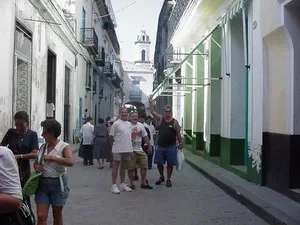
Nor can I describe the poignant feeling that Havana evoked in us - a city beautiful in its neglect.
An elusive charm that will disappear when the Castro regime collapses and foreign investors flood into Cuba.
But let us return to the eroticism that indeed permeates the Cuban air.
In Cuba, pleasures can easily be found for everyone, regardless of gender or sexual orientation.
If you want that, of course.
And this applies not only to young men who professionally hit on lonely foreign women in cafés (these are easily brushed off with just the mention of husbands who “are waiting for us at the hotel”).
Songs, dances, and flirtation are in the blood of any Cuban man or woman. But unlike representatives of many southern peoples, Cubans are not pushy. Men here are true caballeros (so claim foreign women who live here). Whether you want to play their game or not, in any case the atmosphere of clearly expressed male (but polite!) adoration will not leave you on this island. And not only because you are a foreigner or have blue eyes. It is customary here to treat women with frank admiration. "My love, it's raining today, why didn't you take an umbrella?" asks an elderly Cuban man to his young pretty neighbor. And having heard the explanation that she forgot it somewhere (buying any consumer goods on the island is a huge problem), he adds: "However, you have nothing to fear. Flowers only become more beautiful from rain." They also say that Cubans are excellent lovers. No wonder foreign women (and not only our undiscriminating girls, but also fastidious European women) fall in love with them, marry them, and stay to live in Cuba. These marriages, however, are fragile. After a year, overseas wives begin to demand fidelity and means of subsistence from their Cuban husbands. And that is something true caballeros, as a rule, cannot offer their chosen ones.
They also say that for all their ease, Cuban men and women are very jealous. Murders on the island mostly happen out of jealousy (men choose cold steel, women prefer to set their unfaithful husbands on fire while they sleep). A typical Cuban scene: a Cuban man, in the presence of his wife, follows someone's curvy figure with an interested glance (on Cuba, full female beauty is valued). "I'll burn you, Eduardo," the Cuban woman warns her husband. Such are the passions.
And with foreigners, Cuban women have calm and practical relations. Another scene from life. A shoe store accepting hard currency in a five-star hotel. Under the skeptical looks of the salesgirls, a foreigner chooses stiletto heels for his Creole companion. Taking advantage of the tourist not understanding Spanish, the girls from behind the counter say to their happy compatriot: "Listen, you don't know how to walk in heels anyway, buy something simpler." "No," the Creole woman replies. "He wants to buy stilettos, let him. I'll bring them back to you later, in exchange for money."
So, men, be more attentive to Cuban girls! Girls, do not be afraid of Cuba and the fiery local flirtation. No one will lay a finger on you without your consent. By the way, you can safely walk around Havana without men even at night (it is an absolutely safe city crime-wise). The biggest nuisance that awaits you there is intrusive questions on every corner: "Hi! Where are you from?" But tourists who have been to Santiago de Cuba do not particularly advise risking there: people in this cradle of the Cuban revolution are tougher.
And one more piece of advice for the future. Having returned from Cuba, do not try to find the local atmosphere in our ersatz clubs. The light carefree fun is replaced there by a heavy stupor, "mojito" by incomprehensible swill, and light flirtation by dirty advances from dark-skinned boys of definitely non-Cuban origin. You risk going out onto the cold domestic street and crying: "I want to go back to Cuba!" Well, hasta luego, see you on the Malecon! And God grant Fidel health.