
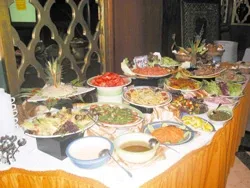
Now, of course, the situation is different: in a normal hotel, the cook must serve exclusively fresh food. Only the serving principle remains: all the food is on display in front of the guest, and he can decide for himself what he wants to try and what he doesn't, and take as much as he wishes. As the magazine "Beach" notes, the buffet is considered the most democratic form of dining; it allows the guest to eat well, with variety, and quickly. That is why it has taken root in large beach hotels.
Kitchen economy
Despite all its abundance, the buffet costs the hotel far less than plated service. First, because everything is cooked "in bulk," and many dishes at the buffet are made from the same ingredients. Olives - in four salads and one hot dish, smoked fish - in two types of appetizers, beans - in two salads and one hot dish... Of course, at the buffet, each guest can pile a huge plate of food heaped high, which is impossible with plated service. But practice shows that this happens only in the first days of the vacation. Then the guest says, "I've stuffed myself silly" and returns to the human norm or even goes on a diet. So on days with large arrivals, more food is prepared, but then the quantity decreases.
Under this system, the cook can use inexpensive products and, by preparing them abundantly, beautifully, and tastefully, earn the guests' praise. With plated service, you can't get off so cheaply.
The buffet also "plays" on the cost of dishes. Thus, in high season, when there are many guests, a salad may consist half of seafood and half of greens. And in low season, when there are few tourists in the hotel, the same salad "slims down" and there is much more greens. The number of dishes remains the same, but their cost price drops sharply.
Depending on the meridian
The composition of the buffet menu is tied to cultural, religious, and national characteristics - the basic menu will always be local. But most hotels even specifically emphasize that the buffet includes European (that is, the most neutral) dishes. The question is how the local cook understands them. For example, in Indonesia you can't find a European cook for love or money, and a local cook quickly forgets the "European school" and starts generously covering even French fries with pepper and spices.
Often the chef pampers guests with so-called "evenings of national cuisine," when the whole dinner consists exclusively of dishes of, say, Italian or Mexican cuisine. That is still more or less familiar, but in Thailand, for example, they might treat you to... fried grasshoppers. It's not such a bad thing, I must tell you - they are salty, like our dried roach.
If you know the East only from Turkey, then other countries may disappoint you in terms of the buffet. First, in Muslim countries, which also include Egypt, the UAE, and Tunisia, they categorically do not eat pork. In Turkey, in principle, the same picture, but there they try to compensate for the lack of meat with fish, poultry, salads, and fruits in immeasurable quantities. In Egypt, on the contrary, the buffet is usually not rich; the choice of dishes is smaller - chicken, lamb, salads with mayonnaise, and fruits arrive mainly in summer. But in all Eastern countries, the tables are laden with sweets: there is baklava, sherbet, Turkish delight, and all sorts of pastries, and some baked baskets with a filling for which it is difficult to find a name.
But in Southeast Asia, they abstain not only from pork but also from beef: the cow is a sacred animal. Although connoisseurs claim that it's not only about religion. It's just that a virus dangerous to human health lives in the blood of Indian cows, so Hindus and Thais prefer to limit themselves to the same chicken. And they don't eat pork for other reasons: in their understanding, this animal is inedible because it feeds on waste. However, for ordinary Eastern people, happiness lies elsewhere - in seasonings. Therefore, at their buffets, you will certainly see many jars and cups with sauces and powders that have a rather pungent smell and too spicy taste.
But in Europe, there is pork, beef, and chicken. However, all this is served in much smaller quantities: overeating here is considered uncultured. Again, we will see national features: in Italy, the menu is built on dozens of types of spaghetti, and in Spain, paella will almost always live on the table.
An interesting paradox is observed in Greece, Bulgaria, and Croatia: the countries seem to be maritime, but you will almost never see fish at the buffet. The main thing they cannot do without is olives and feta cheese, and then the rest depends on the hotel's stars.
Two salads, three stars
In European countries, the dependence on hotel stars is more noticeable. Both the variety of the menu and the number of dishes at the buffet are connected with the hotel category. If the hotel has only two stars, the maximum you will be offered is a sandwich with instant coffee for breakfast and something fried with vegetables with mayonnaise for dinner.
The higher the hotel category, the larger the assortment. In Spain, for example, variety starts already with the three-star hotels. True, they are divided into good and not so good. In the good ones, they may give you a whole basin of strawberries, sophisticated salads, shrimp, fried fish, and stewed meat - and all this for one dinner. In the bad ones, there are three or four simple salads and a couple of uncomplicated hot dishes. True, the price of accommodation here is much lower.
If the hotel category is five stars, the dishes will not necessarily become more numerous, but their composition will turn toward exotic and expensive ingredients. For example, ordinary shrimp will be replaced by king prawns, freshly squeezed strawberry juice will be served at breakfast, and among the fruits there may be some rambutan.
In the same India, high-category hotels rely on their favorite seasonings: if in a two- or three-star hotel you'll be served plain rice, here they'll put on the table red rice, yellow rice and white rice. Just don't think these are different varieties - they simply poured a different sauce into each plate. But the sauces are not ordinary, but made from special, high-quality ingredients, for true gourmets.
And in Turkish high-class hotels, in addition to all sorts of delicacies, there is usually a diet table and a children's table, where various hamburgers and French fries are laid out. Harmful? But the kids are happy.
However, in reality, there are no general rules for organizing a buffet for hotels. Each hotel's director and chef decide for themselves what the menu will be. For example, in Croatia, two hotels stand almost on the same territory: one is two-star, the other is four-star. The price for accommodation is naturally different. Nevertheless, neighbors from the expensive hotel try every evening to come to dinner at the cheap one. And for good reason: there they offer a choice of two kinds of fried meat, several kinds of fish, five different side dishes, two soups, a lot of sauces, various pastries and ice cream... True, guests of the neighboring hotel have little chance - the duty waiter only lets people into the buffet with a special card.
What the chef prescribed
No matter how many stars a hotel has, the chef is the one who calls the shots in the kitchen, and they spare no expense to attract professionals. After all, if a talented cook and strong organizer is at the helm, the hotel will quickly gain a rating, become popular, be able to raise prices and still be full. The chef assembles his own team, and very often invites cooks from different countries - for example, from Thailand or Italy - to treat guests to exotic dishes every day. In Turkey, for example, there is one hotel where the chef is "imported" from the Far East, and all the dishes are sushi and their varieties.
Many hotels even make their chefs their calling card. And tourists deliberately go to the same hotel, knowing that their favorite scaloppine with sauce, created by a famous master, will be waiting for them there.
Just add water
A separate topic is drinks. If the hotel does not operate on an all-inclusive system, then at dinner all juices, waters, and wines are sold for an additional fee and are in no case included in the buffet. But at breakfast - juice, coffee, cocoa, tea - everything is free. In some Spanish hotels they even pour champagne in the morning, apparently assuming that the clients had a wild night.
The quality and quantity of all drinks, both paid and free, again depends on the characteristics of the country and the chef, and to a lesser extent on the hotel's star rating. If you are staying in a European hotel, be it a five-star or a two-star, you will rarely be offered freshly squeezed juice for breakfast. What will be poured from a special machine in the center of the dining room is made from a powder, like Zuko or Invite. Coffee, of course, is also instant. In some hotels, craftsmen manage to add water to alcoholic drinks too. But don't think they are deceiving you. This is just a general economy hysteria – it is in the blood of Europeans, especially in southern countries like Italy, Spain, France.
And natural juices usually appear in Turkish and East Asian dining rooms - the farther from Europe, the better. In the Maldives, for example, you will be given juice from fresh pineapple or watermelon. In Turkey, however, everything is usually limited to orange.
Based on materials from the magazine "Plyazh".