
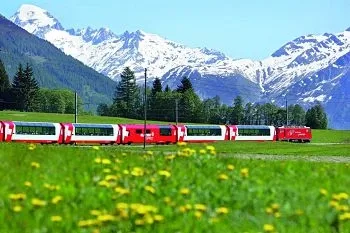
Train on the slope above Grindelwald
Those who, due to their work, are more often in large Swiss cities – in my case Geneva and Basel – and do not like skiing, the Alps may offer an unexpected surprise: it turns out that in the off-season you can have a pleasant time there. The traditionally winter ski region is surprisingly beautiful in early autumn, and small towns, more like large villages, offer almost unlimited opportunities for relaxation and active recreation not only in winter but at any other time of the year.
Between two lakes
The journey to the Jungfrau region begins at Zurich Airport: from there, using a special transfer ticket from the Swiss Travel System, you can reach your resort or hotel with any number of transfers and on any mode of transport. However, if you are planning an excursion program or want to take a trip on one or more routes of the Grand Train Tour, it is better to buy not a transfer ticket but a Swiss Travel Pass, which gives unlimited travel on several modes of transport (train, bus, boat) throughout Switzerland for 3, 4, 8, or 15 days. An eight-day pass for an adult in first class costs 581 francs, in second class – 363 francs. Moreover, the Swiss Travel Pass also allows discounts on tickets to some museums.
The final destination of my route was the village (or small town?) of Grindelwald in the Jungfrau region, Canton Bern, but along the way I had the opportunity to use the ticket and take a boat ride: one of the intermediate transfer points on the way to Grindelwald is Interlaken, a town in the "interlake region", a surprisingly beautiful place in the valley between Lake Thun and Lake Brienz. A boat ride is nice on warm, slightly windy days when small sailboats glide across the lakes connected by a strait.
You can see both lakes at once from the Two Lake Bridge observation deck on Harder Kulm mountain – but only if you are not afraid of heights. The funicular has been operating there since 1908. The deck is a rather long balcony-”tongue” with a transparent floor, hanging over the mountain slope, offering views of the mountains, lakes, and the town. You can stand there for a long time, mesmerized, watching the sunset-pink mountains turn blue, or you can (which, by the way, many Chinese and Japanese tourists do) noisily wave selfie sticks, photographing yourself and friends from all possible angles. Against the backdrop of the peaks of Jungfrau, Eiger, and Mönch – or against the backdrop of a full-size dummy of an Alpine cow standing right there on the deck. On the wide rump of the fake cow, disciplined Swiss have stuck a notice that trying to ride it is punishable by a fine of 50 euros.
You can eat on the mountain at the Harder Kulm restaurant in a half-timbered cottage with a steep tiled roof built around the turn of the 19th-20th centuries, with characteristic terraces, external beams, and a turret crowning the roof. The cuisine is European and Swiss, the wines are local, as are the cheese and other snacks. The restaurant does not offer gastronomic intrigues, but the views eclipse any shortcomings of the cuisine.
The Watch Trail
After the relatively flat Interlaken, moving to Grindelwald – a village at an altitude of over a kilometer above sea level – is already an adventure. The village is stunningly picturesque. Perhaps not as much as the gingerbread town of Zermatt in the neighboring canton of Valais, but nonetheless: in front of it, like a theater set, the Jungfrau mountain range opens up, and stepping out onto the balcony of your hotel room in the morning, even on a warm autumn day, you see eternal snow.
The surroundings of Grindelwald are especially loved by hikers, trekkers, fans of Nordic walking, and Alpine running. Even if you move at a slow pace, the exertion is considerable: after all, the altitude is over a kilometer. It is for hikers and "Nordic walkers" that the authorities of the Jungfrau region, together with the Swiss watch brand Tissot, opened in 2016 a new scenic hiking trail on the relatively low mountain First – First Cliff Walk by Tissot, accessible by cable car. A convenient path with benches for rest and platforms for photographing natural beauty leads to a mountain lake; the walk takes one to two hours, depending on fitness level. There are hikers with children in backpacks and dogs on leashes, and professional athletes – runners, skiers, and triathletes – who come to improve their form in the rarefied atmosphere of mid-altitude mountains.
The most picturesque (and at the same time most nerve-tingling) section of the trail is a long balcony that wraps around the rock at the summit of First and leads to a café and souvenir shop. The balcony floor is lattice, not for the faint of heart. You can reach the café and shop without this extreme experience, but it is from the balcony that you get the best shots with a view of the Grindelwald valley. The descent into the valley is a separate attraction. You can, of course, simply and boringly descend in the cable car gondola, or you can again tickle your nerves and use more extreme methods.
First, a zip line – a cable along which you descend in special harnesses somewhat resembling kangaroo backpacks, then so-called mountain carts – three-wheeled devices similar to go-karts or children's pedal cars, but without a motor and even without pedals, only with steering and brakes, and on the lowest section of the serpentine – trottibikes, huge mountain scooters that, unlike ordinary scooters, cannot be pushed with a foot – only steer and use hand brakes for maneuvers, the scooter rolls by inertia.
On flat sections, you can stop if you wish to photograph the views or again the cows, but this time live ones, not plastic.
The Dwarf Road
But no matter how good the Grindelwald views are, it's impossible to come to Jungfrau and not climb a real mountain. This isn't some measly kilometer and a half – it's a four-thousander, 4,158 meters above sea level, and nearby there are two more mountains just below four thousand meters: the Eiger (sometimes called Eiger) and the Mönch. But there's another attraction besides the mountains themselves: while Jungfrau, for all its impressiveness, is only the third highest peak in the Bernese Alps, the railway leading to it is the highest in the world. The tracks start in the village of Kleine Scheidegg, and then seven of the nine total kilometers run through a rock tunnel, literally piercing the Eiger all the way to the Jungfraujoch pass: an elevation difference of almost one and a half kilometers.
They had planned to build the road as early as the mid-19th century, but something always got in the way: sometimes a lack of funds, sometimes organizational and administrative problems. As often happens, the project was realized thanks to the enthusiasm, bordering on obsession, of a single person: Adolf Guyer-Zeller. He wanted the beauty of the mountain landscapes to be seen not only by risk-taking climbers (incidentally, the first to ascend the mountain were the Swiss Johann Rudolf and Hieronymus Meyer, which is why Jungfrau, which means "Virgin," was jokingly called "Madame Meyer"), but also by ordinary tourists. Guyer-Zeller devoted all his time and energy to the railway, construction of which began in 1896, and achieved his goal, although he did not live to see its completion (he died in 1899). His sons finished the work.
The project began with the construction of a power plant, then rails were laid (trains operate on the rack railway principle to prevent rolling backward) to the mountain, and then workers, like dwarves, dug into the rocks of the Eiger, placing explosives and wresting meter after meter from the stone. In several places on the north face of the mountain (incidentally notorious for the deaths of several climbers), large windows were left so that passengers could step out of the carriage and admire the views of Grindelwald.
The construction process was not without accidents and incidents: six miners died, dynamite depots exploded, the ten-million budget was exceeded by half (which for meticulous Swiss is a huge sum, especially in those days). In the end, the summit of Jungfrau was never conquered; the final station was built at the pass. But that station, the Jungfraujoch, opened in August 1912, remains the highest in the world to this day (3,454 m above sea level). Nowadays, the ascent takes about an hour. The price is around a hundred francs.
The top station is something like a railway station with a monument to Guyer-Zeller, a souvenir shop, restaurants, a bistro, a labyrinth in the thickness of an ancient glacier with ice sculptures, and also the world's highest Lindt chocolate shop. Tourists can step out onto the observation deck and photograph the Aletsch Glacier (the entire Jungfrau massif, for its beauty and natural uniqueness, has been inscribed on the UNESCO World Heritage List, the first in the Alps), and then descend onto the glacier and ski or ride snow tubes, as well as go snow hiking (of course, with proper equipment). Essential items at the top are warm clothing, waterproof footwear, a windbreaker, and dark glasses, as well as a high-SPF sunscreen. Getting sunburned in the mountains is easy, even though snow always lies here: it actually reflects sunlight, only increasing that risk.
Tourists are not allowed into the high-altitude "Sphinx" observatory on the Jungfrau: it is a closed facility engaged in observations of the atmosphere, the cryosphere (glaciers), and the lithosphere (the Earth's surface). But you can photograph it from the outside: it looks impressive, almost like the observatory from the latest Bond film, though it wasn't that one that was used in the movie, but its counterpart from the canton of Valais.
On the snow of the Aletsch, competitions in non-winter sports are regularly held: this is a kind of promotion for well-known brands, mainly watch brands. Sports stars have engaged in boxing, cricket, football, and tennis at the Jungfraujoch, and in September 2016, the same Tissot brought basketball legend Tony Parker to the mountain, who played a friendly match with Swiss footballers on a court laid literally on the snow. Friendship won, of course.
Veronika GUDKOVA.
"Lenta.ru"