
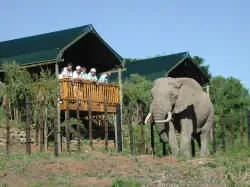
Namibia: Etosha Park
Etosha National Park in northern Namibia is one of the largest and oldest nature reserves in Africa. It turned 100 years old in March of last year. Most of the park, covering an area of 22 thousand square kilometers, is a desert with a truly Martian landscape and giant red rocks. Because of this unusual landscape, Etosha is also called the "Park of Mirages."
Perhaps the most impressive are the huge flocks of pink flamingos flocking to the shores of the water bodies. In particularly rainy years, the entire basin fills with water, but even then the lake depth rarely exceeds one meter. At night, you can watch animals coming to the watering hole from special observation towers. Even in the dry season, when the vast expanse of Etosha Pan is covered with a cracked crust of white clay, life here does not stop. At this time, the park's inhabitants use water from mineral springs.
In total, the National Park is home to 144 species of mammals, 90 species of reptiles, and about 340 species of birds. The main feature of the park is the large Etosha Pan depression, covering an area of 5 thousand square kilometers, which during the rainy season is covered with many lakes.
Uganda: Bwindi Park
The main reason tourists embark on a difficult and expensive trip to Uganda is the unique chance to see mountain gorillas, of which there are only a few hundred in the world, and half of them live in Uganda. The country's authorities issue a very limited number of permits to visit gorilla families.
When planning your trip, find a good online shoe store and sports goods store. Because you should think about good shoes and waterproof clothing in advance: the trails in the park are very muddy, the path is not short - several kilometers through mountainous terrain. In addition to guides, tourists are accompanied by porters who, hoping for good tips, are ready to literally carry their clients on their hands. Sometimes you have to push through impassable thickets, and some mountain slopes are so steep that you have to climb on all fours. But what you see makes you forget all the hardships of the journey. You can get quite close to the gorillas, but it is safer to stay at a distance of more than seven meters.
Despite their formidable appearance, gorillas are quite peaceful, eat only plant food, and pay no attention to tourists. However, there are rules that must not be neglected: you should not look gorillas in the eye, especially males, you cannot talk loudly or smoke in their presence, and using a flash when photographing is prohibited. All this can frighten the animals and provoke aggression.
Every day, three groups of eight people each go into Bwindi National Park. The time spent near a gorilla family is no more than one hour.
Tanzania: Serengeti Park
In the Maasai language, Serengeti means "endless plains" - a very accurate name for the National Park, which covers an area of about 15 thousand square kilometers. It is truly one of the largest nature reserves in the world, stretching from northern Tanzania east of Lake Victoria to southern Kenya.
The wild world of Serengeti lives its own special life, and only the Maasai can graze their cattle in the park. Its landscapes are very diverse - from lush meadows with tall grass to savannah and forested hills. The park is so unique that it has served as a backdrop for Hollywood blockbusters more than once. In terms of the number and diversity of animal species, it is unrivaled. Particularly adventurous people can view the park's beauty from a hot air balloon flying at low altitude.
There are over three thousand lions alone here. In October-November, when the rainy season ends, more than 200 thousand zebras, about 500 thousand Thomson's gazelles, and 1.3 million wildebeest go through the Serengeti to the green pastures of Kenya along a route laid millennia ago. This spectacle is truly fantastic. Thousands upon thousands of animals and accompanying flocks of birds literally cover the horizon. In April-May, it all repeats, but in the opposite direction.
The Serengeti is home to about 500 species of birds and 300 species of wild animals, including five-meter Nile crocodiles in the Seronera River.
Kenya: Maasai Mara
The Kenyan park Maasai Mara is a continuation of Tanzania's Serengeti. Maasai Mara is an excellent place to get acquainted with Africa's "Big Five": elephants, rhinoceroses, buffaloes, lions, and leopards. This motley group of animals owes its honorary status to its temperament, which made them the most dangerous and most prestigious hunting trophies.
The most cunning of the "Big Five" are leopards, which look like huge spotted cats. Guides always warn about this. Leopards are not controlled by anything, even satiety. You can approach a well-fed lion quite closely in a jeep. But it's still not worth angering him. An enraged three-hundred-kilogram king of beasts is not a sight for the faint of heart. But elephants willingly make contact. Possessing considerable intelligence and some familiarity, they occasionally try to stick their trunk through the metal grilles of the jeep.
Like the Serengeti, Maasai Mara is located on the ancestral land of the ancient Maasai tribe, which leads a nomadic lifestyle and does not recognize modern state borders. For a modest fee of $10-20, the Maasai let tourists into the closed world of their villages, built in the bush from clay and donkey dung.
The Kenyan park Maasai Mara covers an area of 1,510 square kilometers, home to more than 80 species of mammals and 450 species of birds.
South Africa: Kruger Park
Legendary President Paul Kruger of the rebellious Boer republic of Transvaal was the first to think of preserving the local fauna by fencing off a large area of savanna with barbed wire through which electric current was run. Today, Kruger National Park in the Republic of South Africa has grown to the size of a small state. It is located in the eastern part of the country right on the border with Mozambique and stretches from south to north for 350 km in a wide strip of 60 km. It is also called a modern "Noah's Ark", giving shelter to one and a half thousand species of animals.
For example, in Satara you will definitely encounter lions, in the vicinity of Olifants whole herds of elephants graze, and Berg-en-Dal is built in close proximity to a rhinoceros watering hole.
Animals and people in the park have switched places. The former roam completely free. The latter move only accompanied by experienced guides. The usual way of getting to know each other is a multi-day journey from camp to camp in jeeps along the winding dirt roads of the park. It usually starts early in the morning or towards evening.
Around Kruger Park there are another 17 small private reserves. There are no fences between them, and together with Kruger Park they form a single natural ecosystem with a total area of more than 30 thousand square kilometers. In some of them you can hunt. The license is expensive. For one zebra, for example, at least $3,000.
For tourists in Kruger Park, there is an airport, a hospital, a car rental point, more than 20 service stations, 14 large camps and several dozen campsites.
Kruger Park is home to 147 species of mammals, 33 species of amphibians, 114 species of reptiles, 507 species of birds and 50 species of fish.