
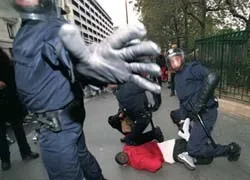
However, this time the street unrest does not cause Parisians the shock they had to experience in November. Because under the windows are marching, chanting and fighting with police not dark-skinned children of immigrants from Africa and the Middle East, but students of quite European appearance. This riotous fraternity is nothing new to the French: the famous student unrest of May 1968 went down in the country's history, and many are even proud of it.
The lights of the Latin Quarter, sung by generations of poets, where students of Paris universities traditionally settle, have dimmed somewhat in recent days against the backdrop of bonfires that illuminate street barricades and smashed shop windows. In their flickering light, the silhouettes of young people fighting with the “flics” (the nickname of French police officers) seem like some fantastic, grotesque figures - as if a merry company of gargoyles had descended from the colonnades of Notre-Dame and decided to stretch their legs nearby.
What is the matter, what is happening again in France? The parents of today's demonstrators, who in their time made quite a noise on the streets of Paris in 1968, say that they at least had a worthy opponent - Charles de Gaulle. Back then they nearly started a revolution - they wanted a different republic, they wanted to overthrow the general and the entire system along with him. Today's unrest and today's power-holders seem to them simply pygmies. The Prime Minister Dominique de Villepin and President Jacques Chirac, they say, constantly recall de Gaulle in their speeches, but they themselves do not even resemble his shadow.
But today's demonstrators also do not set themselves great goals; they simply want to achieve a calm, protected life. They are afraid of not finding a place for themselves in modern France - their parents did not know such fear. And no one can overcome this fear for their own future, no government, and certainly no de Villepin. He begins every speech with his famous youthful smile, but in recent days it looks more and more pale. Not even a year has passed since he became prime minister - and here he is, forced to fight the first crisis of his career in this post.
The head of the French government, relying on the support of two-thirds of the deputies of the National Assembly, “pushed through” parliament a new law, the so-called Contrat premiere embauche (CPE). According to CPE, anyone who first takes a job before their 27th birthday is obliged to sign their first contract for two years, and during these two years they can be dismissed at any moment and without explanation of reasons. In essence, this is a legalized two-year probation period for any young specialist. De Villepin did not even propose the new package of laws for consideration by deputies, but personally approved it, citing the constitutional right of the cabinet of ministers to adopt a law under its own responsibility without any parliamentary debates.
Of course, the French prime minister was aware of the possibility of coming under fire from criticism. However, he hardly expected that his actions would bring thousands of demonstrators out onto the streets across the country - mainly students and high school seniors. They were always told: “Study, get your certificates, enroll in universities and earn your diplomas - and then you will have a reliable job, and everything will be fine.” Now it turns out: “Study, earn your diplomas - and then maybe the employer will not throw you out onto the street. If you are lucky.” It is clear that neither students nor schoolchildren like this prospect at all. And they took to the streets.
The authorities apparently thought that it would be much easier to deal with intelligent students than with the fighting young Arabs and blacks from disadvantaged neighborhoods - and as an additional argument in favor of the new law, the police offered demonstrators to get acquainted with water cannons and rubber batons. However, it was not to be. Such methods caused a storm of indignation, which in youth groups, as a rule, tends to find an outlet in rather reckless actions. As a result, there were fights with the “flics” wall to wall, the demonstrators took up the “weapon of the proletariat” - cobblestones, and on one of the days even managed to set fire to the famous university library of the Sorbonne. And now, when de Villepin embarrassingly declares that his government is “open to dialogue and ready to help young people,” he is not so much not believed - he is simply not heard. It is difficult to conduct a dialogue amid the roar of police loudspeakers and the clinking of broken shop windows.
The curiousness of the situation is that the package of laws on first employment was conceived as a way to ensure equal chances of obtaining work for young people. The CPE laws appeared as a reaction to the November events: after all, the political elite of France, observing the pogroms in the suburbs of Paris, came to the conclusion that the local youth acts this way out of hopelessness and the impossibility of getting any kind of work.
The term “liberal policy” in Europe, and especially in France, is not considered a swear word. Therefore, the government decided to liberalize labor legislation so that employers would be interested in hiring young people, without being burdened by thoughts that if they suddenly turned out to be unsuitable, they could not be gotten rid of. A similar system works wonderfully in Denmark, Ireland, Sweden - but in France it failed from the very beginning.
Every year, 60,000 young people in France drop out of school and remain without any certificates at all. Their chance of finding a job is almost zero. And they are completely unable to understand their peers from universities: for them, the CPU laws are at least the beginning of changes for the better. Some of them also find two years of probation too long, but it is better than nothing at all.
Parisian high school and university students, who marched in the tens of thousands from Place d'Italie across the whole city, hold a different opinion. The government, however, finds itself literally between two fires, and there are already voices advising ministers to simply step away from the line of fire – to resign.
Boris ALTNER.
IA Rosbalt