
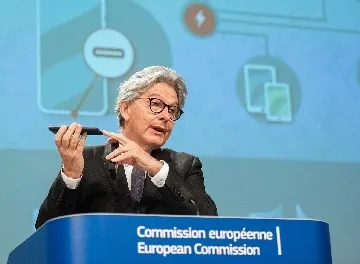
EU Internal Market Commissioner Thierry Breton advocates for a single standard
As the publication "Russkaya Germaniya" notes, the commission's proposal boils down to making USB-C the single standard port for all smartphones, tablets, cameras, headphones, portable speakers, and portable gaming consoles. Additionally, the commission proposes separating the sale of chargers from the sale of electronic devices. This means that a charger will no longer be included with a phone.
"Years of working with industry on a voluntary approach have already reduced the number of charger types for mobile phones from 30 to three over the past decade, but have not been able to provide a complete solution. Now the commission is putting forward legislation to create a common charging solution for all relevant devices. This will increase consumer convenience and reduce the environmental impact associated with the production and disposal of chargers, thereby supporting the green and digital transitions," the European Commission said in a statement.
The European Commission also proposes to legally prohibit device manufacturers from artificially slowing down the charging speed of devices with a common charger. After the law is adopted, the European Commission will provide a two-year transition period during which manufacturers will have time to prepare for the introduction of new rules.
"European consumers have been frustrated for quite some time by incompatible chargers piling up in their drawers. We gave industry enough time to come up with their own solutions. Now it's time for legislative action on a common charger. This is an important victory for our consumers and the environment and is in line with our green and digital ambitions," said Margrethe Vestager, EU Commissioner for Competition.
The EC expects that the new measures will help consumers limit the number of new chargers they buy and save them €250 million a year on unnecessary purchases. In total, about 420 million mobile phones and other portable electronic devices were sold in the EU in 2020.
On average, consumers own about three mobile phone chargers, of which they use two on a regular basis. Despite this, 38% of consumers report that they have encountered a problem at least once when they could not charge their mobile phone because the available chargers were incompatible. Discarded and unused chargers are estimated to accumulate up to 11,000 tons of e-waste each year.
The EC also acknowledges that a single standard is needed on both sides of the cable. And while agreements have now been reached on compatibility on the device side, a mechanism for reviewing the compatibility of the external power supply will be launched later this year.
Apple is unhappy
Most manufacturers of chargers for the Android operating system will obviously be satisfied with this decision. Many of them have already switched to using USB-C charging in new versions of their phones, although micro-USB is still found in many devices. The new law will hit Apple the hardest, as it uses a different standard – the Lightning port.
As Reuters notes, half of all chargers sold with mobile phones in the EU in 2018 supported the micro-USB port, 29% USB-C, and 21% Lightning. In subsequent years, the share of micro-USB declined in favor of USB-C.
Apple called the EC initiative an impediment to innovation. "We continue to believe that strict regulation mandating only one type of connector stifles innovation rather than encouraging it," Apple said in a statement.
Furthermore, the iPhone maker is confident that the measure will contribute to environmental pollution, in particular, leading to an increase in e-waste, because after the new legislation is introduced, all devices with a Lightning port will become electronic waste, given that there are currently about a billion iPhones with a Lightning port in Europe alone.
"We do not believe there is a basis for regulation, given that the industry is already moving to USB Type-C through a connector or adapter. This includes the Apple USB-C power adapter, which is compatible with all iPhone and iPad devices. This approach is convenient for consumers, allows charging a wide range of portable electronic products, encourages people to reuse their charger, and enables innovation," Apple said in a statement.
Incidentally, Apple itself is already partially complying with the EC's requirements and has not included a new charger in the box with mobile phones since 2020, citing environmental reasons. This approach, however, is not always liked by the end consumer, who believes that the company is thus artificially stimulating the growth of sales of additional accessories.
The European Commission responded to Apple's claims by saying they do not accept them. "I have known these companies for many years. Every time we propose something, they say – this will hinder innovation. No, it does not hinder innovation. It does not hinder anyone. It is done for the customers. If Apple wants to continue equipping devices with its own port, it will have the opportunity to do so. Manufacturers can install two different ports on smartphones," said Thierry Breton, EU Internal Market Commissioner.
Analysts, however, note that Apple is likely to take a different path and stop equipping smartphones with any charging port at all. The company has long had a vector toward widespread adoption of wireless charging. Perhaps the nearest iPhone models will be released without ports. Since the new EC initiative regulates only wired charging systems, Apple may circumvent the imposed restrictions. However, it is not excluded that if this happens, the European Commission will try to regulate wireless charging as well.
Industry experts also have mixed views on the European Commission's proposal and recall that in 2009 the EC wanted to make micro-USB a single standard, so if that had happened, the industry would not have received the faster and more advanced USB-C connector. Now the EC, by making USB-C a universal connector, hinders further improvement of charging technology.
“I think the intention is good, but the way it is implemented is not. If you want to reduce electronic waste, why not just introduce tax incentives for companies that decide to switch to a single standard,” wrote Christina Warren, a representative of the Microsoft cloud technology developer community.
“I support cable standardization, but does the EU understand that even USB-C cables differ from cable to cable?” said Dan Seifert, deputy editor-in-chief of The Verge.