
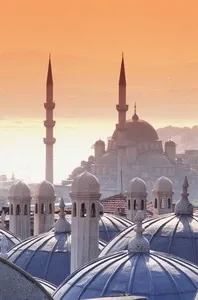
Morning in Istanbul
We were approaching Istanbul at dawn, when the warheads of minarets pierced the pre-dawn mist with vague silhouettes. Passing endless neighborhoods of "wild" buildings of eastern migrants, we entered the sleepy city. The bus wound through deserted streets, where glass-and-mirror monsters of modern offices dozed next to small shops. Our people in the bus whispered animatedly, clarifying the current lira exchange rate and exchanging addresses of the most worthwhile retail outlets. And Istanbul was waking up. It lazily and impassively looked at us - strangers, alien in faith, spirit, and customs.
"Megapolis" is just a word. Thirteen million inhabitants, five million cars - just numbers. Centuries-old city walls that remember the troops of Darius and Alexander the Great - just history. Countless shops and stalls, whose windows display leather cloaks and sheepskin coats - just business. And the city itself is a restless feeling of one's own microscopicness in the boundless cosmos. Here it is before us - former Byzantium, former Antonina, former Second Rome, former Constantinople, former Tsargrad, and present-day Istanbul. It is also called a wonder of the world, the pearl of the Bosphorus, the abode of legends, the capital of emperors. The latter is certain: the city was the residence of 10 Roman and 82 Byzantine emperors, 30 Ottoman sultans.
This is a city with no center - each district has its own, and many residents do not leave their district for years: they are born, study, marry, work and die there... Istanbul is rightly called the city of two continents. Europe and Asia met here for a conversation. For $55 per person, we, Russian-speaking tourists from Bulgarian beaches, were allowed to join this conversation...
Dust of History
It is impossible to retell the history of Istanbul; it must be learned by heart like the surahs of the Koran: Greeks, Romans, Byzantines, barbarians, Seljuk Turks, Ottoman Turks... Dynasties and religions changed, fortress walls collapsed and palaces were erected, "houses of God" passed from Christians to Muslims... And the city lived its own life.
There is still debate about the name "Istanbul" - where it came from and what it means. Our guide Shenil, a cheerful stocky guy, told this story. They say that once the city was besieged again by the Ottoman Turks. The siege was sluggish and not bloody, so many townspeople did not even notice it. In the morning, merchants hurried from the suburbs to the bazaar and to the perplexed questions of the besiegers - like, where are you going, there's a war? - calmly replied: "Istam buli" ("I am going to the city").
The pragmatism of Istanbul is striking. You cannot enter a mosque with bare legs, arms, and head. But right at the entrance you can get a huge piece of cloth (for a purely symbolic sum, and with a bit of impudence, even free). Muslims do not eat pork: fatty meat spoils quickly in a hot climate. But they prepare such dishes from beef and lamb - you'll lick your fingers. Drinking in the heat, you understand, is a dubious pleasure. But Allah does not forbid relaxing over a hookah. Polygamy, harem - oh, horror! And when the last khan's harem was abolished, the liberated women of the East were left without means of subsistence, but with the demands of princesses. And they were not at a loss - in the spirit of Istanbul pragmatism, they organized the show group "Secrets of the Harem" and successfully toured all over Europe with it.
Mosques and minarets, minarets and mosques
There are many mosques in Istanbul, very many, terrifyingly many, and even more. They say about five hundred. All of them were built either by the architect Sinan or his students. (One gets the impression that this Sinan took a government contract for all Istanbul mosque construction.) The most famous is the Sultan Ahmed Mosque, built in the early 17th century. For its interior decorated with bluish tiles, it is called the Blue Mosque. Huge and at the same time graceful, surrounded by six minarets, it seems light and elegant. Everywhere - on the walls and on the columns - there are sayings from the Koran, written by the hand of a skilled calligrapher. To the left of the mihrab, on the wall in a frame, is a piece of the sacred stone from the Kaaba - a thin marble tile with a beautiful pattern. On both sides of the mihrab stand two huge candlesticks with equally huge candles.
And the largest mosque in Istanbul is the Suleymaniye Mosque. Sultan Suleiman II, its builder, is considered one of the most outstanding Ottoman monarchs. It was under him that Hungary, Rhodes, Iraq and Yemen became part of the empire. In its splendor, it was to surpass all the wonders of the world. According to legend, the Persian Shah sent Suleiman a casket of jewels, hinting that he would not have enough funds to complete such a mosque. Suleiman ordered that the shah's gift be used in construction on an equal footing with ordinary stones. So the mosque truly became precious.
In the mosque there is only silence and a strange, almost mystical feeling of someone else's God. I have always been interested in how differently people communicate with God. We, Orthodox, stand during worship or kneel on the bare cold floor. Catholics and Protestants pray, like schoolchildren, sitting on comfortable desks and benches with a prayer book spread out in front of them. And Muslims fit human pride onto a tiny square of carpet, bowing down before the greatness of God. Are they fanatics? Hard to say...
I enter the mosque. The hour is late and still.
Not in thirst for a miracle nor with a prayer.
Once I stole a rug from here.
And it has worn out. I need another...
Omar Khayyam
Earlier, five times a day, muezzins climbed the high minarets and called the faithful to prayer with a loud voice. Now modern clergy broadcast from below into a microphone, and the loud call is transmitted by loudspeakers.
Istanbul Customs
...We were looking for the famous Grand Bazaar - Old Bazar, Kapaly Charshi. The prospect of seeing four thousand shops under one roof pleasantly tickled our female nerves. The crowd indifferently flowed around us, insolent Istanbul cars rushed past, honking continuously and every now and then trying to jump onto the sidewalk. I was turning my head in confusion, looking for a suitable source of information. Oh, finally! An elderly Turkish grandmother was slowly floating toward me - dark-haired, dressed more or less in a European style: in a long skirt and a worn-out cardigan. "Please, where is Old Bazar Kapaly Charshi?" Oh, my English left much to be desired, but then again, the grandmother was not a descendant of Shakespeare. "You need the bazaar? It's straight ahead, you'll pass a big church and there you'll see it," - the old lady waved her hand and trudged on. I shut my mouth and decided not to be surprised at anything anymore.
Russian is understood in Istanbul, and how! Among the announcements on poles you can find a call "Looking for a Russian language teacher". Signs are full of Russian words, the main one being, of course, "leather". Given our undying attachment to leather goods, one might think that we all desperately long for the "Murka" in leather jackets.
What to buy at the bazaar? Probably only souvenirs - plates, pillows, carpets and rugs, cheap gold jewelry. The goods are not of high quality, but they touch the soul with their naive, garish naturalness. They are made right there. Everywhere, in houses, on the first floor there is a small shop or store, and on the second - a mini-factory where all these goods are sewn. The roofs of houses are not empty either. On a nine-story building we saw several tiny houses, and near one of them there was also... a miniature fountain!
And at the bazaar I bought a Turkish pillow: with a moon, sun, stars and red silk tassels. It smells of ginger and absolutely does not match the interior of my Kiev apartment. My husband calls it kitsch and cheap. The cat hisses at it.
On pearls of the harem and the present day
Turkish women are beautiful. But they dress terribly: wide "mackintoshes" (the kind our grandmothers wore in their pre-war youth) in non-staining colors, shapeless slippers or sneakers, headscarves wound up to the very eyebrows. And to tie a scarf (hijab) in the Muslim way is something you need to know how to do. First, it must fit tightly around the head. Second, the upper edge of the scarf should almost touch the eyebrows, and the lower edge, carefully hiding the ears and part of the cheeks, should slightly overlap the chin. This art was taught to me by a stern, middle-aged saleswoman at the bazaar - perhaps the only woman among the trading folk. Out of habit, my scarf either crept over my eyes or tried to get into my mouth. My teacher patiently unwound it and again and again instructed me in the basic procedure of a Turkish woman's toilet...
In the struggle of political parties, the women's headscarf plays a significant role, serving as a symbol of backwardness or (in its absence) of enlightenment. Women prefer not to get involved in politics and wear it in the vast majority. But their faces were given to them by nature, and no government - neither religious nor secular - has power over their eerie beauty.
Rarely do you see a lone female passerby; for the most part, they all move around the city in small groups. Sometimes a European-dressed businesswoman flashes through the crowd - and nothing, no one turns to look at her, no one shakes their head reproachfully. But at the tables of summer cafes sit either men or elderly women with young grandchildren who suddenly wanted something to eat. Turkish men do not look at Turkish women. Or, at least, that is how it seems to us European women.
Near a newspaper kiosk I saw two people - a guy and a girl. He sat on the railing of a low fence, she stood a meter away from him. He was in a T-shirt and jeans, she was in a hijab and a "mackintosh". Both looked straight ahead at the stream of passersby and carried on a quiet conversation, occasionally throwing quick glances at each other. Never have I felt such frank and powerful sexual tension as in this sweet, decent little scene...
By the way, rumors about Roxelana's beauty are greatly exaggerated. As her contemporary wrote, "Lisovsky's daughter is healthy and comely, but does not dazzle with her looks..." It was with something else, oh, with something else that the nimble Nastya captured the languid Suleiman the Magnificent.
What can you see in the city in one day? Almost nothing. Only the city itself. Or, rather, feel it. You know, there are cities where you want to live. I remember wandering around old Tallinn (when it was still spelled with one "n") and thinking: this is where I would live. And why not? I am well-mannered, I speak softly, I don't cut in line, I would have fit in there. And there are also cities that need to be explored by planning, studying guidebooks and plotting a route with a pencil in hand. St. Petersburg, Paris, London - there are many. And there are cities, strange, unfamiliar, where you walk, sniffing at unfamiliar smells and irritated by the local beauties and lifestyle. They are alien, like lunar craters, where we can neither live nor breathe. You cannot describe them - the everyday words of your daily life cannot convey what you feel when you remember them. It's just that I will never forget Istanbul.