
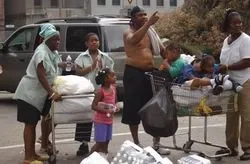
Hurricane Katrina has become one of the worst natural disasters in American national history. Assessing the scale of the disaster from a height of 500 meters on the way from Texas to Washington, President Bush, who had interrupted his vacation, did not hide that the restoration of the region would take not months, but years. For urgent assistance to the affected states of Louisiana and Mississippi, the president ordered the allocation of funds from the emergency fund.
No one is yet willing to predict the exact number of hurricane victims. Neither in Mississippi, where several coastal towns stand completely flooded and destroyed, nor in Louisiana. New Orleans Mayor Ray Nagin believes that the number of victims is "at least hundreds, but most likely thousands".
Experts do not rule out that the costs of eliminating the damage caused by the hurricane will not only be comparable to, but will also exceed the funds spent after the September 11 terrorist attack in New York. According to James Lee Witt, who headed the Federal Emergency Management Agency under Bill Clinton, we are talking about "astronomical" sums.
In a water trap
However, for now the main task of the authorities is not to count the colossal losses that the United States has suffered, but to save people caught in the disaster zone. The administrations of New Orleans and the state of Louisiana, the Pentagon and the White House have joined forces to evacuate up to one hundred thousand people from the city, provide them with food, medicine and temporary housing, stop the looting of the city by marauders and prevent the spread of disease. A state of emergency had been declared throughout the state even before the hurricane arrived; now New Orleans has been placed under martial law.
At present, 80% of New Orleans is under water. This is exactly what the city authorities feared most when "Katrina" moved toward Louisiana from the Gulf of Mexico. When the hurricane passed by New Orleans, it seemed that flooding on such a scale could be avoided. However, the system of levees that protected the city, located below sea level, from the Gulf of Mexico, the Mississippi River and Lake Pontchartrain, was too badly damaged and gave way. Water flooded the first floors of high-rise buildings; other houses are completely hidden by water.
The authorities did not immediately admit that a total evacuation was unavoidable. Initially, Ray Nagin cautiously said that residents would not be able to return to their homes in the near future. But only when the situation took a catastrophic turn was everyone who had not yet done so recommended to leave the city. The administration had no choice - the infrastructure is completely destroyed and staying here is extremely dangerous.
The bulk of the people awaiting evacuation have gathered at the indoor Superdome stadium - more than 20,000 people. Of these, eight thousand have already spent several days there - they took shelter from the still approaching hurricane. The rest came after the water level in the streets began to rise. Conditions in the stadium building are extremely difficult; its life-support systems are not designed for so many people to remain for such a long time. The authorities allocated 300 buses to move residents out of the sports arena, but ground evacuation had to be stopped because fires prevented access to the stadiums. Later, air evacuation was also suspended - this decision was made after one of the military helicopters was fired upon from the ground by marauders.
The death of civilization
One of the central problems now is the danger of epidemics. Sewage from the sewer system has entered the water that flooded New Orleans, and the bodies of the dead are also under water. According to US Secretary of Health Michael Leavitt, the authorities fear the spread of cholera, typhoid and other serious infectious diseases. In addition, the risk of outbreaks of tropical fever and so-called West Nile fever, transmitted by mosquitoes, has increased.
The situation is aggravated by the lack of electricity supply throughout the city. In addition to hospitals being unable to function properly without power, the authorities are also concerned about the possibility of carbon monoxide poisoning for those using portable generators or makeshift stoves. There is also no telephone connection - not only landline, but also mobile. Supplies of food, drinking water and medicine are running out.
Against this backdrop, New Orleans has been swept by a wave of looting. Forming gangs, people are robbing pharmacies, hospitals, offices, not to mention residential buildings, shops and hotels. Armed groups attack vans, including police vans. Shots are heard in the city (it was reported that a police officer was wounded in the head in one of the clashes), and fires are breaking out.
To combat looting, the city mayor ordered police to temporarily switch from rescue operations to maintaining law and order. Martial law allows authorities to deal with marauders without unnecessary formalities. To help the police, the Pentagon sent additional National Guard forces to the affected region - 10,000 more people arrived in New Orleans in addition to the 11,000 already there. Louisiana Governor Kathleen Blanco admitted that the actions of the marauders infuriate her. "We will do everything necessary to restore law and order in this region," she declared.
If law and order can be restored in a few days, restoring New Orleans' infrastructure and housing stock will take much longer. Ray Nagin believes that eliminating the aftermath of the hurricane will require two to four months. Only then will residents be able to return to their city, which for now, in his words, is "uninhabitable". However, judging by the photographs and reports from the scene, the mayor's opinion looks too optimistic - until the moment when New Orleans fully recovers from what it has experienced, apparently, more than one year will pass.
Ekaterina ROGOZHNIKOVA.
Lenta.ru