
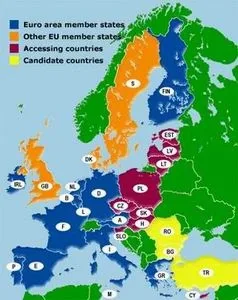
"All our problems are because of these new Europeans!" - lament residents of Brussels. With the appearance in the Belgian capital of a contingent from the East, prices for apartments, office spaces and garages have sharply increased. After all, in addition to two thousand new officials, the arrival of about 10,000 journalists, businessmen, experts, analysts, lobbyists is also expected...
To illustrate the threatening "invasion" of the EU headquarters in Brussels, one can give the following example. Until recently, 11 languages were used there, and after May 1 there will be twenty. Three million pages - such is the annual output of the translation services in Brussels. At least 60 translators must be constantly at the disposal of Euro-officials. Already today, taxpayers pay 700-800 million euros a year for translation, and from May 1 this figure will increase to a billion.
However, the expenditures are not limited to this. The transformation of the erstwhile "countries of people's democracy" from European Cinderellas into princesses will cost old Europe 42 billion euros in 2004-2006. This means that for every Frenchman, German, Italian and the like, fraternization with eastern neighbors will cost about 25-30 euros a year over the next three years. So to speak, Brussels alimony to Europe that suffered from communism... Here a logical question arises: will these non-repayable loans help create an exemplary earthly paradise?
"Regarding what will happen in Europe after May 1, there are generally more questions than answers," believes Philippe Manen, professor of law at the Sorbonne, legal consultant to the EU. "The document developed in Brussels regulating the accession of ten new member states to the EU consists of 10,000 pages. I do not know whether the leaders of these states have studied it, but even if they have, there remain many legal gaps. And they are all connected with the huge distance separating the levels of development of the two Europes." The scholar is echoed by a politician. "Never before has a whole group of countries joining the EU differed so strongly from the other European states," said Michel Barnier, former European commissioner and now French foreign minister. "The differences will intensify, which will create a political problem." And the main difference between the new Europe and the old one is, of course, people.
...Salt panic began with a rumor spreading through Latvia about an upcoming ban imposed by the EU on certain products imported from non-European countries. In particular, on coarse salt, allegedly not meeting strict Brussels requirements. The point is that in Brussels and other Rotterdams, cucumbers and tomatoes are placed in glass jars, poured with hot vinegar, and sold in supermarkets in such an indecent state. In Latvia, however, as throughout the post-Soviet space, vegetables are preserved with special reverence. They do not hesitate to put into a barrel or an enameled bucket - rather than a half-liter jar - some garlic, some dill, and a horseradish leaf. This requires only coarse salt, which the European Union has encroached upon. In the Middle Ages, this terrible news would have been enough to spark another salt riot in towns and villages; in the era of mass consumption, passions were limited to frantic queues in shops. When warehouses emptied, merchants and the politicians who joined them assured fellow citizens, who could not see a rosy future in the ranks of the EU without pickles and milk mushrooms, that coarse salt would not disappear from shelves in a united Europe. True, prices for such a vital product will rise. As will, indeed, many other components of the Latvian consumer basket.
In all EU countries, virtually all prices are more or less aligned. In the absence of customs barriers, this cannot be otherwise. This means that if current wages in the Baltic states are maintained, gasoline, cigarettes, alcoholic beverages, etc. will automatically become more expensive. The cost of services will also rise significantly. Because of strict EU requirements, excise taxes on petroleum products will increase. Consequently, transport prices will rise (primarily bus fares - the main means of transportation in the Baltics), car owners will be hit in the pocket, and the costs of heating homes and powering enterprises will increase. And medicines... Any pharmaceutical product will require European licenses. To obtain them, one must pay enormous amounts of money. Farewell to popular validol, citramon and valerian, once abundantly imported from Russia, Belarus and Ukraine, since there are no corresponding certificates for them in the EU. Four hundred drug names will be banned. However, European analogues in bright packaging will appear, but they will be extremely expensive.
And the transition from local currencies to the euro! Prices from this currency metamorphosis in the EU's new member states will rise by about 20-25 percent. This happened, for example, in France after its government abandoned the franc. Of course, this will not happen tomorrow, but in 2007-2008. But it does not add optimism to Eastern Europeans. Especially to peasants. They, of course, do not read Le Monde and Le Figaro, which write in black and white: "The organic agriculture of Eastern European countries poses a threat to French agriculture." But a plowman from Samogitia or a farmer from Latgale is not so stupid as to fail to realize that the Western agricultural industry will crush him.
But maybe all this is compensated by the freedom of movement across the European Union's territory? If you lack money for more expensive goods, go looking for a higher salary in old Europe. 'The question of the free movement of individuals within the EU has always been a thorny issue for Brussels,' says Professor Philippe Manin. 'It concerns not only itinerant Gypsies but also the workforce. There are countries that do not want to see new guest workers from Eastern European countries. And here we must take into account that in the coming years the EU veteran countries have the right to keep workers from Eastern Europe out of their borders. Of course, citizens of the new member states have the formal right to free movement within the EU, but it is not granted to them immediately. A transition period is provided for these states, during which they must prove their ability to develop in a European way. This period can last up to seven years, but it is not ruled out that for some countries it will be shortened depending on their successes. The treaty on the accession of new countries to the European Union states exactly that: the implementation of certain rights of the new member states and their citizens will be stretched out over time...'
If the rights of seemingly full citizens of united Europe are so scanty in the EU, what can be hoped for by those who in the Baltic republics are called nothing other than non-citizens? 'From a legal point of view, the main thing for belonging to the European community is a passport of a citizen of one of the EU member states,' notes Professor Manin. European documents have the terms 'citizen' and 'immigrant', but the concept of 'non-citizen' does not exist. And almost a million residents of the Baltic countries belong to this category: Russians, Ukrainians, Belarusians, Poles. And in general: out of a little over seven million inhabitants of the Baltic republics, as the Poet sang, 'a quarter was our people.' What will happen to them in united Europe?
'Unfortunately, we now see more difficulties associated with the expansion of Europe than advantages from it,' is forced to state Richard Burgstaler, president of the Alsace Chamber of Commerce and Industry. This authoritative French industrialist sees the cause of all the problems connected with the increase in the number of EU member states in the relative poverty of the newly arrived countries: 'In eight of the ten new countries, GDP per capita does not even amount to 40% of the average for the EU...'
However, Eurocrats led by European Commission President Romano Prodi are jubilant: since May 1, the number of EU member states has increased to 25, the population to 453 million, and the European Union itself has become an interstate association with the most powerful consumer market.
Kirill PRIVALOV,
Valeria SYCHEVA.