
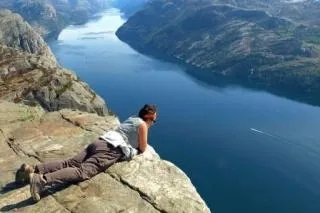
At the Preikestolen cliff
Continued. See beginning: NORWAY: A VIEW FROM ABOVE
Voss has been known as a transit point between two fjords since the late 19th century, when the elegant white Fleischer's Hotel was built. Since then, the latter has, of course, been renovated, but has retained the old-fashioned charm of a family hotel: it is still managed by the founder's descendants. It is very, very quiet here – despite the fact that one of the hotel's facades directly overlooks the railway platform connecting Bergen with Oslo. Norwegian trains run so quietly (the wheels don't clatter at all) that the station master has to announce the train's arrival by striking a bell.
In forty minutes, the train with plush seats will take you to Myrdal station, from where the highest mountain railway with standard, not narrow gauge, begins – the twenty-kilometer Flam Railway (Flamsbana), manually laid through the mountains in the 1930s not for tourists at all, but for the inhabitants of villages on the other side of the ridge. Nowadays, it carries passengers from multi-deck cruise ships that easily fit into the narrow Sognefjord, but back then all these beauties with mountain peaks and waterfalls were just part of the railway landscape.
At the most scenic spots, the train slows down so that owners of Canon and Nikon cameras, like tea in a cup, surge from side to side and click, click, click their shutters, capturing the white threads of waterfalls and green mountains in their lenses. In an hour, the train will arrive at the final station – Flam, where the rails end right at the white side of a cruise ship that seems to occupy all the water of the Aurlandsfjord.
To see the same mountains from the water, you don't have to buy a cruise ship tour: smaller vessels also sail along the Sognefjord.
There are also things to do in Voss itself. In summer, it's worth going to the rafting center (most water activities are available from May to October) and the Klatrepark, where, wearing a helmet and safety gear, you can play at tightrope walkers, balancing on cables, logs, ladders and other unstable contraptions stretched parallel to the ground at a height of at least ten meters. In winter, Voss turns into a ski resort. Advantages of Voss skiing – early and guaranteed snow, ski passes cheaper than the Alps, and many easy runs for beginner and intermediate skiers and snowboarders.
However, you can also ski in Norway in summer. Conditions for this exist on the southern arm of the Hardangerfjord, the Folgefonna glacier, a quarter the size of Moscow. On its lower part, you can ski from May to August (and even jump from a ski jump), but in winter they don't ski here at all because there is too much snow and it covers the lift. The average thickness of ice underfoot in summer is 50 meters, the thickest place in winter is half a kilometer, the length of the run is about 1100 meters, the elevation change of the snow-covered part is 250 meters.
For those who don't like skiing, let alone jumping, it's worth trying a simple ice climb for a first-timer. You can come to the glacier in just a T-shirt: the careless will be given a jacket, high boots, gloves, hats and even sunglasses, for which special thanks to the rental point, because you can only look at the ice without squinting under a cloudy sky. The air temperature on the glacier, even in summer, does not exceed plus five degrees Celsius, but if the sun goes in and the wind picks up, it feels like August frosts have hit. On top of your gear, you'll have to put on a safety harness and helmet, attach crampons to your boots, after which the guide will hand you a real ice axe, also known as an alpenstock, also known as the murder weapon of Leon Trotsky.
The heavy-looking piece of iron unexpectedly sits comfortably and easily in the hand. Without it, you're not allowed on the ice, although for a first 'greenhorn' climb you probably won't need it. The rules are simple: don't brake and don't rush, stop all together, step only in the footprint of the person in front to avoid accidentally falling into a washout where the ice is especially blue (it's just a trick of the light, the guide will explain, all ice is actually the same). Such a climb is accessible even to a nimble eight-year-old, and many actually come here with children, including Russians. 'This year,' says the guide of angelic appearance with dignity and without a hint of boastfulness, 'one of your oligarchs came with his children, very calm, called himself Roman.'
The view even from the lower part of the glacier is quite picture-perfect: bare rocks, green patches of forest lower down, a leaden high-altitude lake not visible from below, and a piece of the deep-blue fjord. Down below, after descending the serpentine road along which sheep graze fearlessly, begins a huge area entirely planted with fruit trees: apples, pears, plums, and cherries, which ripen beautifully in Hardanger, contrary to all our ideas of Norway as a terribly cold country.
Monks taught local inhabitants to grow fruit as early as the 13th century; they also taught them to press juice and make cider from it, which eight centuries later, in 2009, received the status of an appellation of origin (AOC) – like champagne from Champagne and cognac from Cognac. A hundred years ago, cider production by Hardanger farmers reached industrial scale, but simultaneously with the declaration of independence from Sweden, a state monopoly on alcohol sales was established in Norway. Everyone still makes homemade cider in Hardanger, but, unfortunately for travelers, only for their own consumption: they are not allowed to sell it. However, you can taste cider right at one of the local factories, and see the production at the same time.
Continued: NORWAY: A VIEW FROM ABOVE - 3
Maria ZHELEZNOVA.
