
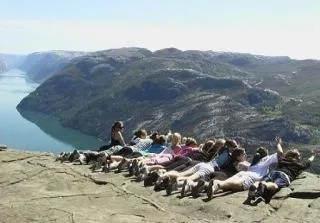
On the Preikestolen Cliff
Conclusion. See beginning: NORWAY: VIEW FROM ABOVE
In May they bloom together, in September the foliage also turns into rich red-yellow tones, and this quiet beauty approaches the highway from above, from the mountains, and from below – in the reflection of gardens in the asphalt-calm water of the fjord.
Local cherries ripen a month later than European ones, at the end of July – beginning of August, and in sweetness and size they bravely compete with June Uzbek cherries. Cherries from Hardanger are a patented name, as are local apples, pears, and plums. Patented fruit in season is easily sold from stalls along the road on homemade wooden tables, where even a seller is not needed: you stick a bill into the money box yourself, you take a cardboard box of berries yourself. And if the filled boxes are already taken, here's an empty box, here's the tree, pick yourself.
An excellent view of the gardens and Folgefonna opens from the eastern side of the fjord, from the one-hundred-fifty-year-old hotel "Ullensvang" in Lofthus. It was this landscape that inspired Edvard Grieg to write the music for "Peer Gynt". Both in Grieg's time and now, the hotel is run by the Urne family, though back then it was much more modest than today's "five stars". Grieg, for example, always stayed in the same tiny house that only fit a piano and a bed. Since then, many weddings have been held here: a white dress looks great against the dark water and bright grass.
Two of the most famous and very "postcard" views involving the fjord, however, are located much further south, in the county of Rogaland. This is the perfectly flat platform at the edge of a 600-meter cliff, Preikestolen ("Pulpit Rock" in Norwegian), and the boulder firmly stuck between two vertical cliffs in a crevice at a height of 1000 meters on Mount Kjerag (Kjeragsbolten).
Both of these attractions, photos of which are inevitably found in any guidebook to the fjords, are located above the waters of the Lysefjord. Hiking trails are laid to them, but climbing requires considerable patience. There will be plenty of people wanting to take photos on the edge of the world above the blue abyss, so you will have to wait at the top too. If for some reason you don't want to climb the mountain, you can also view the hanging boulder from the water, from the deck of a ferry (no worse than a cruise, only cheaper).
The Lysefjord begins at another ancient city of Norway – Stavanger, the capital of fatty Norwegian herring and (one does not interfere with the other) oil production, the basis of the kingdom's current prosperity. Getting onto the oil platforms, which look like huge futuristic houses on chicken legs, is difficult, but you can visit the oil museum. The city also has a museum of canned goods, including herring. Besides herring, they also prepare other food excellently: every year Stavanger hosts a large gastronomic festival, the largest in Northern Europe.
For herring itself, as well as mackerel with moiré skin, cod, and halibut, it's worth going even further south, to Farsund, to the quietest (unless a wedding has arrived) place Farsund Resort. A very diverse crowd comes here to fish: families with children, male companies, and business colleagues. Fishing for horse mackerel in the open sea with a spinning rod, which at first seems like a catastrophically melancholic activity, turns out to be an event of choleric fervor.
First of all, you should put on a professional fisherman's overall, waterproof and warm – exactly like a Teletubby's outfit. This comical attire will reliably protect you from the wind and cold that comes from the sea water even in summer. It will take about forty minutes to get to the fishing spot by motorboat, winding between islands with rare colorful houses. ("Meine Frau," the mustachioed and taciturn captain, as imagination demanded, will say at some point, pointing a finger at a yellow house, and then fall silent for another hour and a half.)
Better, though unsportsmanlike, if the boat has a fish finder. If you are lucky enough to find a school of mackerel, even an inexperienced fisherman will pull a dozen thick autumn fish out of the gray water in an hour, previously known only as headless smoked fish. And if the school is large and dense, then horse mackerel risk catching on hooks even with their sides, backs, and other unreliable parts.
The catch can be prepared by yourself (the cottages with three or four bedrooms have a full kitchen), or you can persuade the chefs of the local restaurant Moll&Nielsen, who will smoke it or prepare an unexpected horse mackerel sashimi. Norwegian laws allow you to take out of the country up to 15 kg of caught sea fish (the restriction does not apply to catching salmon, sea trout, and crayfish in rivers, but for such fishing you need to buy a license from the landowner) plus one large trophy fish. The size of the trophy is limited at most only by luck, and at least by law: you cannot catch cod shorter than 40 cm, pollock and horse mackerel shorter than 32 cm, halibut shorter than 80 cm. These numbers, promising serious fishing, warm the heart even of a novice fisherman.
It is worth including Norway in the list of potential destinations first of all for those who care about the opportunity to spend a vacation away from the broad masses of compatriots, and for those who go on holiday with a mixed company and are afraid that there will be nowhere to escape for a day or two if needed. Yes, there are still not many travelers from Russia in Norway, including at the increasingly popular ski resorts, but there are many English people from cities across the North Sea. Not that this matters to everyone – but for those it does, keep it in mind.
And yes, in Norway it is easy for a group to split up. If you don't want to climb mountains, go canoeing. If you don't want to row, go for a walk along the toy-like embankments of fishing towns. If you don't want the city, hide on a farm and press cider with the locals. If you don't want to see anyone, that option is also possible. In Norway it is easy and, most importantly, pleasant to be alone with yourself. Sometimes, you know, you really want to.
The author thanks the travel company "Jazz-Tour" (www.jazztour.ru), a tour operator for Norway and other Scandinavian countries, the USA, South America, and the Caribbean for organizing the trip.
Maria ZHELEZNOVA.
