
Accordingly, the package of services is also selected to cover a minimum set of risks. Even if you do not plan to engage in extreme sports, it is better to purchase an insurance policy yourself in addition to the one the travel agency will offer you. Most likely, it will be somewhat more expensive, but in return you get the opportunity to include additional conditions in the contract. When choosing an insurance company, it is better to trust those who already have experience and a good reputation.
Possible options
Basic travel insurance programs include only emergency medical care and the purchase of necessary medications, as well as the provision of transportation services in case of injury, sudden acute illness, or death.
If you choose an extended program, the insured event may include not only injury and acute illness, but also acute toothache, loss of luggage or documents, visa refusal, the need for early return for valid reasons (death or illness of relatives), liability (civil or administrative), as well as an accident resulting in full or partial loss of ability to work. «Such programs, as a rule, provide a wider range of services for the traveler - including evacuation of the insured's unattended children, a visit from a relative in case of illness of the insured, and legal assistance,» says expert Sirma Gotovac.
The insurance policy includes several groups of risks, for which different situations that constitute insured events are defined. For example, if for objective reasons you were unable to take the planned trip, this will also be an insured event. Objective reasons here may include, in particular, a hurricane or cancellation of the trip due to circumstances beyond your control. In this situation, to receive reimbursement of expenses related to the cancellation of the trip, you will have to provide the insurance company with relevant documents from the competent authorities. For example, if it was a hurricane, such a document may be issued by the Hydrometeorological Center.
The policy becomes effective from the moment you cross the border, that is, at the airport after going through customs.
The price of health
The cost of the insurance policy will depend on the program you choose. Understandably, the basic offer is cheaper. The sum insured also matters, and the requirements for it vary from country to country. On the Russian market, the most widely demanded policies have liability limits from $15,000 to $50,000. For example, for entry into Schengen Agreement countries, the minimum sum insured must be €30,000. «For resort countries - Turkey, Egypt, India, UAE - $15,000 is sufficient. The largest sum insured is required for entry into the USA - $100,000,» says Sirma Gotovac.
According to a representative of the insurance company Alexander Varentsov, the amount of the sum insured, as a rule, depends on the cost of medical services in a particular country. For example, the USA, Canada, Australia, and Japan are distinguished by the high quality and cost of medical care. A high sum insured may also be due to the significant remoteness of the country where the vacation is spent from the tourist's permanent place of residence. This is associated with expensive transport costs in the event of the necessary evacuation of the patient or repatriation.
You can purchase an insurance policy for any period - for the duration of the trip, a month, six months, a year, with the condition of visiting one or more countries during the validity of the policy. The cost of the policy is accordingly calculated depending on the number of days spent abroad.
Tourists visiting countries such as Turkey, Egypt, Cyprus, and Greece most often seek help. Much less often - tourists visiting European countries. This is due to the fact that people traveling to Europe are more likely to enjoy a measured, calm holiday, which is correspondingly less traumatic than, for example, a holiday on the beaches of Turkey. In addition, the climatic conditions of European countries are more similar to ours, while Turkey and Egypt differ quite significantly both in climate and food - as a result, sunstrokes, poisoning, and injuries while swimming in the sea from sea urchins, jellyfish, etc. are not uncommon.
Assistance will help us
The procedure for action in the event of an insured event, as a rule, is described in sufficient detail in the policy or the attached instructions. Most often, prior contact with a service company is required to approve expenses (insurers themselves call such companies assistance companies - from the English assistance). It is this company that, under an agreement with the insurer, will provide assistance in the territory of the country where you are. The service company gives recommendations on which clinic to contact, or itself sends a doctor to your location and takes on the responsibility for resolving all financial matters on the spot.
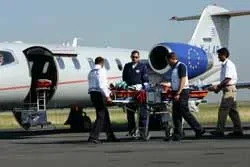
Assistance is created to provide any, sometimes the most bizarre needs - whatever the insured may need. «In my practice, there have been cases when I had to use a US Coast Guard helicopter to help a sick sailor or repatriate remains from an African country,» says Arseny Ulchenkov, head of the mass personal insurance department of the insurance company.
If an insured event occurs, the first thing to do is to call one of the 24-hour service center numbers. There should be no problems communicating with a service department employee, as its staff speak Russian or have an interpreter on staff. The service company will tell you about the nearest medical facility where you can be admitted for treatment, or, if necessary, the service company itself will arrange to transport the injured person to a clinic. You only need to provide your details, insurance policy number, and also indicate your location and a phone number where you can be reached.
To pay for the mandatory set of medical services, you do not need to have cash or bank accounts, as all expenses are borne by the insurance company. If you have to buy prescription medications, be sure to keep the receipt, for which the insurer will reimburse the money.
To avoid unforeseen situations, you need to carefully study the insurance policy before crossing the border. As a rule, the policy clearly formulates the actions of the insured, but if you have questions, be sure to address them to the insurance company representative.
It should be understood that the service company does not provide services not covered by the insurance contract. That is, if you paid for the basic program, then, for example, there can be no question of any legal assistance or compensation for lost baggage.
If there wasn't enough money
The sum insured is the maximum that the insurer will pay upon the occurrence of an insured event. If treatment requires more funds than the insurance company is willing to guarantee, a foreign medical institution will most likely not throw the patient out onto the street, but it will not be possible to continue treatment in an expensive clinic. “As a rule, the patient will be transferred to a charitable clinic or to a state clinic for the poor with an appropriate level of service, which is also reluctant to make contact with the service,” explains Arseniy Ulchenkov. Therefore, most insurance companies in such a situation will prefer medical evacuation home. If expenses, for example for treatment, exceed the sum insured, the difference is paid by the traveler himself.
Deductible
As in any other type of insurance, a deductible (a portion of expenses not paid by the insurance company) may be applied here, by the way, significantly reducing the cost of the policy. Despite this, the policyholder receives all the benefits - in particular, if it is necessary to see a doctor, he can use the service company’s database. And paying $40-80 for a visit to the doctor - approximately what that visit costs - the traveler is usually capable of doing even without financial assistance from the insurance company.
However, so that this does not come as a surprise to you, do not forget to ask when purchasing a policy whether this insurance company has a deductible. The policy can also be issued without a deductible, but this is possible only with mutual consent. However, for example, the Finnish Embassy insists on the absence of a deductible for unforeseen expenses.