
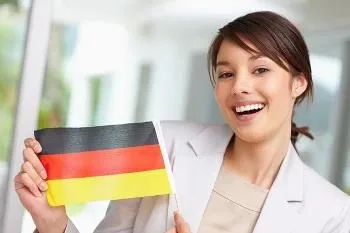
Many Ukrainians view language courses as an anti-crisis measure
The choice of German language courses in Kyiv is vast: for every taste and budget. Google returns at least two dozen, mostly private schools, studios, and centers that offer programs ranging from learning the basics to advanced professional courses.
The largest and most well-known center for learning German in Kyiv is, of course, the Goethe Institute. At the institute's Kyiv office, they said that more than five thousand students attend German language courses annually. More than half of them are young people and adults. "Demand for German language courses is high and increases by 5 percent every year. We can no longer fully satisfy it," notes Igor Berdnikov, responsible for organizing courses and exams in the language department of the Goethe Institute.
Training is divided into trimesters. Group classes are held two to three times a week. But for those who work or study, there is an alternative. Not long ago, at the Kyiv branch of the Goethe Institute, it became possible to study German in a combined format: half of the classes are held in the classroom, half online.
"These courses are very popular now. We noticed that their students write better, and language practice does not suffer," says Igor Berdnikov. The cost of training ranges from 3 to 3.5 thousand hryvnias per trimester. Classes in the "intensive" and "super-intensive" format will cost from 2.5 to 7 thousand hryvnias. According to the expert, demand for intensive language courses has doubled recently.
This trend is also noted by Bohdan Horokhovsky, head of the Aachen Academy of European Languages. According to him, if in 2008 people had "extra" money and studied German often for general development, then in 2013-2014 language courses began to be attended more by those who know exactly why they need German. "Now very motivated, determined people come," says Horokhovsky.
It is for such students that the academy offers an accelerated German language course: in one academic year from September to May, one can complete four levels – from A1 to B2. In such classes, books are almost not used, and the material is studied through communication and use of the internet.
"For example, we go to the websites of German supermarkets and choose hypothetical purchases, discuss them. It seems nothing special, but the learning process is intensive. And then we move from speaking to grammar," explains Bohdan Horokhovsky. In addition, participants of language courses read the German press. The center employs teachers who studied in Germany and lived there for a long time. The cost of the course is 3 thousand hryvnias for two and a half months of training.
German is especially popular in Kyiv among middle and senior managers who work in German companies or cooperate with firms from Germany and Austria. "Many sign up for specialized German, business German. This is an additional bonus when applying for a job," believes the head of the European Language Studio, Evgenia Domnikova.
In this school, besides German, they teach English and Spanish. "But people are more willing to take German. These are mainly young professionals who want to work in international companies," says Domnikova.
In the studio, organized by teachers from the Kyiv-Mohyla Academy, the class schedule is drawn up taking into account the wishes of the students. Visitors to traditional classes also have the opportunity to participate in a conversation club on Saturdays. And those who cannot come to class can make it up with a teacher via Skype. Such an unconventional approach to language learning will cost 650 hryvnias per month. Intensive classes cost 1300 hryvnias per month. Students can determine the pace of progressing through language levels themselves.
Professional German language courses are not rare in Kyiv, but finding a German language school, especially for medical professionals, is difficult. Alpha-Intensiv is currently the only center that offers such classes. At this center, the organizers emphasize, they were the first to realize that there would be demand for such courses – and they were not mistaken.
"Over two years, the number of doctors who would like to learn German has doubled. We receive medical professionals of various specializations: surgeons, neurosurgeons, therapists, gastroenterologists," explains the center's educational program coordinator Elena Zhadan. At the same time, she notes that some of those who completed the courses are already working in Germany in their specialty.
To obtain a certificate confirming language proficiency, doctors must complete all language levels up to B2.2, and then pass a language test. The center offers an advanced course for doctors that lasts two months and costs about 3.5 thousand hryvnias. "Doctors are taught medical vocabulary. They also practice professional conversational topics: for example, how to interview a patient, how to fill out a medical history, how to interpret test results," emphasizes the representative of the training center.
You can study the language here in groups or individually. "Demand for individual lessons is high due to the widespread belief that it is better. However, we recommend studying in groups because we are confident that with our teaching method it is more effective," advises Zhadan. In addition, the Alpha-Intensiv center holds grammar trainings, conversation trainings with native speakers, exam preparation classes, internships, and seminars for teachers.
Liliya Rzheutskaya.
Deutsche Welle