
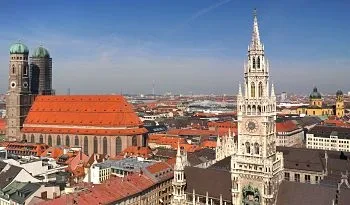
Munich – the most expensive city in Germany
According to experts' calculations, residents of the 20 studied cities spend on average about 4,070 euros per year on rent, leaving them with 16,278 euros in their wallets. While three-quarters of Germans live in rented housing, in some cities the cost of owning a roof over one's head is quite comparable to the amount of rent.
As reported by Deutsche Welle, among the 20 cities studied by HWWI and Berenberg Bank, residents of Munich spend the most on rent. They spend 22% of their annual income, or 5,702 euros. This is not surprising: Munich traditionally leads among other German cities in cost of living, so renting accommodation here is several times more expensive.
Thus, in 2014, a landlord for an apartment in the mid-price segment asked 14.10 euros per square meter compared to 4.8 euros in Duisburg. The price for a well-renovated apartment in a prestigious area of Munich reached 21.3 euros per square meter. However, Munich residents end up with more money left over than residents of other cities (20,253 euros per year), since the average income in the capital of economically prosperous Bavaria is higher.
Stuttgart is almost on par with Munich in terms of rental expenses: spending on this item accounts for 21.9% of residents' annual income. However, they have a significantly smaller amount left – 17,762 euros per year. Third place on the list is Bonn, where a tenant pays 21.7% of annual income for housing, leaving them with 16,444 euros in their bank account.
Meanwhile, Berlin residents ended up in second-to-last place in terms of disposable funds after paying rent. A resident of the capital has 13,962 euros per year left, or 1,164 euros per month, which is less than the national average. Residents of Duisburg spend the least on rent (13.9% of annual income), but they also have much less left than residents of other cities (14,340 euros per year).
Looking at the average figures, many families in major German cities pay rather large amounts for rent, notes HWWI economist and study author Dörte Nitt-Drieselmann. At the same time, 70% of families living in these cities have below-average income. According to her, it is becoming increasingly difficult for the most vulnerable segments of the population – low-wage earners, single parents, and students – to find affordable housing. One reason, the expert explains, is growing competition for cheap square meters from refugees or pensioners, who, due to the aging society, require more apartments.
Over ten years, from 2004 to 2014, the average rent increased in almost all of the 20 cities studied by HWWI and Berenberg Bank. In Berlin, rent for average-priced housing soared by 57%, in Stuttgart by 45.8%, in Dresden by 47.7%, and in Hanover and Essen by 40%.
Given the considerable cost of rent, many prefer to take out loans and buy their own housing. Especially since the amount of payments in this case can be roughly the same as rental expenses, claim the authors of another study, cited by the newspaper Die Welt.
According to calculations by the German research institute Empirica, when buying a more modest-sized home than a rented one, loan payments will be approximately equal to rental costs. Thus, in the first quarter of 2016, a German with an average income had to sacrifice only six square meters of space when purchasing new housing, claim Empirica experts. However, they note that this is an average value for Germany: the final payment amounts vary greatly depending on the city.
For example, in Munich, even when buying a home on the secondary market, one has to give up 35 square meters of space. An average family living in the Bavarian capital has to spend almost half of its income on loan payments for its own home, according to Empirica.
From 2004 to 2014, the rental and owner-occupied housing markets in 20 major cities developed differently, according to HWWI and Berenberg Bank. In cities such as Munich, Stuttgart or Hamburg, the increase in prices for owner-occupied housing significantly outpaced the rate of rent increases. In Munich, apartment prices rose by 73.5%, while rents rose by 23.1%. The cost of a 70-square-meter owner-occupied home there is equal to 27 annual rents for an apartment in the mid-price segment excluding utilities, the economists' study shows. In the high-price segment, one would have to pay 29.4 annual rents.
In Düsseldorf, Berlin, Hamburg, Stuttgart, Bonn and Dortmund, the cost of a new apartment corresponds to 21 annual rents. The most affordable apartments are in Essen: for new housing there, one would have to pay an amount equal to 13.2 annual rents.