
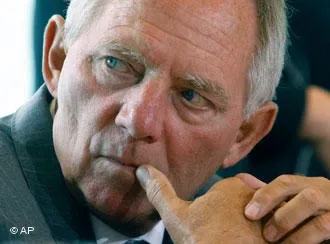
German Interior Minister Wolfgang Schäuble believes that Germany has 'long overfulfilled any obligations' regarding the acceptance of refugees
Cyprus, Greece, Italy and Malta bear the maximum burden of accepting refugees from Africa, representatives of these states emphasized, and demanded that equal quotas for the distribution of immigrants be developed for all EU members as part of the so-called Stockholm Program to strengthen cooperation in customs control, security and justice.
Under current rules, the application for asylum must automatically be processed by the relevant authorities of the country through which the migrant entered the EU. In 2008, such applications for Mediterranean countries amounted to more than 67,000. 'It is unfair and unacceptable,' says the head of the European Council, Swedish Minister for Migration Tobias Billström, 'that an illegal who arrives in Europe by boat from Africa has no chance of obtaining asylum in, say, Germany. The burden is distributed unevenly. Voluntary measures in accepting refugees are insufficient; we need to develop a unified mechanism of action and set quotas for receiving migrants that are mandatory for all EU members.'
But this demand, also supported by Austria, Spain, and France, met with the iron argumentation of Wolfgang Schäuble. The German interior minister categorically rejected the idea of forced 'equal distribution of migrants,' reminding colleagues that Germany 'long ago overfulfilled any obligations' by accepting hundreds of thousands of refugees from the Balkan countries in the 1990s, in particular Kosovo Albanians.
Germany has traditionally been one of the main destinations of the migrant flow. According to current statistics from the Interior Ministry, in the first six months of this year alone, 12,454 applications for asylum were accepted for processing in Germany – 1,443 (13.1%) more than in the previous half-year. The largest group of refugees are from Iraq and Afghanistan. In 31% of cases, applications receive a positive response.
These figures proved far more convincing than the emotional demand of Vice President of the European Commission Jacques Barrot to 'even in a time of crisis, treat with full attention and understanding those who have fled persecution and violence.' The issue of developing a common European strategy for managing migration flows and cooperation of legal institutions for external border control was postponed to December 2009.
From January to June 2009, Germany accepted 3,168 refugees from Iraq, 1,120 from Afghanistan, 722 from Turkey, 682 from Kosovo, 670 from Vietnam, 399 from the Russian Federation, 397 from Syria, 369 from Iran, 347 from Nigeria, 318 from Serbia.
4,381 people in the same period were granted refugee status under the 1951 Geneva Convention, and another 4,146 under the Federal Law on Refugees. Among those from Russia, 19.9% received positive responses to their applications, almost half of whom were Chechens.
Lena MÜTZER,
"Russkaya Germaniya"