
Photo: "Russkaya Germaniya"
The technical innovation will make it possible to 'ensure the possibility of quick one-to-one identification of a person without the bureaucratic procedure of searching in the federal database,' Hannig emphasized, addressing participants of a conference convened on the initiative of enterprises to exchange experience in the field of digital communications and software development.
The fact that the presentation of the 'chip idea' took place at an economic forum and not, say, at a meeting of heads of state interior ministries, whose main interests include security issues, is not surprising. Because the 'residence cards' are conceived not only (and maybe not so much) as another obstacle to the penetration of illegal immigrants into Germany, but as a 'mechanism for a sharp cyclical upswing.' Large knowledge-intensive enterprises are constant winners from the growing threat of terrorism. In recent years, the same, almost ritualistic pattern has been repeated: law enforcement agencies report a new prevented (or, unfortunately, accomplished) terrorist attack, politicians immediately call an emergency meeting to work out ways to protect citizens' lives and health. As a result of this work, the government places orders with industrialists for the manufacture of mass batches of video surveillance cameras for train stations and airports, particularly sensitive metal detectors, iris scanners, devices for reading digital images, etc. Orders – for amounts proportional to the number of victims of the suicide fanatic and material damage.
• By the way, the specialized website www.worldvision.com.ua offers high-quality video surveillance systems and various components for security systems. Here you can choose intercoms for your home, video cameras for your country house, or security systems for a cottage community.
In 2000, the total turnover of German corporations engaged in the production of devices used to enhance security measures was €1.5 billion; by 2005 it was already €2.2 billion. On a global scale, the corresponding growth in the five years after the tragedy of September 11 reached 40%. 'I would not speak of a boom in our field,' cautions Hans-Martin Fischer, director of the professional association 'German Security Systems.' 'But we proceed from the assumption that demand for our products is growing and will continue to grow.'
State investments in the production of just video cameras alone by the end of this year will amount to 90 million; according to Fischer's forecasts, the further development of visual surveillance systems in public places will result in government orders of 500-700 million euros annually. How much the 'residence cards' for foreigners will cost and who will pay for them is not yet completely clear. Apparently, their price will not differ much from that which German citizens currently pay for new-generation biometric passports. 59 euros for each masterpiece of the federal printing office, equipped with an electronic chip from the Infineon concern, have been paid since last November by those wishing to travel to the United States. The time for introducing internal identity documents of this type (with digital photo and fingerprints) is set by the German Interior Ministry as 'mid-2008'.
As for the 'cards' for foreigners, which, according to August Hannig, will 'strategically equalize citizens and non-citizens of the country in identification,' they will become everyday reality already in early 2007, immediately after approval of the corresponding project by the European Union. Consideration of this issue is scheduled in Brussels for this coming winter, and in implementing the innovation, Germany, the state secretary promises, will be 'in the forefront of the civilized world.'
The money collected for passports since November 2005 is already sufficient, according to Interior Ministry experts, to cover the costs of equipping the document with additional fingerprint information, archiving of which will begin in March next year. Considerable income is also promised, apparently, by the introduction of 'residence cards' – they will replace the old inserts in the passports of foreigners permanently or temporarily residing in Germany. But even more could be earned if the federal authorities agreed with the proposal of the state ministries of education to supply all schoolchildren in the country with electronic 'cards'! And to store on the chips data on academic performance, attendance, type of educational institution, and native language of children and adolescents.
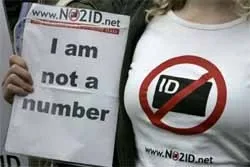
This fresh idea, which, according to Schleswig-Holstein Minister Ute Erdsiek-Rave, 'would optimize the entire system of statistics and allow verification of the effectiveness of educational policy,' was met with hostility by educators and human rights activists. 'I am invariably skeptical about any attempt to assign to anyone any serial or other number,' says Harald von Bose, chairman of the Federal Conference of Data Protection Commissioners. 'The practical benefit of such an innovation is illusory,' echoes Ulrich Thöne, head of the GEW teachers' union. 'Children are not dogs to have tags implanted in their ears! They are perfectly aware of their actions and do not need cataloging! Democracy must guarantee a child, especially a primary school student, the freedom of individual development, not limit him with registers that capture the image of a "transparent schoolchild."'
Indeed, democracy has somehow been forgotten in the era of the universal fight against terrorism. Under a hail of possible reproaches from the aforementioned civilized world, it certainly will not withstand the 'transparent schoolchild.' But the 'transparent foreigner' with a dog tag in his ear – it will withstand quite well.