
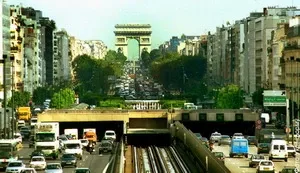
Photo: Ukrinform
First impression: complete nightmare. Cars are coming from all sides. Where and how to go? Panic seizes you, and, shameful to say, a womanish reaction arises - to drop the steering wheel and squeeze your eyes shut.
In fact, everything is extremely simple. At the Étoile, the driver must look to the right, not turn his head too much, and slowly crawl in the direction he needs to go. You give way to cars on your right, and those for whom you are on the right will give way to you. Tested personally and by the experience of generations: you will get through slowly, but without problems, if you follow this uncomplicated rule.
Why did this mechanism develop in this way and work flawlessly for many decades? Ignorant people, when answering such a question, usually start reasoning about culture, gallantry, civilization, and other speculative concepts. In reality, order on the Parisian and, in general, French roads is ensured not so much by the police and law-abidingness as by the insurance policy. What does it have to do with road safety and driving through the Parisian Étoile? Let's take things in order.
Any car that appears on French roads must be insured. Driving without a policy is one of the most serious violations, punishable by criminal liability. The presence of a policy is evidenced by a light-green replaceable coupon, which is constantly kept in a pocket in the lower right corner of the windshield. It also indicates the expiry date of the policy. If, for example, a young lady from the police service, who walks along the streets and melancholically writes out fines for improper or unpaid parking, sees that it has expired, there will be trouble.
But whoever says "insurance policy" means money. It costs money and has the habit of expiring after a while. If a French driver drives without accidents, the company will give a discount (bonus) when renewing the contract. If the driver is at fault in an accident, the fee will increase (malus). Since France (like most countries) follows the rule of right-hand priority and you must give way to a car coming from the right, drivers at the Étoile also give way to those on their right. That is why they look to the right. All participants in this outwardly chaotic movement do likewise: no one wants to pay more for an insurance policy.
What does French auto insurance consist of? Like the OSAGO and CASCO we are used to, it consists of two elements - mandatory civil liability insurance and a whole set of voluntary insurance services.
What does a typical French contract provide in the part concerning mandatory civil liability insurance? Compensation for material and physical damage caused to a third party, regardless of who is at fault in the accident. It covers objects and people outside the insured vehicle, as well as people inside that vehicle (except the driver) who were transported in unsafe conditions or for money.
All other types of insurance are strictly voluntary.
Prices for all types of auto insurance, including mandatory, are free; they are set by insurance companies under competitive conditions, taking into account certain rules common to all. At the same time, all companies are obliged to inform the Ministry of Economy and Finance of the tariffs they practice. In practice, the cost of car insurance can vary by more than two times for different categories of drivers living in different parts of France. On average, according to the Institute of Statistics and Economic Studies, about 2% of an average French family's annual expenses goes to this item.
In the event of an accident, the insured driver must report the accident to his company within five days, providing all necessary information, as well as details about the other participants in the incident, including the names of their insurers. For this purpose, every French driver has a special standard form in the car's glove compartment, valid in most European countries.
Another curious element is the calculation of insurance bonuses and maluses. For each year of accident-free driving, the driver receives a five percent discount when renewing the contract. These amounts can be accumulated - their total amount can reach 50% of the initial cost. This requires driving without accidents for 13 years. Each accident or other offense entails a malus. Each accident will increase the price by 25% (if the parties to the accident are equally at fault, by 12.5% each).
Violations that increase the price of the policy even more include: driving while intoxicated (plus 150%), fleeing the scene of an accident (100%), deprivation of driving rights for various periods (from 50% to 200%, depending on the reason). However, the total amount of the additional increase cannot exceed 400% and is canceled after two years. (By the way, the increase in the rate for a young driver cannot exceed 100% of the base price.)
Interestingly, since 1992, the price of insurance has not increased for a number of categories of accident-free drivers who turn out to be at fault for the first time in an accident. There are also cases in which the owner of a damaged car does not bear financial responsibility for it: if another person, as a rule, the driver of another car, is at fault in the accident, if the car was stolen, became a victim of vandalism, fire, or if something happened to it while it was parked correctly.
Now - the main thing. And how does this work in practice, and does it work at all?
Nothing is more convincing than personal experience. Over many years of reporting in Paris, car mishaps happened to me three times. Twice I was hit: once in the left rear door, another time in the right headlight at an uncontrolled intersection when I was driving on the main road. The third time, during a rare frost and snowfall in those parts, a hardened lump of snow fell from a roof onto the trunk of a parked car and dented the metal. In none of the cases was I at fault; the relevant papers went to the insurance company on time (naturally, no one called the police to the scene, since there was no conflict). Then I took the car, which had a comprehensive policy, to a workshop where an insurance representative came without me to assess the damage. The damage was repaired at the insurance company's expense, after which I was asked to pick up my four-wheeled friend.
By the way, afterwards my policy premium was never raised, because I was not at fault. True, I didn't get a bonus that year either—which is probably fair.
Although... Where has it been seen—a commercial establishment that tries to err in your favor rather than its own? French insurance companies are no exception. For example, a legal battle is unfolding these days between the government and insurers.
The authorities boast of a sharp decline in accidents and fatalities on the country's roads thanks to a whole series of measures adopted and consistently implemented. In 2003, 5,732 people died in road accidents in France—this figure fell below the six thousand mark for the first time. It should be noted that 30 years ago, more than 16 thousand people died on French roads each year... Of course, the French are still far from British achievements. Currently, on average in France, 14 people per 100,000 die on the roads, while in Britain it is six. For comparison: in Portugal—21. Nevertheless, the improvement is evident.
Under these circumstances, French Prime Minister Jean-Pierre Raffarin demanded that insurers take into account the increase in road safety when setting insurance rates. "The results in increasing the level of road safety are beyond doubt," he said. "Our fellow citizens will not understand if insurers do not draw appropriate conclusions from the achieved successes." So far, this call has not met with understanding. Companies in response complain that their annual auto insurance costs increase by 10%. At the same time, as the newspaper Le Figaro acknowledged, there is another reason that insurers are uncomfortable talking about: "Insurance companies compensate for the decrease in profits obtained on financial markets by using revenues from auto insurance."