
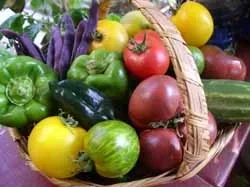
America is currently experiencing a boom in naturalness in everything. In clothing, preference is given to cotton and linen; cars should not spew dirty exhaust into the atmosphere; in diet, the undisputed favorite is food without chemicals. Suffice it to say that over the past five years, sales of organic food in the United States have doubled, reaching $16.9 billion. And this is only the beginning, experts predict.
Living Healthy
There are at least three reasons for the current boom. First: America seems tired of being a nation of fat people. After all, obesity has become a real disaster in the US over the past two to three decades, turning more than half of the adult population into lard-asses. The blame for the thickening of the average American is placed on high-calorie, additive-packed, devilishly tasty and terribly unhealthy food from McDonald's, Burger King, and other fast-food establishments. The second reason: the cult of longevity has finally become established as the mainstream life philosophy. The prosperous post-war generation of Americans is retiring en masse and wants to live out their old age without being painfully tormented. And to die from "natural causes". It is precisely this environmentally friendly formulation that increasingly appears in doctors' verdicts that put a final point on the medical histories of deceased patients. Finally, despite all the successes of official medicine, there is a palpable widespread disillusionment with its traditional methods. The alternative is to become closer to nature and consume only "natural products".
Today there is a constant struggle, so to speak, around semantics. What does the phrase "organic product" mean? Should everything in it be entirely natural? Of course, when labels are stamped onto packaged products, cans, and bottles on the assembly line, the manufacturer is responsible for the printed claims before national oversight agencies and numerous inspectors at various levels of government—from local to federal. Theoretically, it is possible that someone might pass off a regular product as organic. But in practice, the penalties for liberties are so severe—huge fines and administrative sanctions up to halting production and closing the company—that the likelihood of fraud is extremely low. There is an immutable rule: for a food product to have the right to be called organic, all its components must be produced and grown without chemical fertilizers, pesticides, bioengineering, or ionizing radiation. Animals cannot be fed antibiotics or growth hormones, and they must be kept in humane conditions. Only then will the inspection of the Department of Agriculture issue a special certificate.
According to current standards, a product that contains absolutely no chemical components is entitled to be called 100% organic (Organic). Simply "organic" products may contain less than 5% chemical additives from an approved list, which lobbyists are always trying to expand. Right now, for example, they are pushing through the Department of Agriculture an additional list of 38 spices, dyes, flavorings, and other non-natural ingredients. The idea of the project is to allow the country's chief food watchdog to let them add these "a little bit" to organic products. Advocates of purity are protesting. Billions of dollars are at stake, and it is not yet clear who will win.
As for the "natural" label, experts advise reacting critically and always reading the "breakdown" of ingredients, which manufacturers are required to print on the packaging. The fact is that unhealthy food is often completely natural, such as corn syrup, which is considered the main culprit in American obesity. And the indication of its 100% naturalness should not be misleading.
Television channels and newspapers vilify agricultural firms and food corporations when they supply poor-quality or contaminated products to stores. Restaurant owners and merchants who foist second-fresh sturgeon are publicly pilloried. According to the Centers for Disease Control and Prevention, more than 76 million US residents are poisoned by food at least once a year.
As for rosy news from the fields, such promotional positivity has never been cultivated in America. With one exception: when it comes to organic farms, ranches, and plantations. For example, in Washington state, there were only two "natural" dairy farms five years ago, and today there are 45. But here's the problem: demand for organic dairy products in the US grows by about 20% each year, while production of organic feed increases by only 4%. Enthusiasts of "green" food are calling for a sharp increase in acreage for alfalfa and soybeans. The latter have to be imported all the way from China, and it's hard to verify their compliance with American standards there.
Chrysanthemum-Light
If the unforgettable Koroviev were to enter one of the Whole Foods supermarkets, he would have every reason, as in Torgsin, to exclaim: "A splendid store! A very, very good store!" For the last few years, I have worn a path to one of these newfangled meccas of healthy food, located in the respectable town of Montclair, New Jersey. Shopping there is a sign not only of good taste, but (and this is the main thing!) of concern for one's health. After all, everything sold here is grown without pesticides or chemical fertilizers. At least, this is declared on the store's website, its windows and stands. The set of products is the same as in a regular supermarket, but everything costs two to three times more. Even flowers are organic, although in appearance and smell they are indistinguishable from ordinary ones.
For the first time, I remember, I walked into a "health food" store in Brookline, a district of Greater Boston, in the mid-90s. It was called quite expressively - Bread and Circuses. And many people really went there mainly to gawk. It, like many other natural food stores, was absorbed by the Whole Foods chain. And the chain itself proudly traces its lineage back to 1978, when a 25-year-old college dropout John Mackey and his 21-year-old girlfriend Renee Lawson borrowed $45,000 from relatives and friends and opened a small store in Austin, Texas. Three years later, a flood literally washed away all the goods, and the owners had not yet taken out insurance at that time. But the store had already become so beloved by locals that they, in a single impulse, came out for a series of volunteer clean-ups, pooled money together with suppliers, and the store reopened as good as new. In 1984, the all-American expansion of Whole Foods began, and in 2004, the chain bought seven stores in the UK.
Of course, the American natural products market is not limited to this chain. There are nice non-chain stores. There, like in a general store, they have everything, but in a limited assortment. And even more expensive. Therefore, for strategic shopping, most health-conscious residents of my town prefer to drive to the aforementioned sesame in Montclair. It has another advantage: the staff are chosen from among enthusiasts, and if you ask about an unknown brand, they will give you a whole lecture. And you can return products without giving a reason.
The giant chains of "normal" supermarkets like ShopRite or Stop & Shop realized they were losing customers, and in the last year or two have been frantically setting up their own sesames in the form of special natural food sections. Even in Las Vegas, the city of sin, where clouds of tobacco smoke envelop the casinos and players devour multi-layered hamburgers, organic enthusiasts have appeared. The press recently reported on an exemplary cooperative warehouse store opened there by 49-year-old Kathy Garnier. "We have almost everything the public loves: from frozen pizza and Italian pasta to smoked beef and chocolate syrup," she says proudly. "And it's all organic."
The Organic Woman
Compared to Chekhov's times, "fat" and "thin" have swapped statuses. Today in America, thinness is a sign of success. Well, exceptions happen, but they only confirm the rule. The fitness cult is, of course, promoted with the help of movie and show business stars. They are also the loudest enthusiasts of organic products. My acquaintance, model and actress Carol Alt, is a walking advertisement for the strict natural diet she has been using for about fifteen years. Carol is 46, but she could easily pass for 10-15 years younger, which is significant considering she is married to famous NHL hockey player Alexei Yashin, who is 13 years younger than her. In the list of "10 Supermodels of All Time," Carol ranks fifth, behind only Kathy Ireland, Christie Brinkley, Gisele Bundchen, and Cindy Crawford. For more than two decades, Carol Alt was one of the most recognizable people in the world. At 18, she became the youngest model for Lancôme. Her chiseled face graced the covers of over 700 magazines. In addition, she has acted in 65 films and TV series.
I came to Carol's office in Tribeca, a trendy neighborhood of Lower Manhattan. She treated me to natural tea, caffeine-free, of course. She told me how around age 34, various ailments began to bother her, she started gaining weight and - oh, horror! - wrinkles appeared. A doctor was found in Los Angeles who did not stuff her with antibiotics, as per the generally accepted method of most American doctors, but advised her to switch to an organic diet. So Carol did, suppressing her habits - drinking strong coffee in the morning and having a heavy lunch. She became interested in raw food, became a regular at natural food stores. She wrote a best-selling book "Raw Food" about her mistakes, misconceptions, and methods of healing.
"You could offer me a trillion dollars, but I would not agree to eat thermally processed food," said Carol. "I'm not a vegetarian at all; I eat meat and fish raw, of course, sashimi, tartare, carpaccio, even steak, lightly seared but raw on the inside. I eat fats - coconut, olive, nut oils. I eat a lot, like a maniac. I'm not afraid of oil, not afraid of fat, like many other health food advocates. They don't understand the difference between raw and thermally processed fats, i.e., trans fats. Trans fats are poison, they're ballast that settles around the lower back and in the abdominal area."
And if you, Carol, I asked not without slyness, were offered Russian pancakes with caviar? Would you refuse? "Why?" she asked back. "Pancakes don't have to be fried, and caviar itself is raw. What I am not going to give up under any circumstances are the principles of a healthy diet."
More and more organic fans like Carol are appearing in America. They are called health freaks here, that is, crazy about health concerns. For this kind of obsession, besides desire, you need a considerable income. Organic oats are expensive nowadays. However, in many cases, it's simply about reallocating the budget, such as giving up smoking and trips to the bar.
Walking into an American store, not necessarily into an organic paradise, you can see from signs and labels which way the wind is blowing. Today, low-calorie, fat-free, "no cholesterol," 100% natural, no salt or sugar, and so on are in fashion. This abundance now has a younger wunderkind sibling, and its name is "light." It all started with soft drinks and cigarettes, then the food market was conquered, and now the fashionable trend seems to be spreading wide and deep. People are already talking about light politics, light religion, light economy, light journalism.
I wanted to end on a light note, but I remembered the still-unrealized personal American dream, even if it is somewhat ridiculous. After 12 years of living in the US, I still haven't found cucumbers, tomatoes, and greens here that would smell fragrantly like their counterparts from our ordinary dacha, from a homemade plastic-covered hothouse. Whether it's the typical supermarket ones, or 100% organic, or farmer's market produce straight from the field. They don't smell at all, period! I was told the issue lies in seeds, selection, agricultural methods. Probably, it's an inevitable price for abundance, but as the romance song goes, "something main is lost."
Oleg SULKIN.
Itogi