
In Turkey, food preparation has always been of great importance. In the Topkapi Palace in Istanbul, substantial funds were allocated for the kitchen, and more than a thousand people worked there. All cooks were narrow specialists. Some only made soups, others prepared frozen meat, and still others made sweets.
Traditions in this country are very strong, so even today chefs have not lost the experience of their ancestors. True, modern cooks do not have such strict specialization, but they cook no worse, and the recipes have not changed at all since ancient times. Contrary to popular belief, Turks use spices and herbs very moderately, even though any spice market sells them in abundance. It would seem that fragrant herbs should be everywhere. But no. One of the rules of Turkish cuisine: the taste and aroma of the main dish should be preserved, not hidden by sauce or seasoning. For example, only a little mint and dill are used to prepare zucchini. And only parsley is added to eggplants. A few cloves of garlic are put into cold soups, giving them a slight spiciness. And cumin seeds are added to lentil soup or kofte, which only enhances, but does not overpower their flavor. Lemon juice in yogurt, served with meat and vegetable dishes, is very common.
The basis of Turkish cuisine is bread and flour products. Bread is an obligatory part of any meal, whether it is breakfast or dinner, whether the family is well-off or not. Besides ekmek, ordinary white bread, they also bake pide, a flatbread, and simit, round rings sprinkled with sesame seeds. Every tourist who has been to Turkey has probably tried such pastries; they are sold in any hotel, and they are exactly the same as those that Turks eat at home. It must be said that Turkish bakers carefully keep the secret of bread-making, which is why their bread is so tasty. Every settlement has its own bakery, where bread is baked twice a day—morning and noon—filling the streets with the aroma of fresh baked goods. Ekmek and pide are usually eaten fresh, on the day of preparation. If there are leftover pieces of dough with meat filling, they are usually served for breakfast on Sunday, after mixing them with garlic and adding melted butter with red pepper.
Hot soups are prepared in every tavern. In Turkey, as in our country, soup is the first course, only it is served for breakfast, lunch, and dinner. Conventionally, all Turkish soups can be divided into several groups. The first is soups based on meat, usually chicken broth, with the addition of vegetables, rice, noodles, and yogurt. Then there are pureed soups with added butter, as well as soups seasoned with lemon juice and egg. Another version of soup, similar to our okroshka or tyurya, is cacık. It is made from fresh cucumbers with yogurt and seasonings, and served with rice. Among other things, one of the peculiarities of Turkish soups is the addition of tarhana. Tarhana is a dough made from wheat flour, to which various spices are added, after which it is dried in the sun and ground. Very common are thick lentil soup, fish soup, tripe soup, and a sour-spicy rice soup with yogurt and mint. The most original dish is considered "wedding soup," which is made from the back of a lamb carcass.
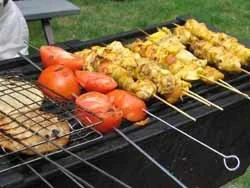
One of the oldest meat dishes of Turkish cuisine is shish kebab, or kebab. It appeared in those distant times when Turkish nomads had no other way to cook meat than roasting it over a fire. Today, the most popular types of kebab are shish kebab and döner. For shish kebab, meat is cut into pieces, threaded onto a skewer, and cooked over coals. Much like our shashlik, except the meat is never marinated. Döner is another meat dish—where layers of minced meat and fairly large pieces of lamb leg are stacked on a vertical spit, slowly rotating in front of a vertical grill. As it roasts, the outer layer of meat is sliced off in thin pieces. If, for example, a whole lamb is roasted in a pit dug in the ground, that is called tandır kebab.
Also very popular in Turkey is meat in pide and Adana kebab—where minced meat seasoned with spices is grilled on a skewer. This dish is named after the southern city of Adana, where it was first prepared. Often, a green salad with red onions is served with the meat. Such Turkish fast food, but properly prepared, is incredibly tasty.
No less popular and tasty are Turkish köfte. They are usually made from minced lamb with the addition of spices, egg, and finely chopped onion. The prepared mince is formed into balls, and sometimes elongated rolls. Then they are fried, baked, or boiled.
Another well-known dish that many may have tried but did not know it was Turkish. It can often be found on the menus of upscale restaurants in world capitals under the name "meat tartare." This is steak tartare, or raw köfte. Its origin is also owed to nomads, who stored raw meat seasoned with spices under their saddles, and when it became saturated with the aroma of spices, they chopped it finely and ate it raw. Preparing steak tartare is very simple: the meat is ground twice, mixed with finely chopped sweet and hot peppers, and left to marinate for several hours. Small, bite-sized rolls are made from the mince prepared this way. True gourmets should try it.
One well-known dish, dolma, can be vegetable. This is a vegetarian's dream. Tomatoes, zucchini, eggplants, peppers, rice, nuts, and spices are used for its preparation. Stewed vegetables with nuts are mixed with rice, and this filling is used to stuff grape leaves. Everything is cooked with olive oil and lemon. You cannot visit Turkey without trying börek—a type of pastry that is thin, flaky dough filled with cheese, herbs, spinach, fish, or meat.
National Turkish drinks include ayran - cold yogurt diluted with water (served in hotels, incredibly good in the morning), tea, coffee, and raki - grape vodka with anise.
Special importance in Turkish cuisine is given to sweets. As noted by Financial Izvestia, they have exotic names. The most famous is baklava, but we also advise not to refuse hanım göbeği, stuffed peaches, pudding.