
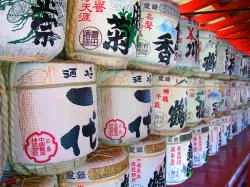
Sake is stored in such barrels at the Itsukushima Shinto shrine in Hiroshima Prefecture
And it's no wonder: the maximum strength of the so-called "rice vodka" at best reaches 24-25% ABV. Moreover, the production process resembles either rum or beer, so you don't even know which class of beverages to assign to Japan's alcoholic heritage. A couple of thousand years ago, the technology matched the best slave-owning traditions. Specially trained workers chewed rice and spat the resulting mass into special containers, where the raw material fermented to the desired state.
A little later, common sense and hygiene prevailed: to trigger fermentation, the Japanese began to use a special mold fungus - koji. Now, to prepare the drink, rice is thoroughly polished, steamed, spring water and the fungus are added, wait about a month, and then proceed to filtration, pasteurization, and other refinements. But no one will allow you to immediately try the "fresh stuff"; you have to wait another six months or even a whole year. However, there are fans of unpasteurized raw sake. Even those who can learn twenty varieties of whiskey in one drinking session get confused by the varieties of the finished product. In short, all rice splendor can be divided into "ordinary" (futsū-shu) and "specifically designated" (tokutei meishō-shu). The first is for simpler consumers. When preparing an ordinary drink, no more than 10% of the weight is lost during rice polishing. "Fermenting" substances - strong alcohol, sugar, or glucose - are added to the unpretentious raw material.
With specifically designated names, it's more complicated. This category includes a whole pack of drinks: from "honjōzō-shu", for which 30% of each rice grain is polished away, to premium "junmai daiginjō-shu". During the production of the latter, more than half the weight is lost during polishing, and the presence of any additives is absolutely not allowed: only rice and native fermenting fungi. However, the classification does not end there. By the time you figure out the remaining types, you could easily twist your tongue. For example, there is clarified (sei-shu) and unclarified (nigorizake) sake, young (shin-shu) and aged over a year (ko-shu).
Thankfully, labeling allows you to understand the strength and aging without linguistic feats. But those heroes who have memorized this amazing set of sounds can count on the favor of every other female visitor to the nearest sushi bar. And if you also figure out the list of leading producers, you can safely skip the gym: such an intellectual doesn't need muscles at all. Young ladies are partial to romantic names, even when it comes to an alcohol factory. From this perspective, for an authentic Eastern date, it would be good to buy a bottle from the "Sawantsuru" factory (that is, "Marsh Crane") or "Hakutsuru" (which means, don't be surprised, "White Crane"). The story of why the Japanese have such a love for long-legged birds can be made up yourself. As a starter: according to legend, a crane dropped a rice grain into a crack in a reed, where it successfully fermented and turned into sake. Who found and how the fruits of the bird's labor were discovered, history does not say.
However, comrades with poor vocabulary memory have a chance to make up for it through the drinking ceremony. There is, for instance, the rule of the "circulating cup". The hospitable host pours alcohol into a spacious cup - up to 30 cm in diameter - takes a sip and sends the vessel around. After the warm-up, the most interesting begins. The receiving lucky one fills the guest's cup, he empties it and returns it already filled. The host, having finished his portion, moves on to the next guest. If more than 15 people have gathered at the banquet, the poor fellow has a hard time. Orthodox sake consumers even went to meet the unfortunate and introduced a special assistant tradition who would take the full cup from weakening hands. While the hospitable citizen recovers, the others, in brief intervals between songs and dances, continue to ply each other with drink.
Apparently, the Japanese find it boring to drink from their own cups. So the initiator fills a small cup and passes it to a responsive comrade. He, with a grateful expression and the phrase "ona-gare tedai" ("my dear, allow me to drink from your cup"), downs the contents, refills the vessel, and passes it back to the partner. In Japan, it is believed that in this way people exchange not only germs but also souls. Therefore, they are especially scrupulous in choosing a drinking companion.
If a young lady is in charge of a secluded home banquet à la Japan, keep your wits about you. In the morning, you could inadvertently find yourself engaged or, worse, married. The point is that the climax of the Japanese wedding ceremony actually consists of drinking authentic alcohol. The newlyweds seal their vows with a brief ritual. Sake is poured into three cups - small, medium, and large. The bride takes three sips from the smallest cup and passes it to the future husband - as if to say, don't worry, guy, maybe it won't be so bad. After the process is repeated with the remaining cups, the drinking companions can officially be considered husband and wife.
As for the temperature regime of drinking, liberties are allowed - both at the wedding ceremony and in less exciting situations. If you want, you can put ice in a glass; if you want, you can heat it almost to a boil. Experts assure that the human tongue perceives tastes most acutely if the treat is heated to 15-30 degrees Celsius. So hold it in the spring sun, take a deep breath, and go - on to new alcoholic exploits.
Boiling the potion, however, also makes no sense: already in the first minutes alcohol slowly evaporates from it. Moreover, at elevated temperatures, sake becomes sticky like cheap liqueur and sometimes acquires an unpleasant cloying taste. The smart way to heat the drink is in a water bath or by lowering a porcelain bottle of sake into a pot of boiling water. A couple of minutes is enough to avoid burning yourself and spoiling the pleasure with extraneous flavors. The substance cools much more slowly, so watch your tongue - it'll come in handy. To properly heat the drink in a microwave, it's a good idea to place a glass rod in the jug (a cocktail stir stick will do): a simple trick allows you to achieve an even temperature throughout the volume of liquid.
Connoisseurs claim that heated sake is more likely to cause a hangover. In any case, if you manage to get properly drunk from the drink, your heart will inevitably beat faster in the morning. Add to that a headache, nausea, and start behaving reasonably before it becomes excruciatingly painful. The Japanese ward off the reckoning with heavy doses of sweets at night. Allegedly, rice alcohol sharply reduces blood sugar levels, and a dozen chewy candies easily compensate for the deficiency.
However, those who decide to use all their sake for cocktails are unlikely to escape a hangover. Consider just the "Bomb Sake": a shot of "rice wine" in a glass of beer. You can drink one after the other, the most daring are not even afraid to mix the ingredients. For a female companion, meanwhile, it's worth preparing something sweeter. For example, mix 100 ml of sake with the same amount of jasmine green tea, add 10 ml each of honey and vanilla syrup, and then watch a sober, puzzled girl all evening.
For battle girlfriends, a more serious option is suitable. For a cocktail listed on bar menus under code 187 URGE, you'll need to take equal parts (an ounce is enough) of sake, whiskey, and vodka. Right in the glass, the mixture should be slightly sweetened with sugar, spritzed with cherry brandy and cherry liqueur, and topped with a decent amount of Dr Pepper. Cool sake can easily replace vodka and other strong drinks in classic cocktails - at least in the same Bloody Mary. For fullness of flavor, sherry is added to them, but even with it, it's impossible to get drunk on such mixtures. Sake goes well with raspberry liqueur: you can mix the cool rice product with liqueur in a ratio of five to one right in the cocktail glass. Or you can make an excellent shot drink with a hot drink, pouring it into a glass over a berry layer.
Surfers appreciate the Japanese variation of tropical cocktails: one part light rum, two parts sake, a little more pineapple juice, and lemon soda to taste. The anti-hangover recipe is called the "Black Samurai": 15 ml of soy sauce and 25 ml of sake are poured into a shot glass and infused for a minute. "Rice vodka" also goes well with regular vodka, as well as with dry and sweet vermouths.
So that supplies are enough for both cocktails and morning resuscitation, some determined compatriots even try to make the drink at home. For this, it is enough to obtain the mentioned koji mold and wait three to four weeks. For one bottle of sake, you will need a cup of rice, one and a half cups of water, half a cup of hard-to-find starter, a teaspoon of lemon juice, and half as much baker's yeast. The rice is soaked overnight and then cooked for a long, long time. Then it is transferred to a sterile dish, the remaining ingredients are added, and you wait until victory. Every single day, the container must be shaken, then the lid slightly opened, and after straining, store exclusively in the refrigerator.
It is said that the current crisis forced the Japanese to return to the roots of home winemaking, so it's no sin for inhabitants of our vast expanses to follow their example. Especially since recently scientists from the National Institute of Longevity, examining drinking Japanese, found that they are slightly smarter than their abstinent brethren. The IQ level of those who like to have fun over a drink is a couple of points higher. Some say that this is rather due to raw fish or cheese, which are eaten with sake in Japan. Therefore, to be on the safe side, it's better to lean on both drink and snack. Just make sure the research doesn't drag on. Otherwise, it would be very disappointing to find yourself a brilliant mind in a chronic binge a few years later.
Yulia MAKAROVA.
Turist.ru