
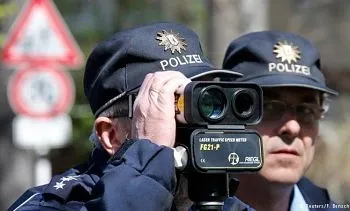
Speeding is one of the most common reasons for temporary driving bans in Germany
Germans are punished for traffic violations with fines and points in the register of the Federal Motor Transport Authority in Flensburg. Germans fear these points more than monetary penalties. They expire slowly, and if you accumulate 8 points, you lose your license and have to get a new one.
Speeding up to 20 km/h over the limit does not incur penalty points, so these violations are not included in the statistics. Fines for them range from 10 to 35 euros. Speeding within built-up areas is more expensive than outside: exceeding by 21-25 km/h costs 80 euros and one point; by 51-60 km/h costs 280 euros, 2 points, and a two-month driving ban.
In built-up areas, the speed limit is 50 km/h; outside them on regular roads it is 100 km/h, unless otherwise indicated. On the autobahn, there is no general speed limit, but a recommended speed of 130 km/h. It is safe to say that many Germans consider the freedom to drive on the autobahn with the gas pedal pressed to the floor almost their constitutional right. Discussions about restrictions always provoke a storm of indignation.
Despite heavy traffic, accidents on the autobahn are less frequent than on other roads, but often with more serious consequences. In 2015, there were about 305,000 accidents with injuries and fatalities in Germany. Of these, about 20,000 occurred on the autobahn. The total number of deaths was 3,459, with 414 people losing their lives on the autobahn.
Speeding is one of the most common reasons for temporary driving bans in Germany. In 2015, this measure was applied 380,000 times. Decisions to revoke driving licenses were issued almost 95,000 times for speeding, drunk driving, drug use, etc.
By the way, rumors about the freedom to race on all autobahns are greatly exaggerated. The total length of carriageway in both directions is about 25,000 kilometers. On 2,300 sections totaling 8,000 kilometers, permanent or temporary speed limits apply. Signs are placed before interchanges, exits and entrances, at dangerous spots, to reduce noise near residential areas, and before construction sites.
The price list for speeding on the autobahn can be studied while stuck in a traffic jam: 16-20 km/h over – 30 euros; 21-25 km/h over – 70 euros and one point. More than 70 km/h over – 600 euros, two points, and three months without a license. Guilt may be aggravated by tailgating. Penalties for this violation range from 25 to 400 euros and from one to two additional points.
Radar enforcement, according to the principles of German traffic laws, should primarily serve not to punish but to educate drivers, as well as to monitor particularly dangerous sections with many accidents. The good road-safety intentions of legislators give local authorities wide latitude for interpretation. Fines go into local budgets, which stimulates the appetites of mayors and treasurers.
Fines, according to legislators, should not have the flavor of blatant extortion. Moreover, during measurements, the occurrence of emergency situations should be avoided as much as possible. Therefore, on the autobahn, appropriate signs – "Radarkontrolle" – must be placed before stationary radar traps and sections where mobile stations frequently operate.
Warnings about controls are placed on the autobahn because sudden braking can lead to accidents; indeed, upon spotting a radar, many drivers begin to slow down or even abruptly hit the brakes, even if they are driving at the permitted speed. In built-up areas, no radar warnings are required.
There are about 3,500 stationary radar units installed in Germany. However, technology is constantly improving. There are even systems that photograph motorcycles, i.e., from the driver's back. Each installation costs several tens of thousands of euros, and its housing is a kind of safe. There are cases where drivers try to break into the radar to remove the film, but unsuccessfully.
Revenues to the budget from each unit can reach several million euros per year. One of the most famous spots is on the A2 highway near Bielefeld. Here, radar monitors every lane, and flashes go off every minute. Every second photo leads to a fine, and over a year the amount accumulates to 10-12 million euros.
However, not every violator can be held accountable. First, not all photos meet technical and legal requirements. Second, it is difficult to collect fines from drivers with foreign license plates. Agreements exist with some Western European countries, but Eastern European citizens often go unpunished.
Things are different when measurements are taken with police involvement, where violators are stopped a couple of hundred meters after an open or hidden mobile control post in built-up areas or on regular roads. The autobahn is patrolled to catch particularly reckless speeders in inconspicuous cars equipped with special technology and video recording systems. In these cases, fines are collected on the spot.
German drivers are great at contesting fines in court. This is especially true for situations where measurements are taken by mobile stations or handheld radar devices. Very strict requirements apply to their approval and operation, and calibration at each new location is documented in detailed protocols. Moreover, a possible tolerance of 3-5 percent is deducted from the result in favor of the driver.
Speeding fines must be issued within three months; otherwise, the statute of limitations expires. For example, the stationary radar in Bielefeld takes about 1,200 photos per day. To prevent cases from becoming outdated, nearly 40 city administration employees process the data.
In some cities, local authorities install, so to speak, dummy radars that don't take photos. On boards visible from afar, they first show the driver the speed, and then, depending on the result, a corresponding smiley – smiling or frowning.