
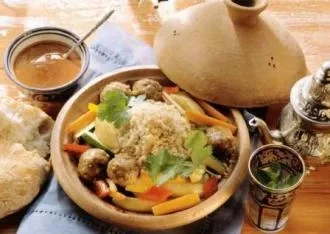
Local residents have adopted much from the French way of life. Such a strong influence of France could not but affect the national cuisine. The fusion of French and Arab traditions makes Tunisian cuisine surprisingly original.
As in all Muslim countries, pork is forbidden here. The variety of meats includes lamb, beef, goat, camel, and poultry. Locals cook almost all meat over high heat. A distinctive feature of the national cuisine is that no oil is used when frying meat. Usually, meat is cooked whole or cut into small pieces to cook on skewers. The exception is kebab – a dish where the meat is thoroughly minced.
Thanks to its geographical location – along the Mediterranean coast – the country is rich in fish and seafood. Tuna is especially popular. It is inexpensive and tasty, so it often serves as the basis for a wide variety of dishes – it is added to soups, salads, and even pastries. In addition to tuna, Tunisian cuisine includes other types of fish, such as sardines, mackerel, eel, mullet, and many others.
Also, for exquisite but expensive delicacies, the meat of octopus and cuttlefish is used. Side dishes for meat or fish are legumes, rice, and vegetables, for the preparation of which they use cast iron and steel pots.
The favorite dish of Tunisians is undoubtedly couscous. This national delicacy has many variations. Depending on the composition, there are chicken, lamb, vegetarian, and others. There is also a festive sweet version of couscous – mesrouf, which includes dates, almonds, and pistachios.
The dish is prepared as follows: finely ground cereal (usually semolina) is processed in a special way, then steamed together with stewed vegetables, meat, or fish.
Harissa can be considered an essential attribute of the table – a spicy paste made from pureed red chili peppers with olive oil. The piquant mixture is usually seasoned with various spices and herbs. This traditional sauce is served as a condiment to almost all dishes, often in a separate bowl, which is necessarily included in a national tableware set, which can be bought at any local market.
Tunisian cuisine has many egg-based dishes. One of the most common is oja. Typically, this dish includes, besides eggs, spicy sausages, various vegetables, and tomato paste or adjika.
Sweets in Tunisia are presented in huge variety. Many of them are made from date molasses. The most delicate dessert assida is especially famous. It is made from milk custard, eggs, nuts, and decorated with pistachios and pine nuts. Also, baklava – a layered pastry with honey and nut filling – and mahroud – a semolina cake with cinnamon, orange zest, and candied fruits – have amazing taste.
Among drinks in Tunisia, coffee with cardamom and mint tea are popular. Alcohol is forbidden by Islam, however, table and dry wines, as well as beer, are produced in the country. Tourists are allowed to drink alcohol, so restaurants have a wide selection of spirits. Among national strong drinks, one can note fig gin called 'boukha' and 'tibarine' – a liqueur infused with dates.
_