
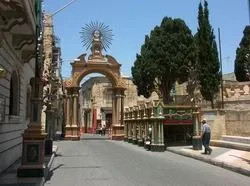
« Oh, Malta, cramped hothouse, where a crowd of warriors throngs!..»
Long before the arrival of Europeans, ancient Phoenicians, Greeks, Romans, Byzantines, and finally Arabs managed to mix here. In 1530, Holy Roman Emperor Charles V gave the island to the Order of the Hospitallers - one of the oldest knightly orders, which has since been referred to as the Maltese Order. Knightly Malta was destined to experience much. There were glorious pages, for example, when in 1565 the Maltese, led by Grand Master Jean de La Valette, withstood a four-month siege and did not surrender to the troops of Sultan Suleiman the Magnificent, who had a sixfold advantage; and there were shameful ones, when foreigners living on the island descended into piracy and the slave trade.
It was not without Napoleon, who on his way to Egypt in 1798 «sailed, saw, and conquered» the impregnable fortress absolutely bloodlessly. Napoleon's own stay on the island lasted only seven days. Nevertheless, even during this time he managed to carry out a number of reforms: he introduced primary education, banned slavery and the Inquisition, and founded the first newspapers. But the French were not destined to write the last page in the history of Malta's conquests.
British rule lasted 150 years - from 1813 to 1964. For more than a century, the island was one of the largest bases of the United Kingdom's navy. It is hard to say whether the Maltese themselves gained from such proximity. One thing can be asserted with certainty: even under the British, their courage was subjected to serious trials. Thus, during the first year and a half of World War II, the island was bombed more than three thousand times. The second «Great Siege» brought great destruction: three-quarters of Valletta lay in ruins. For the heroism displayed, in 1942 King George VI awarded the island the Order of Saint George.
With the closure of the last military base in 1979, the British era did not end. Several thousand Britons still continue to work here. As a legacy from the descendants of William the Conqueror, the Maltese received an administrative system, red telephone boxes and mailboxes, which look more than surprising against the local architecture, time-worn low «pot-bellied» buses, and the English language, which became the second official language here (naturally, after Maltese). It was Shakespeare's language that turned out to be a very substantial revenue item for the state budget.
« Do you remember how it all began?..»
The first English language school, NSTS English Language Institute, in the creation of which the Faculty of Linguistics of the University of Malta played a significant role, opened back in 1963. Currently, NSTS offers a wide range of programs for children and adults; in particular, it is the only center in the country where teachers can obtain the prestigious Cambridge CELTA certificate. But it is unique not so much for its courses as for its infrastructure: only NSTS has its own beach and aquatic center.
The main linguistic boom came in the early 1990s: it was then that language centers began to appear like mushrooms after rain. Today, more than 40 schools have been licensed by the Maltese Ministry of Education; 17 of them, moreover, have united into the professional association Feltom (Federation of English Language Teaching Organisations Malta). In different years, «English hunters» on these islands of prosperity made up from 7% to 10% of the total number of tourists. These figures are growing rapidly: in 1996, 31 thousand people studied English in Malta; seven years later, in 2003, there were already 57 thousand. Such statistics are provided by the president of the Feltom association, John Dimech.
He also notes an increase in interest in local English for special purposes programs in such areas as business, marketing, banking, tourism, medicine, law, and engineering. More and more students are coming for «Academic Year» and «Academic Semester» programs. It is curious that Malta remains predominantly a European linguistic fiefdom: again, depending on the specific year, European students here account for 80-94%. Among them, Germans, Italians, French, and Austrians lead.
The choice of programs, as well as the schools themselves, among which there are both ultramodern objects of glass and concrete and small old (or artificially aged) mansions, staggers the imagination. Most schools are concentrated not in the capital itself but in its suburbs, small towns spread to the east and northeast.
The Maltese have two trump cards in the fight against competitors. First, summer programs for children from 8-10 years old. Sun, sea, English, which is spoken here more slowly than in Great Britain, but with good articulation, genuinely friendly locals. There is no crime; school administrators do not let children out of sight. Paul Fenech, director of Magister Academy, assures, for example, that children coming to his school individually or in closed groups are under supervision 24 hours a day, from the moment they are met at the airport until their departure. Second, English with additional options in the form of diving, sailing, etc. Many schools sign agreements with specialized clubs, so clients have the opportunity to train and learn the language at an equally high professional level. This is how they proceed, for example, at the Linguatime School of English, located on the Sliema waterfront. Unlike, say, Australia, in Malta teenagers are enrolled in «water programs» without any problems. For example, at the English Language Academy, students will be taught sailing and deep diving from age 12-14.
As for accommodation, Malta can offer more than a rich choice of hotels of various classes, youth hostels, campsites, etc. Many schools rent entire hotels for their clients in the summer. Those who are interested in how Maltese people live can be recommended to stay with a family. Unlike most countries where language tourism is developed, here they try to monitor not only the quality of the courses themselves, but also the quality of accommodation and entertainment programs. Thus, until recently, the local Ministry of Tourism was responsible for inspecting all families that host foreign students and issuing them special licenses if the level of service meets the required standards. This year, this responsible mission was entrusted to the Malta Tourism Authority (MTA - Malta Tourism Authority). And of course, many schools offer accommodation in apartments - small one- or two-room apartments or in dormitories.
For those who cannot imagine themselves outside the capital even in summer, we recommend the schools of La Valletta. Most of them are "adult" schools and accept students from 18 years old. A typical representative is Britannia College, a language center with Art Nouveau interiors, located a few minutes' walk from the capital's main pedestrian street. True, in relation to Valletta, the concept of distance somewhat loses its meaning: everything is close by here. Britannia College is one of the few schools nowadays that does not hide its respect for traditional teaching methods and tries to combine them with communicative ones when possible. This school's specialty is general and business English and English for specific purposes. There have been very few Russian students here so far; most of them studied under the Worklife English program, which is designed to help refresh the knowledge of those who have already reached the Intermediate level. There are two unusual programs: "English and the History of Malta" and "The Language of Cinema". The first involves guided tours in the morning and classes in the afternoon. The second is meant to facilitate "entry" into the profession for those who plan to connect their lives with "the most important of the arts": students are to write scripts and master the professional jargon of filmmakers.
"Into the deep grotto he entered at last..."
The island of Gozo, the second largest island of the Maltese archipelago, is a green paradise with numerous lagoons and beaches. Here, as on Malta itself, Phoenicians, Carthaginians, Romans, and Arabs left their mark. Despite its turbulent, eventful past, Gozo is now the embodiment of absolute calm and serenity, which stressed-out capital dwellers lack so much. On Gozo there are ancient megalithic temples built a thousand years earlier than the Egyptian pyramids. There is also a unique natural phenomenon - the Azure Window, which the sea "carved" into the rock over several million years.
But perhaps the most famous attraction of all - the grotto of the "fair-haired and cunning" nymph Calypso, who held the "godlike", "steadfast in troubles" Odysseus captive for seven whole years. The "bright dwelling of the mighty goddess Calypso" from Homer's epic turns out in reality to be a long and very narrow cave, where even one person can hardly turn around, so one can only imagine how the nymph and the messenger of the gods Hermes sat here "on richly decorated chairs" and decided the fate of the king of Ithaca if one has extraordinary imagination.
Gozo is an ideal place for "adult" study; children's and youth camps and schools are completely absent here. The well-known center B.E.L.S. is a most typical phenomenon for this island: a small sand-colored building that gives a deceptive impression of being ancient. No more than 40 people can be accepted here at a time. Among the comforts of civilization are a pool intended exclusively for "internal use" by its students, a terrace, and a small garden. In another local school - International House Malta-Gozo - the similar set is supplemented by several rented apartments located in the school building itself. The main clients of this center are businessmen over 30, coming mainly from Scandinavia. Naturally, they favor business English and English for specific purposes. They study either individually or in small groups of 4-6 people. An original development is English in the hospitality industry.
In general, one can confidently say that Malta can offer something of its own to a person of any age and any temperament. Everyone is good here. Everyone, except rabbits, on which some total hunt has been declared: the poor long-eared creatures are caught, cooked in wine and herbs, and served with garlic sauce. "Rabbit Evening", which is held in many language schools, is an extremely tasty event. If you want to try it, come!