
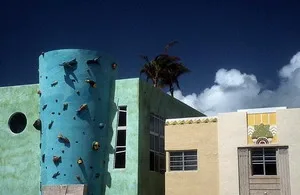
Especially if it is in Florida
It is believed that the real estate market in Florida began to develop actively with the advent of modern air conditioning systems. As Russky Fokus writes, there is undoubtedly some reason in this: during the year the temperature in this dream state does not fall below +15 degrees, rising in the summer months to +35. Discarding all kinds of guesses, let us admit only that Florida, formerly famous for its swamps, crocodiles and sharks, is the state with the most rapidly and steadily growing real estate prices, attracting not only Americans but also wealthy citizens from all over the world.
Since the 70s of the last century, real estate in Florida has gained popularity as a second home, first for wealthy Americans, and then for their “colleagues” from Europe and Latin America. In the early 1990s, this dream state officially sheltered the first Russians as well. Unsurprisingly, over the last 10 years, real estate price growth in this area has been enviably stable, ranging from 8 to 15% per year. Of course, it is not Russians, as in the case of elite real estate in central London, but Americans themselves who play first fiddle in raising prices. The state of Florida creates attractive conditions for both small and large investors by the absence of additional state taxes (investors pay only federal taxes). Thanks to the favorable business opportunities being created and the good geographical location, most of the largest US firms choose the state’s main cities for their head offices. Sociological surveys show that about a thousand people move to Florida every day to live and work here. And this means constant demand for the sale and rental of real estate.
And finally, such a factor as baby boomers. This trend, which began in the 1940s and showed very high birth rates, is important for Florida. The fact is that this generation, which today holds significant power in the American capital market, will soon reach retirement age. And, as the results of sociological studies conducted at the beginning of this century show, 60% of them expressed a desire to spend the final period of their lives in Florida, investing part of their capital in the purchase of real estate.
All this allows American realtors to predict the preservation of the current trend of increasing real estate values at an average level of 8% per annum over the next five to seven years. At the same time, the growth in the cost of apartments in the most popular places today in 2004-2005 could reach 15%.
There are small ones - for 50 thousand. And large ones - for several million
The range of real estate prices in Florida is truly huge. According to Richard Limmer, director of AccountabLes, Inc., one can buy a quite inexpensive little house or a small townhouse for $60-80 thousand. The only question is what quality this real estate is, whether it will generate income in commercial use, and whether you yourself will be satisfied with the purchase.
The cost of the most in-demand real estate - apartments in high-rise buildings with an ocean or bay view - starts from $700 per square meter. As everywhere in the world, the price varies significantly depending on the prestige of the location, view characteristics, floor level, and the number of additional services provided. No less in demand are gated club versions of freestanding residential communities. They offer for sale apartments in condominiums, townhouses, and detached houses in the styles of Patio, Executive Homes, and State Residences. Depending on the location and area, their cost ranges from $150 thousand to $1.5 million. If one tries to somehow rank the prestige of various cities and towns in Florida, Miami and Hollywood will undoubtedly be in first place. They are followed by Fort Lauderdale, Miami Beach, and Palm Beach. Note that all these cities are on the Atlantic Ocean coast. The Gulf of Mexico coast is less prestigious, though it too has its own highlights: Pensacola, Panama City, St. Petersburg. Real estate located in the interior of the peninsula can be conditionally called the least prestigious and the cheapest.
As Henry Hicks, president of TitleMark (Title Insuarance Agency), notes, when conducting a real estate purchase transaction in Florida, the buyer pays the so-called mandatory closing cost, that is, expenses for closing and registering real estate as property. These expenses do not exceed 5% (could be 3.9, 4.1%, etc., depending on the location, the real estate itself, the county, etc.) of the total cost of the real estate. This is a fairly long list indicating where, how much, and for what was paid - payments to various government registration authorities, to the real estate inspection, a fee for determining its legal purity, processing of a mortgage loan, etc.
Real estate taxes in Florida are from 1.5 to 2% per year of the total value of the property. Plus mandatory insurance, the average amount of which is about $50 per month. Moreover, the closer to the water, the higher the insurance amount.
Almost all investors in the USA use the opportunity to purchase real estate with a mortgage loan. According to representatives of Renaissance Lending LLC, which works with banks in Florida on mortgage loans, the only difference when obtaining a mortgage for non-residents is that, unlike Americans, their down payment when purchasing real estate is not 10%, but 30%. For the rest, the conditions are absolutely equal for everyone. Florida banking structures offer about 30 different mortgage programs to choose from. Their choice depends on whether the property is purchased for living, for renting it out, or for participation in an investment project. Interest rates range from 1.25% (the minimum rate subject to certain financial conditions) to 6-7% per annum. Today, the usual rate for a fixed annual rate is 6%, and for commercial investment projects it is 7%. The standard term for which a mortgage is taken is 30 years.
Buying 'off the drawing board'
According to American realtors, today one of the most advantageous options is buying an apartment in 20-40-story high-rise buildings on the coast 'off the drawing board'. By this concept Americans mean the following scheme. Even before construction begins, development companies start selling apartments at a price much lower than the market price in order to prove to financing banks the viability of the project. Unlike in our country, the funds obtained in this way from private investors are not used by builders, but until the construction is completed and the apartments are handed over to ownership, they are kept in a separate escrow account that has a government guarantee.
As a rule, no more than 10-20% of the total number of apartments are sold at 'off the drawing board' prices. Therefore, the announced initial price for various projects lasts at most one or two weeks, and for the most successful project last year, the price was raised after just one day of sales. At the first stage of reserving an apartment, the buyer pays 10% of the cost. The second major increase in prices for apartments in a building under construction occurs after 30-40% of apartments are sold, after which the cost per square meter (more precisely, the square foot, which is more familiar to Americans) gradually increases until the end of construction. By the way, the investor makes a second ten-percent payment only upon completion of the floor on which the reserved apartment is located. The final ten-percent payment is made by the buyer upon completion of construction, and at the same time the closing cost with the registration of ownership rights is paid, which is no more than 5% of the total cost. Note that by this time, according to data for the last two years, apartment prices in buildings under construction rose on average by 20-40% from the initially announced cost.
For the remaining 70% of the apartment's cost, a 30-year mortgage loan is issued, currently at 6% per annum (at a fixed rate). Thus, the main idea is for the investor to be among the first 20% of buyers. In this case, he will be able to purchase an apartment at the lowest possible price. On this, among other things, one can also make good money: many construction companies begin a secondary resale (naturally, in agreement with the investor) of apartments reserved at the first stage after 95% of the total number of real estate properties offered for sale has been sold. In most cases, based on the results of 2002-2003, the investor managed to resell a reserved apartment with a profit of 50% to 90% per annum before it even came into his ownership. Given the average construction period of one and a half years for a residential building in Florida, such a resale begins, as a rule, a year after the start of apartment sales.
On Americans' love of mathematics
However, you can earn money on real estate in the Sunshine State not only through overall price growth. According to Irina Gurko, marketing director of the Florida Investment & Marketing/Russia project, most Americans who buy real estate in Florida as a second home widely use the opportunity to rent it out and get a good income from it. Short-term rental is especially popular, when a house or apartment in a resort town or an apartment in a condo hotel is rented out to vacationers under the management of a certain management company.
For example, in the well-known project 'Fontainebleau' (a condo hotel), property management is carried out by Hilton Management, and for most projects in the resort town of Reunion, by another well-known company: Ginn Hospitality. Naturally, with this option of short-term rental, the owner always has the opportunity to come and relax in their apartment, for which it is only necessary to decide in advance on the dates of arrival and inform the management company. On average, income from renting out real estate in Florida in 2003-2004 is about 15% of its value per year.
You can verify this on the basis of the calculations provided by Hilton Hotel Management for renting out apartments in the condo hotel at Fontainebleau III. At the beginning of 2004, the cost of a one-bedroom apartment with a total area of 526 square feet (about 50 sq m) was $425,000. Thus, to purchase this property, it was necessary to pay 30% of its total cost, which is $127,500. For the remaining 70% ($297,500), a 30-year mortgage loan was issued. According to calculations by representatives of Hilton Hotel Management, the costs of maintaining these apartments amount to $35,629.65. Of this amount, the largest part - $23,740.50 - applies to mortgage payments, taking into account the maximum rate of 7% per annum. The annual property tax (2%) eats up $8,500. The costs of maintaining the property are $3,389.15 per year.
And now the revenue side. Its basis is income from apartment rentals. Based on the average rates existing in 2003 for renting similar premises at $550 per day and an average occupancy of 220 days per year (60.27%, although 70% is considered normal), the apartments can bring in $121,000 per year. Of this, the hotel management company's share is 55% ($66,550), and the investor's share is 45% ($54,450). Now we subtract expenses from income and get a profit (before taxes) of $18,820.35. It looks quite good.
However, as Irina Gurko notes, a similar return can be achieved with a long-term lease option. For example, consider the option of buying a townhouse in the Miami suburbs for $200,000 and leasing it out for three years. To purchase such property, you would need to pay the same 30% of the price, i.e., $60,000, and pay closing costs (preparation of all contracts, notarization, payment of state fees, mortgage application, etc.) of 3% to 5% of the total price (about $6,600). The cost side of maintaining the house will consist of mortgage payments, which will amount to $140,000. At a possible rate of 6% per annum and a 30-year loan term, monthly mortgage payments will be $749 per month. Monthly property tax payments (1.5-2% per year of the total value) will be about $250. Property insurance will take about $50 a month ($600-800 annually). Plus we include $150-200 for unforeseen expenses, such as minor repairs, etc. We get a cost side of about $1,200 per month.
Now for the more pleasant part – income. The average rental rate in Florida is about 1.1% per month of the total value. In our case, that gives us $2,200 a month. Total $1,000 a month, which over three years will amount to $36,000 (excluding taxes). In addition, over three years our property will grow in value to approximately $238,000, based on average forecasts for price growth rates in Florida. That is another $38,000 in income, which together with rental income gives $74,000. Do not forget to subtract from this amount the agency commission for finding a tenant, which is $2,200 (the cost of one month's rent).
Plus the realtors' commission when selling the house after three years (6% of $238,000), which will amount to $14,280. And again 1.5% closing costs – $3,570. We get in total just over $20,000. This makes it possible to expect a profit of $50,000 over three years of operation – with an initial investment of $66,600. Not Moscow, of course, but also not bad. In any case, all these calculations do not depend on whether George W. Bush remains President of the United States for a second term.