
If on a Turkish road you see a car flying significantly faster than the speeds allowed on local highways, if it starts off like Schumacher and enters a steep hairpin turn with squealing tires, ignores turn signals when changing lanes, and so on, know that this is our compatriot. You can pull up next to him at a traffic light, honk, and chat in your native language. And rest assured, he rented the car for the first time. That’s why he’s letting loose. He simply hasn’t yet met the local traffic police, hasn’t felt how expensive gasoline is here, and hasn’t realized how treacherous Turkish roads and the behavior of local road users can be.
But let’s start in order
Actually, the maximum speed in Turkey is 100 km/h. In populated areas, it is forbidden to accelerate faster than 50 km/h, and on motorways - 120 km/h.
But you will accelerate later; first you need to rent a car. There are three main options: contact a rental company at the hotel reception, go to town and pick the first “Car Rental” sign you see, or talk to the guide accompanying your group.
In decent hotels, as a rule, there are well-known rental companies such as Avis, Hertz, Budget, Eurodollar, and Europcar. There, prices for the most modest car (for example, a Fiat Punto 1.1) start at $100. Most likely, they will require a credit card or ask for your passport as a deposit. Of course, everything is reliable and civilized, but it’s just too expensive.
Fly-by-night offices in Turkish towns near the hotel strip offer much better terms: rental there costs about three times less than at the big-name companies. The cars are roughly the same. It seems advantageous. But you can easily be deceived - they might slip you an uninsured car. Then, in the event of an accident, you’ll have to pay in full.
It is impossible to check the availability of a policy: as a rule, the documents signed at the rental office are drawn up only in Turkish. By the way, about insurance: the rules here are simple - do not drive while intoxicated and do not entrust the wheel to persons not listed on the policy (up to five people can be added). If you comply with these simple requirements, everything will be in order. And one more subtle point - avoid renting scooters. These machines are not insured at all, and the prices for their spare parts (above all, body panels) are simply exorbitant. You fall, scratch it, and paying will be very unpleasant.
In normal hotels, every group of vacationers is assigned a guide. As a rule, he is our compatriot or someone from the CIS countries who knows Turkish and has connections in the local infrastructure. Through him, excursions are booked, tables are reserved in restaurants, and so on. He is also always ready to assist with car rental. Undoubtedly, the guide will add his $15-20, but then you’ll have someone to call to account.
About this year’s prices - they have risen
A Toyota Corolla 1.6 of the penultimate model will cost from $50 per day to rent, a Hyundai Accent - the same, a Ford Focus 1.6 and a Renault Symbol - $70-75 each. These are the most common rental options and are quite good in terms of price-quality ratio. And in terms of fuel consumption, these cars are quite normal, which is important - converted into our money, a liter of gasoline in Turkey costs about 7 hryvnias. With economical diesels, there is a problem; it is almost impossible to find one for rent. But there are quite a few fairly fresh small cars, there is plenty to choose from.
If you wish, you can order something cooler. For example, a very southern option - a Renault Megane 2.0 convertible - will cost about $100-120, a BMW 318-320 Cabrio - $140-150, and a BMW Z3 roadster - under $200. True, mostly all cool cars are beaten to death - they are taken specifically to “floor it”.
So, you chose a car, signed the papers, paid at the cashier, got the keys and documents. Now let’s go for a drive. But let’s agree right away - don’t race. First, gas is expensive, and aggressive driving consumes a lot even in a small car. Second, speeding fines in Turkey are considerable. For example, the author of these lines was fined 170 million liras ($120) for some extra 34 km/h. And I note, I was still lucky. The Turkish traffic cops were meeting their quota and did not try to extort money on the spot - they handed me a receipt that had to be shown at the rental office. Too bad I lost it. And there is no unified database of traffic violators in this country; this isn’t Europe.
Dishonest enforcers of the law on the roads are also found in Turkey; they may, under the threat of confiscating your license, start demanding baksheesh. You need to bargain, earnestly bargain, like at the market over a product from the local garment industry. Market traders also don’t give in right away, but they do, and quite reasonably - they’ll knock off half the price, or even more. It’s the same with these. The main thing is not to lose your temper and calmly hold your ground. Haggling is appropriate here!
Interestingly, in this country, seemingly completely useless IDs of ours work like a charm. On the road to Pamukkale, right after the police report was drawn up, a white Ford Focus overtook me and went, went... I got on his tail and barely held on, even though our cars were the same - 120, 130, 150! And what about the police?! At the gas station we started talking - the guy turned out to be from Moscow. It turned out that against the local “traffic cops”, my compatriot has a membership card of the “Russian Foundation for Friendship with Interpol”, with the word “Interpol” on the little red card printed in very large gold letters, in English. And it works: the Turks even salute him! It’s a laugh, that’s all.
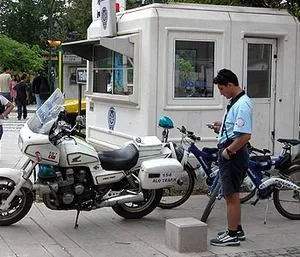
Very often the police mark the place where they stand with a radar using cone-shaped markers placed along the dividing line. With good eyesight and a more or less straight road, they can be seen from afar, so you can manage to slow down. But ambushes in the bushes are also practiced, in our style, so beware. And on motorways (they are toll - 2 million lira entry-exit, but you can give $1 and they'll let you through) there are automatic speed cameras here and there - when you exit through the turnstiles, that's where they'll "get" you. But these speed cameras, it seems to me, are only placed behind electronic signs warning that you shouldn't speed. In any case, following this rule, I always managed to avoid being charged at the motorway exit.
If you are not at all afraid for your wallet, then speed limit signs can be ignored. But only on flat terrain. In the mountains you should be extremely careful - better to keep an eye on them and, noticing one, at least reduce speed a bit. If there's an overtaking ban warning on a mountain road, you must not attempt to overtake under any circumstances - you'll fly down very far. The same can be said about signs for steep ascents or descents - better to shift down in advance, to second or even first gear. Don't forget that in the thin mountain air, where there is little oxygen, the engine runs much worse, so it's easy to stall on a steep climb.
For the most part, roads in Turkey's tourist regions are good. Signs, turn indicators, markings, guardrails, and reflector posts - driving is pleasant. What it's like in the hinterland, closer to Iraq, I don't know - I haven't been there, didn't have the desire. Motorways are generally Euro-standard. But you can even come across a "road of death" in a resort area. For instance, if you drive west from Kemer along the coast, the road runs along the very edge of the sea, over a cliff ranging from 10 to 100 meters high, and there is no shoulder by definition - you err by 20-30 cm and you fly off the cliff straight onto the coastal rocks. There are no guardrails or even road boundary markers there.
It should be noted that Turks are constantly improving their roads; construction works are carried out everywhere. In a year or two, one will be able to forget about such horrors. But for now, you need to be extremely careful. Yes, and some information for vacationers: every day from 13:00 to 15:00 the road from Antalya to Kemer is closed - they are widening the roadbed and carrying out serious blasting works. Traffic jams are terrible, so add another one and a half to two hours to the forbidden interval for sitting in a traffic jam.
A little about local drivers
Turks drive very slowly by our standards (fines are big, and the country is generally poor). At the same time, they violate traffic rules at every turn, especially in the provinces. Their principle is: I drive however I want. Tractor drivers are especially dangerous - at night they come out onto highways and leisurely stroll from the fields, and they have no lights at all. In second place are motorcycle riders and other two-wheeled vehicles - here you can recall a typical Russian village, and everything becomes clear. Taxi drivers, meanwhile, differ from everyone else by their absolute recklessness; they are confident they will get out of any situation, even a head-on collision. Most often they really do manage. In general, you need to be extremely attentive.
I hope I have convinced you that on vacation it's best to relax and, if you can't lie on the beach, move along Turkish roads sedately. First, you have a home waiting for you, and second, why ruin your vacation - we already spend too many nerves on our own roads.