
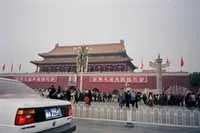
When you arrive in Beijing and go to the mausoleum of Grandpa Mao, you realize that the Chinese have acted and continue to act more thoughtfully than anyone else regarding their national mummy. As Novye Izvestia notes, they approached this delicate issue with extreme practicality. If they spent a lot of money, built a giant tomb, and subjected the Great Helmsman to this “execution,” then this entire undertaking must work, not just decorate the center of the Celestial Empire’s capital with its pompous appearance.
Supermarket at the Cemetery
The “House of Memory of Chairman Mao,” as Mao Zedong’s mausoleum is called in China, is visible from any point of the world’s largest square, Tiananmen. Compared to it, the mausoleum on Red Square in Moscow is “child’s play.” The monumental building looks more like a Palace of Congresses than a person’s tomb. The radiant face of the chairman himself proudly gazes at his own grave from a large portrait hung above the entrance to the former Forbidden Imperial City, now the Gugong Museum. It was from these gates that Mao Zedong proclaimed the founding of the People’s Republic of China on October 1, 1949.
There is a lot of red here – huge flags waving in the wind, numerous red neckerchiefs of Chinese Young Pioneers. They, just as we once were in our Soviet childhood, are still brought here in formation and with songs to look at Grandpa Mao. To get into the mausoleum, we join an hour-long queue of admirers, many of whom have come from different corners of China. There are also many foreign tourists patiently shifting from one foot to the other. The queue moves very slowly. The process is slowed down by the sale of artificial flowers, which every self-respecting Chinese must buy before entering the mausoleum. Calling it a bouquet is, of course, an overstatement. The fact is that these flowers are far from disposable. After Chinese visitors lay them at the body, other Chinese collect these same little bouquets and return them on a special cart to the flower stall in front of the mausoleum. From constant and prolonged use, these flower arrangements have long since faded. But business is thriving.
Finally, after a thorough search and frisk, we enter a spacious hall where a white marble statue of the Chairman towers. Then the human flow splits into two parts. Through narrow passages, where one has to walk single file, people enter the burial chamber. The mummified Mao lies in an elegant crystal coffin, covered with the red party banner. Chinese experts emphasize the uniqueness of the methods of preserving Mao Zedong’s body, which allegedly have no analogues in the world. The essence of the Chinese method is a state secret; it is only known that a “gaseous and liquid medium” is used simultaneously. Chinese scientists assure that thanks to this method their Mao will forever be as if alive. No one lingers by the body; the human flow briskly moves to another room.
It turns out that in the hall adjacent to the burial chamber there is a kind of supermarket. On the numerous display cases there is everything you can imagine – badges, lighters, watches, mugs, bronze figurines, cufflinks, and even women’s earrings. All these little things bear the image of Mao. Trade is brisk. The saleswomen cannot catch their breath – everything is being swept off the counters. And new goods keep being brought and brought.
Mao’s Shadow
To say that in China “Mao is now more alive than all the living” is to say nothing. Despite the fact that, having become chairman of the government of the People’s Republic of China, he experimented to his heart’s content on millions of living people, and it would seem he should be hated. The “Struggle for Restoration,” then the “Great Leap,” the “Cultural Revolution” – all these “amusements” of Mao cost China 60 million lives. Back in the 70s, all universities were closed throughout the country as unnecessary, and almost the entire intelligentsia was sent to remote places for “re-education” through physical labor. However, no one has debunked the cult of Grandpa Mao and does not intend to.
Mao Zedong died on the night of September 9, 1976. Deng Xiaoping, who turned out to be Mao’s only surviving opponent and had himself served time in places not so remote, quietly turned the “Great Helmsman’s” course 180 degrees and led the country to “capitalism with a communist face.” Deng turned out to be clever and did not throw mud at the image of their beloved leader in the eyes of the Chinese. He did as Mao himself liked to say: “The people do not approve of the annulment of verdicts and the revision of the past.” The cunning Xiaoping set forth the official point of view, according to which Mao was 70% right and only 30% wrong. Today in Beijing they still believe that spiritual history and ideas unite the people into a single nation. And the denial of certain periods of history is dangerous for the prosperity of the state. Therefore, an official debunking of the cult of Mao’s personality in the Celestial Empire is hardly possible. And is it even necessary?
Despite the fact that the egalitarian social system created by Mao in the PRC has already been dismantled during the reforms, as a result of which the leader’s legacy has been reduced to the idea of building a mighty and independent China capable of resisting enemies, and despite the powerful economic leap and the development of private business, Mao Zedong’s mausoleum still remains the main national shrine of China. No one has thought or is thinking of burying Mao’s body. Therefore, there can be no doubt: the nationwide love for Mao Zedong will be long.
“The veneration of Mao at the official level is the ruling party’s desire to justify all its past,” believes Yuri Galenovich, chief researcher at the Institute of Far Eastern Studies of the Russian Academy of Sciences. “So that the ‘shadow of Mao Zedong’ does not rise from below as a new banner of social protest, the Chinese authorities are trying to use Mao’s legacy for their own purposes.” Chinese economists, in turn, claim that during the transition to a market economy in China, the Mao Zedong brand continued to work for the might of China. And that this was the plan. Therefore, today the image of Mao in modern China is not only a fetish or an icon, but also an excellent way to make money.
Mao in Rap Style
"Moscow?" - the taxi driver rejoices, a young good-natured Chinese man who pulls his old Audi up next to us. And as soon as we set off, he starts singing. First he launches into "Katusha." The Chinese version of the song sounds unusual and very funny. Then follows an endless stream: "And the battle continues again," "Rise up, bonfires, blue nights," "Eaglet," and "Moscow Nights." He sings for about forty minutes while driving us from Beijing airport to the hotel. He sings alone, without musical accompaniment. And finally he says he adores Soviet songs and knows a great many by heart.
The Chinese Communist Party never stopped thinking about how to maintain the people's "degree of infatuation" with Chairman Mao. With the old people who lived through Mao's rule, everything is clear anyway. Those who did not perish in the camps or were not shot are his lifelong "adherents" anyway. They say dissidents were wiped out completely back then. But something had to be done with the youth who did not live under Mao. The Chinese helmsmen racked their brains over this for a long time. But one day, at one of the party congresses, a brilliant plan was born. Unexpectedly, one of the most creative people recalled that during his lifetime, Chairman Mao loved to sing terribly. And he sang mainly Soviet and patriotic songs. Just the kind the party with a communist orientation needed.
And so two years ago, for the 110th anniversary of the great leader in China, a disc "Red Sun" was released with new arrangements of Mao's songs. And they are all in rap style. The youth of the Celestial Empire squealed with delight. After this album, compact discs with recordings of red-banner songs began to appear on the country's music market like mushrooms after rain. And recently a new hit appeared in China - a collection called "Mao Zedong and Us." As a result, all of China has "got hooked" on Russian songs of the Soviet years.
Books about the leader - bestsellers
"In childhood, Chairman Mao Zedong went to a rural school," our translator Heha, whose name means "holiday," translates for us a colorful children's book about Mao. It is a glossy book with pictures in which a little narrow-eyed Chinese boy can be recognized as the future great leader. "Every morning, Chairman Mao Zedong's mother prepared breakfast, which Mao took to school and ate there during recess. One day during recess, the chairman noticed that his deskmate was not eating anything. Then Mao asked the boy why he did not have breakfast. The boy replied that his mother was too poor to give him breakfast to take to school. Hearing this, Chairman Mao Zedong broke his breakfast in half and gave half to the boy, who ate it with tears of gratitude."
In the PRC, the upbringing of youth is still carried out under the sensitive guidance of the Komsomol. Such books for the little ones are sold in market stalls along with juice and ice cream in the Chinese "Disneyland," which Western businessmen, because of its ideological bias, call "Mickey Mao." The construction of the park was sponsored by the Communist Youth League. And now it not only makes money from the park but can also calmly report to senior comrades in the Communist Party that the grandchildren of Chairman Mao know from infancy how great their Leader and Grandfather was.
In bookstores, entire sections are devoted exclusively to books by Mao and about Mao. The cover of one of the new releases is adorned with a flashy advertisement: "Without understanding Mao Zedong, one cannot understand 20th-century China." An undisputed bestseller is "My Grandfather Mao Zedong," written, of course, by his grandson. There are, of course, other masterpieces, such as "Mao Zedong on Forestry" and "Mao Zedong's Articles on Glorifying and Shaping the National Spirit."
Like most tyrants, Mao wrote poetry - about storms, about fierce struggle, about the immortality of heroes. In struggle he saw the meaning of life, and people were for him only allies or opponents. His famous saying is known: "The people are a blank sheet of paper on which any hieroglyphs can be written." The large-scale reproduction of Mao's calligraphy and poetry makes him more and more like the wise and artistically gifted Chinese emperors of the past. And, perhaps, very soon it will be difficult to tell the difference. Collections of his poems and thoughts are very popular - nothing sits on the shelves.
The Sharp Taste of Revolution
The elite and expensive club "Red Capital" in Beijing is decorated in the style of the early years of the revolution. Here, in a place of honor, telephone sets that once belonged to the chairman are displayed for all to see. Anyone can pick up the receiver and hear the leader's voice. The restaurant's signature dish is tofu meatballs with shrimp and mushrooms in a very spicy sauce with vegetables. This was Mao Zedong's favorite dish. The menu has an epigraph, a famous saying of Mao: "He who does not like spicy food cannot be a true revolutionary!" The club's most popular offering is a 50-minute ride in a "Red Flag" car.
This car - a copy of the Soviet government "ZILs" of the 1950s - belonged to Mao's wife Jiang Qing. The cost of the ride is $230. Despite such a considerable price for the service, demand far exceeds supply. And in general, every self-respecting Chinese person trades in trinkets associated with Mao's name. The best place to buy souvenirs from the "Cultural Revolution" - figurines of repentant "enemies of the people," watches with Mao's image, and, of course, the red quotation book of Mao - is the Panjiayuan antique market.
A Mao quotation book costs pennies. They will practically give it to you as "change." And this is not surprising: the bestseller of all times and peoples was published in the 60s in various languages with a print run of 5 billion copies. There are also Russian-language versions. You open it, read, and your soul sings: "Commoners are the smartest, aristocrats are the stupidest," "The intelligentsia is the most ignorant part of society," "The more you read, the less you know."
Posters in the best style of socialist realist victories, green caps with a red star - everything is here. You can even buy glasses taken by the Red Guards - the "hongweibins" - from intellectuals: "you won't need them anymore." Elderly people trade in this wealth. It is clear that Mao's regime rolled over them and their families with its steamroller. And today it brings income.
"Mao" means "cat" in Chinese. They say the Chairman really resembled a big, important, and cunning cat. He could be soft and courteous, easily charmed people and just as easily subjugated their will. After that, they put up with any whims and nitpicking that the leader was a master of. Today, the image of the leader-cat is widely used by craftsmen who came up with a new souvenir - a cat figurine with Mao's head.
Dragon in the Fog
While the Chinese use their Mao to the fullest, disputes in Russia over what to do with the Mausoleum do not subside. Should Ilyich's body be buried or should his stay be extended in a transparent sarcophagus, which is very reminiscent of the "Behind the Glass" show? The fact is obvious that in the near future the Kremlin will not agree to the removal of the body - such a radical step threatens electoral losses. Moreover, at the slightest provocation, communists begin to riot and announce across the country demonstrative fundraising from pensioners for the maintenance of their favorite mummy.
Disputes continue over who, after all, should finance the maintenance of V. I. Lenin's body in the Mausoleum. On the one hand, the Mausoleum is on the balance sheet of the Federal Protective Service of the Russian Federation. This means that funds for its maintenance are annually provided for in the federal budget. On the other hand, biomedical work is financed by the independent charitable foundation "Mausoleum of V. I. Lenin," which receives money from ordinary people and public organizations. This foundation has existed since 1992, when scientists of the so-called mausoleum group were deprived of state subsidies.
"I don't understand why our state does not want to fully take the Mausoleum under its maintenance," says Doctor of Historical Sciences, chairman of the charitable foundation "Mausoleum of V. I. Lenin" Alexei Abramov. "Lenin is our history. For the 60th anniversary of the Victory, an order was issued depicting the Mausoleum of Lenin. The Victory Parade will take place on Red Square. And all the banners will be from wartime - with the image of Lenin. So we, partially, accept our history. We need to accept it fully. Then our country will have a future."
By the way, a similar opinion is held in China. Reflecting on Russia, on the future and past of their "big brother," Chinese economists say that during perestroika, Russia began to do the right things, but from the wrong end. "You took and changed the political system, while in our country we undertook the modernization of the economy, leaving the political system as is," says Doctor of Social Sciences, employee of the Institute of Eastern Europe, Russia and Central Asia (China) Xu Wenhong. "We left the people their ideals, because doubt is the worm that gnaws at the state system from within. And then you can carry out any, even the boldest reforms."
"Dragon in the Fog" is what this specific Chinese style of governance is called. Its meaning: subordinates should not understand where and where the Dragon is moving and who it might attack in the next second. Perhaps we simply cannot understand this? After all, in our country, only hedgehogs walk in the fog.