
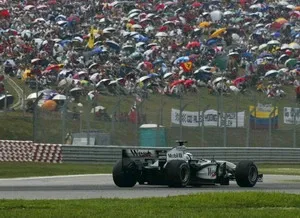
In Monza, a suburb of Milan, motorsport holds a special place. And this is not surprising, given that it is here that the home circuit of the Italian team Ferrari is located.
Everything is just beginning
Friday, the first day of the Formula Grand Prix, is meant for getting acquainted: teams with the track, fans with the circuit. It is time to think about special earplugs that muffle the “music” of engines. You can buy them at the beginning of the long alley leading to the main entrance of the circuit, where souvenir stalls with all sorts of Formula merchandise are located.
You also need to think about tickets. True, only the most naive can hope to buy them at the circuit's ticket offices; they are sold out within a couple of days of going on sale. Before the start of the Grand Prix, only general admission tickets remain at the ticket offices – tickets that give access only to the circuit grounds, but not to the stands. Scalpers are the last hope for people dreaming of a good spot from which to see the most interesting action. From them, you can always buy a ticket to any stand you like at a price one and a half to two times the official rate, and even VIP invitations to the Paddock Club, which are not sold anywhere – a special place intended for honored guests and sponsors. The tickets themselves also come in two types: a season pass for the whole weekend and single-day tickets. For example, only for the race or qualifying. Officially, the most expensive pass for the central stand costs 500 euros, and the cheapest – 100. The price of a general admission ticket only for race day is 55 euros.
On Friday, when it is not yet so crowded, the entrance ticket gives access to any stand, and fans have the opportunity to watch practice sessions of Formula One drivers and qualifying runs of the junior Formula 3000 from spectator seats located right opposite the pit garages. The teams are running their cars around the circuit, cleaning it of dust and dirt.
Battle for pole position
Saturday is perhaps the most eventful day of the racing weekend. The ranks of fans have significantly swelled. The stands are simply blazing with the red colors of the Ferrari team. Veteran fans, who travel from circuit to circuit and have experienced all the ups and downs with their beloved team, sport rare official T-shirts and baseball caps from twenty years ago.
The main event of the day is qualifying, which determines the starting grid for tomorrow's race. Above all, fans are waiting for Michael Schumacher, the six-time champion and living legend of Formula One.
After qualifying comes the traditional Formula 3000 race, but serious people are not interested in it. They hurry to the team headquarters tents, where press conferences of drivers and top managers begin. Politely answering the host's questions, the racers begin signing autographs.
Saturday evening is the most wonderful time of the weekend. The little town of Monza is packed to the brim with fans. The locals are simply nowhere to be seen on the streets. Probably, they are sitting at home waiting for this mayhem to end. At the cafe tables, there is an atmosphere of a big sports festival. It is even more fun in the comfortable campsites set up next to the circuit, with showers, toilets, first-aid posts, and fast-food outlets open around the clock. Here, life is unlike anything else, full of new acquaintances and entertainment. A bottle of wine costs five euros, a pizza – three. But the situation with campsite spots is the same as with tickets to the circuit – all have been sold out months before the race.
Those who did not get spots in campsites or hotels bed down for the night right on the forest clearings inside the circuit. Tent cities spring up before your eyes. The people in them, as a rule, are seasoned, settle in with all conveniences – fry sausages over campfires and dance until morning. Sophisticated fans “without a spot” book in advance the most spectacular areas along the track, pitching tents and building high platforms from whatever materials are at hand, from which they will watch the race. Some settle for the night on the primitive free stands inside the circuit, which stretch from the Lesmo corner, run along the Ascari straight, and end at the Parabolica corner.
The winner takes all
On Sunday, a red river flows toward the circuit entrance. Somewhere halfway, the Italians, blocking the road, stamp Ferrari marks right on the faces of everyone passing by. It is a bit intrusive, but no one takes offense. Especially since those who support Williams, McLaren, or Jaguar are right there painted in their native white-blue, silver, or green colors.
Already two hours before the start of the races, the stands are packed. In the intervals between the old car races, a demonstration air show, and the parade of drivers, who are driven around the track in open cars, there is time to look around and get acquainted with the neighbors. The Dutch can be immediately recognized by the sweetish smell of marijuana spreading around them. And our own – by the flags and the powerful choir performing “They Won’t Catch Us!”. But the Germans set themselves up most sensibly: a case of beer, folding chairs, and a bunch of hamburgers. A TV on the case, and headphones on their heads.
Start! The explosion of emotions is like a nuclear explosion. Twenty deafeningly roaring cars try to squeeze through the eye of a needle at the first corner at the same time. For the first while, while the cars run closely packed, even earplugs do not save you from the noise. But later, when the multi-colored field stretches out, the approach of a Ferrari can be determined with closed eyes by the reaction of the stands. The sea of people erupts – a red dot appears in the distance, like a comet flying over the gray asphalt. At tremendous speed, the car races past, and then in the distance, at the end of the straight, sounds like rapid explosions are heard, and flashes of flame sparkle. It is the driver, braking, downshifting, entering the corner, and disappearing just as swiftly as he appeared.
Finish! The police cordon instantly disappears somewhere, and fans rush to the net separating the track from the stands. It is impossible to resist this surge from the spectators. The net is cut in dozens of places at once, and people begin to be literally sucked into the resulting holes. Those standing behind pull the wire back, letting those in front crawl through, then they climb through themselves, passing the torn ends from hand to hand like a relay. The race is over, but the celebration continues, and no one is in a hurry to leave. Everyone is friends, everyone is brothers, and everyone seems to have gone mad. But each in their own way. Some, kneeling down, start kissing the hot asphalt of the circuit. Others rush to the accident sites to get hold of carbon shards from the crashed cars. Still others, clutching cameras to their chests and waving flags, head for the podium. And, chanting the winner's name, they begin to jump in time with their own shouts. Even if you don't want to jump, you have to anyway - people are packed so tightly. On the podium, the race winners generously douse each other and the spectators below with champagne. Fans caught in the champagne rain are doubly happy. Their stain-covered T-shirts will take pride of place in home museums.