
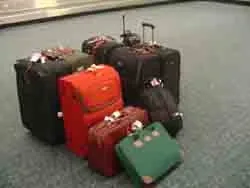
You can talk as much as you like about how normal people don't check valuable items in their baggage – it will sound silly. Because one's own travel bag or suitcase is valued regardless of what is inside. All that remains is to do everything possible to ensure that when checking in your suitcase, you are not saying goodbye to it forever, but only for a while: make a list of items in advance in case the luggage needs to be identified, and later, to assess its value, recommend the newspaper "Novye Izvestia". To help a lost suitcase find its way back to you faster, it makes sense to attach a tag to it with your name, city, country, and contact phone number (preferably in Latin script). (But it is better to omit your home address: as experts say, there have been cases when this information was passed on by dishonest baggage service employees to individuals specializing in apartment burglaries.)
The Law of Compensation
Most often, baggage is not lost in the full sense of the word, but simply disappears from view for a while, having been mistakenly sent somewhere it shouldn't be. The search process for such incidents has long been regulated by both international legislation and the airlines' own rules. If your bag is not found, go to the Lost&Found counter. Most airports around the world are linked by a global baggage search system. According to the law, the airline is liable for damage caused by destruction, loss, or damage to baggage only if it occurred on board the aircraft or while the checked baggage was in the custody of the air carrier. As soon as the bag is removed from the conveyor belt, the carrier ceases to be responsible for it. If the baggage is not found within the time limit (21 days for domestic flights and 90 days for international flights), the airline is obliged to compensate for the damage. The amounts of compensation and the procedures for calculating them vary among airlines. For example, most airlines put a loss at $20 per kilogram.
Most Western airlines have long established a rule: if a passenger arriving away from home does not find his suitcase on the baggage carousel, he has the right to make purchases at the airport's shops at the airline's expense for a certain amount – which can reach several hundred euros. You can buy cosmetics, clothing. In addition, the airline is obliged to provide the passenger left without belongings with essential items upon request – medicines, for example. However, you should demand within reasonable limits: you won't be able to get a bicycle or a gold cigarette case as an item you urgently needed. If your baggage is eventually found and you have already made purchases, you will still be compensated for their cost. The only exception is clothing: you can either return it to the airline or receive half its value.
They Will Answer for Everything
Not as often, but it still happens that a suitcase or its contents are damaged – during transportation, the baggage could have opened, broken, spilled, or become stained. In this case, file a complaint with the baggage delivery department – that is where they investigate who is at fault. If it is established that the damage occurred en route, further proceedings with the airline will follow. In the case of visible damage inflicted during ground transportation, the airport will pay compensation. However, it should be noted: a passenger can receive compensation only if it is proven that the damage was not caused by circumstances that could have been foreseen or avoided. Perhaps you yourself closed your bag poorly or risked wrapping a jar of jam in an evening dress.
But all these are contentious issues; most often the fault is still split fifty-fifty between the passenger and the carrier. A reputable airline will not be petty and will certainly compensate for the damage. There is a known case where passengers who lost a suitcase were not only later returned their luggage, but also given the opportunity to buy a new one worth up to €200 (the old one turned out to be slightly damaged). In addition, they were paid monetary compensation for train tickets which they missed because of the commotion at the airport.
If Thieves Are Involved
Let's say you were delayed somewhere on your way to the baggage claim area, or simply fell into a reverie before the monotonously moving conveyor belt, not noticing your own suitcase, as a result of which someone else got ahead of you – simply snatched your item from the belt. In this case, you should go to the claims department (baggage theft reports are accepted at every airport). The process resembles drawing up a police report – what disappeared, where, when, and under what circumstances.
Abroad, the simplest thing is to immediately contact the airline with which you flew. Although in this case it bears no responsibility, they will help you get in touch with the police, for example.
When No One Is to Blame
In principle, only one measure gives a 100% guarantee of protection against possible material losses – baggage insurance. Moreover, there is a chance to gain a double benefit in the end: if the baggage disappeared through the airline's fault, then in addition to the insurance indemnity (up to $2,000), the passenger will also receive compensation from the carrier. But the benefit of insurance is especially appreciable in case of unusual circumstances in which the carrier is released from liability.
Force majeure in the world of air transportation is, unfortunately, a common occurrence: sometimes the weather lets you down, sometimes the technology (for example, there are known cases when during a thunderstorm there were glitches in the computer system, leading to the mass misdirection of baggage), sometimes a strike at the airport occurs. In all such cases – from a banal theft to natural disasters – one can only appeal to the insurer.