
Compared to last year, the number of foreign participants in MITT increased by 18%.
On the first day the exhibition was lively, noisy, and crowded. Excited by the spring sunshine and the mass of familiar faces around, tourism professionals scurried from pavilion to pavilion, ignoring no one. Everyone was in high spirits - unlike last year, when the war in Iraq, which began on the eve of the exhibition and was compounded by the atypical pneumonia in Asia, forced market participants to keep quiet about their plans and to grin nervously at the word "tourism." This time, agents vigorously stormed the stands of major operators, and breathless managers barely had time to hand out advertising brochures and price lists for summer programs. Behind the stands of national representations, future partners were toasting their first deals. The stream of professionals did not ebb until Friday, when the exhibition was given over to the consumers to plunder.
MITT, held in Moscow for the 11th time, is the largest in Russia and the third largest tourist trade fair in the world, after London's WTM and Berlin's ITB. The Moscow exhibition occupies an area of 36 thousand sq. m. This time it was attended by 2.7 thousand companies - the best travel agencies of Moscow, Russian regions, and more than 110 countries worldwide. Compared to last year, the number of foreign participants in MITT increased by 18%, and Russian by 12%. First-time participants in 2004 were national tourism organizations from Slovakia, Norway, Tanzania, Syria, and Lebanon.
According to the Russian Ministry of Economic Development, tourism now occupies 3% of the country's consumer market. Apparently, that is why the Russian authorities decided to demonstrate to the tourism industry their serious attitude toward it. For example, Boris Gryzlov, Chairman of the State Duma, first sent his greetings to the exhibition, and then appeared at the opening. Industry leaders spoke beautifully about the importance of tourism to the Russian economy and placed special emphasis on the need to develop Russian resorts in particular. Moreover, according to Natela Shengelia, head of the tourism department of the Ministry of Economic Development, 30 million Russians are already vacationing at home.
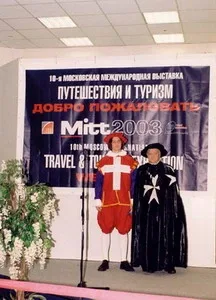
To emphasize its chosen orientation, the exhibition organizers gave the Russian exposition an entire two-level pavilion. It included regional stands, hotels with sanatoriums, an exposition of investment projects of the Russian hospitality industry, and the travel agencies themselves. And not only those that sell the native expanses to foreigners and compatriots. Some large companies focused exclusively on outbound tourism also settled in the Russian pavilion - apparently out of a sense of hidden patriotism. Agents accustomed to the local arrangement of countries and destinations found them with some difficulty. And they had to dress their own employees in Arab burnouses and Indian turbans, whose distinctly Slavic faces completely killed the entire Eastern flavor.
The other MITT pavilions were also divided along national lines, giving one to Europeans and another to Asia, Africa, the East, and exotic islands. The Eastern part of the exhibition, as always, turned out to be the most colorful and whimsical: the Thai representation built a pagoda on its stand, the Arab Emirates - something abstractly glassy, the Egyptian stand was crowned by a traditional sphinx, and the Chinese did not do without lanterns and incense.
Travel companies will only begin to receive profits from deals concluded at the exhibition at the beginning of the summer season. But the Expo Center's restaurants and cafes are celebrating victory right now. Their prices frightened even seasoned Muscovites. "$5 for a cheese sandwich and a thimble of coffee! And they still tell us that everything is expensive in Cyprus!" - people in line for food grumbled. But hungry agents had nowhere to go.