
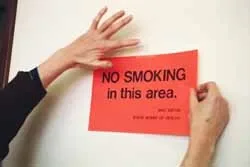
Everyone fights smoking in their own way
Anti-tobacco companies in the world
In the USA, every state fights smoking in its own way. In New York State, for example, smoking is prohibited in enclosed public places and official vehicles. The fine for violation is $1.000.
In Russia, smoking is prohibited in educational and medical institutions, public transport, and stadiums. It is forbidden to film smokers for advertisements and to advertise tobacco products on television. The sale of cigarettes to minors is also prohibited.
In Italy, the fine for smoking in public places ranges from 250 to €2.000.
In the Himalayan kingdom of Bhutan, tobacco has been outlawed. A fine of $225 has been introduced for selling cigarettes. At the same time, the average salary in the country is $16.
A nationwide campaign in Sweden, called "Non-Smoking Generation", affected everyone born after 1975. If a Swedish student studies in Norwegian Oslo or Danish Copenhagen and wants to receive a scholarship, he must quit smoking, as decided by the foundation that distributes scholarships.
In Denmark, 75% of workers have declared smoke-free zones in the workplace.
In Germany, an amendment was made to the insurance law: a non-smoker's contribution is 40% less, since it costs less for medicine. It is known that in Germany time is allotted for smoke breaks. But the time of those who voluntarily gave up smoking is summed up and added to vacation.
In the UK, since summer this year, smoking is banned in all pubs, restaurants, clubs, and most organizations. Smoking is allowed only in private apartments, prisons, and hotel rooms. The fine for violation can reach 2.500 pounds.
In Belgium, a law banning smoking in most enclosed public places has been signed. For violation - a fine of $480.
In the Netherlands, all citizens aged 12 to 16 who, after special tests, prove that they do not smoke, will be paid $200 monthly.
In Finland, a law has been adopted according to which smoking is allowed only outdoors. The 'Anti-Smoking Month' was invented by the Finns.
In Spain, the sale of tobacco products is prohibited in medical institutions and educational institutions. Smoking is prohibited in public transport, in premises where pregnant women work, in administrative buildings, in food production workshops, in reading and exhibition halls, in elevators, in theaters, cinemas, and enclosed sports facilities.
In Poland, smoking was banned in public places, and machines selling cigarettes to any teenager were removed from the streets.
In Hungary, a fine of $125 is charged for smoking in the wrong place, and up to $420 for violating sales rules.
In Canada, smoking is not allowed in all government institutions; smokers are forbidden to appear with a cigarette at work, in airports, and at railway stations. Ashtrays have disappeared from bars and restaurants. Tobacco companies are not allowed to sponsor sporting events.
In Singapore, smoking is prohibited in elevators, buses, subways, trains, hospitals and clinics, cinemas, and restaurants. Cigarette advertising is not allowed in the country, and a high tax has been established. The warning 'Smoking is prohibited - fine $500' has become the norm.
In Osaka (Japan), a company pays bonuses to non-smokers. Employees who have lasted six months without tobacco receive $190.
In Malaysia, the state provides a preferential loan to those who have quit smoking.
In Turkey, in one small village, adults are forbidden to smoke so as not to set a bad example for the younger generation. A violator of the village decree gives a bag of sugar or a bag of flour to the poor. In Turkey, there is a museum where recipes of people who have quit smoking are collected.
Tobacco companies: loss after loss
The anti-tobacco campaign that has unfolded around the world has led to numerous lawsuits by former smokers against tobacco companies. Smokers and their relatives file thousands of claims for multi-million-dollar compensation. The fight of anti-smoking opponents against powerful tobacco companies lasted more than a century and began to bear fruit only relatively recently, when irrefutable evidence was obtained that smoking actually kills.
The most powerful anti-tobacco movement and the harshest laws against smoking are in the USA. For the first time, in 1954, American Eva Cooper accused R.J. Reynolds Tobacco of involvement in the death of her husband, a consumer of Camel cigarettes. But the court found no evidence in the case that Cooper's illness was caused by smoking. After that, the position of tobacco companies remained unshakable for decades.
And only in 1988, the Federal jury in Newark found the cigarette manufacturers Liggett Group partially guilty in the death of Rose Cipollone from lung cancer. The company paid more than $400 thousand to the husband of the deceased, who on the eve of her death stated in writing that she believed the company's advertising claiming that its cigarettes were not dangerous to health. Thus, the first case of compensation for health damage from smoking was registered.
In September 1996, one of the largest lawsuits in history against a tobacco company on charges of health loss was won. The court of Jacksonville (California) ruled that Brown & Williamson Tobacco Corp. (brand Lucky Strike) must pay $750 thousand to the relatives of a man who died five years earlier from lung cancer.
So began a new era, marked by an avalanche of lawsuits. In addition to private individuals, entire state administrations are filing suits. They demand reimbursement of their expenses for treating victims of smoking-related diseases. Defending claims against large companies for real or alleged damage that their products cause to people's health is becoming one of the most popular and profitable legal specializations in the US. The first to come up with the idea of filing a lawsuit against tobacco companies not on behalf of an individual smoking victim, but on behalf of a state that spends large sums of money under the Medicaid program to pay for people's treatment, was Mississippi lawyer Richard Scruggs, who earned more than $1 billion helping American states obtain compensation from cigarette manufacturers for the damage they caused to the health of the populations of the territories involved in the litigation. The settlement concluded in 1998 required tobacco companies to pay plaintiffs $246 billion.
In January 1998, federal authorities approved a court decision ordering cigarette manufacturers to pay $15.3 billion to the state of Texas. At the time, that amount became the largest fine in US history. And this case is by no means an isolated one.
In September 1999, the American government filed a lawsuit in the Federal Court of Washington against eight of the largest American tobacco companies, which account for 98% of cigarettes sold in the US, including Philip Morris, RJR, Brown & Williamson Tobacco, BAT, and Ligget. Tobacco manufacturers were accused of fraudulently deceiving the public for a quarter of a century. The US government's lawsuit alleged that the heads of leading American tobacco product manufacturing companies gathered in 1954 at the Plaza Hotel in New York and agreed to conceal information they had about the destructive effects of smoking on human health.
Over the past few years, more than 40 states have sued tobacco companies in order to recover from the defendants huge amounts of compensation for damage to the health of not only active but also passive smokers. The Palm family showed persistence in the lawsuit initiated by non-smoking Mrs. Han Palm, who died of lung cancer. The persistence of the family members led the court to establish a precedent: "This case of lung cancer can be classified as an occupational injury sustained as a result of passive smoking in the workplace."
In 2000, as a result of the anti-tobacco campaign in the US, Marlboro was ordered to pay $74 billion after losing a court case.
In the same year 2000, a court ruled that tobacco companies operating in the US are obliged to pay residents of the state of Florida compensation in the amount of $145 billion for the damage caused to their health by smoking.
In 2001, a medical insurance company won a case against tobacco companies for the first time. Blue Cross Blue Shield was awarded $17.8 million. In the same year, smoker Richard Boeken achieved a record success. The court ruled that Philip Morris must pay him $3 billion. Later, the amount was reduced to $100 million.
In 2002, a court in the state of Oregon ruled that Philip Morris had misled consumers about the qualities of its "light" cigarettes. The company was ordered to pay $100 million. In the same year, Philip Morris lost another lawsuit. The court ruled that a 64-year-old Los Angeles woman suffering from lung cancer should receive $28 million from Philip Morris because the cigarette manufacturer had not warned her in time about the dangers of smoking.
In 2003, by a court decision, the American tobacco company Philip Morris was ordered to pay $81 million to the widow and children of Oregon resident Jesse Williams, who smoked Marlboro cigarettes for 40 years. The Williams family filed a lawsuit demanding $100 million, but the jury concluded that the tobacco company and the injured party were equally guilty of negligence, after which the amount of compensation was reduced.
In 2004, a group of citizens in California fined a tobacco company $189 million.
In 2005, another case was added to the ongoing series of lawsuits against the tobacco industry in the US. Meryl Jones in New York was awarded $22 million from Philip Morris.
The total amount of claims from people who have damaged their health on Philip Morris cigarettes reaches $150 billion.
In Russia, the first court case of "smoker against tobacco company" took place in March 2001. A St. Petersburg pensioner, Ivan Prokopenko, filed a lawsuit against the tobacco factory "Petro", owned by the Japanese concern Japan Tobacco International (successor to the famous Leningrad tobacco factory named after Uritsky). He claimed that the papirosy "Belomorkanal" produced by the Uritsky factory caused him lung cancer. His defense estimated the damage to Prokopenko's health at 2 million. The trial dragged on for years. In April 2003, Ivan Prokopenko died. Despite the death of the plaintiff, the case is not over. The co-plaintiff is Prokopenko's widow - Anna Antonovna.