
Photo from the Zagranitsa archive
The culinary traditions of Greece, Italy, France, Turkey, Hungary and Austria formed the basis of Croatian cuisine. If you are planning to visit this country, prepare yourself for a rich bouquet of flavors. The concept of "Croatian cuisine" as such does not exist; it is largely made up of the distinct cuisines of the country's regions.
The mountainous part of Croatia is not only peaks overgrown with lush vegetation, turbulent rivers with waterfalls and beautiful lakes. It is also quite simple but very nutritious meat dishes (lamb, pork), mostly grilled, jacket potatoes, and cheese. Croatian highlanders also love smoked lamb and venison, and boiled beans. Dishes typical of coastal areas practically "do not go up" into the mountains, but it is here, in the local forests, that delicacy black and white truffles grow. Gourmands pay considerable sums for the pleasure of tasting these underground mushrooms - about $2,000 per kilogram. Croats value truffles so much that they dedicate an annual festival to them in the town of Livade in October, where specially trained dogs and pigs demonstrate their truffle-hunting skills.
In the center of the country, in the Zagreb area, favorite dishes include Samobor steak, potatoes stewed in wine, salami, and also Samobor cream doughnuts.
The culinary preferences of Istria and Kvarner stand apart. Here, the flavors of the sea prevail. It is a well-known fact that the Adriatic is the cleanest sea in Europe. It is home to more than 350 species of fish, oysters and lobsters, which means that fresh seafood is always on the table. Shrimp, octopus, scallops, and shellfish from various shells are served in different ways. The fish here is mostly stewed and made into soup. Traditional Istrian dishes also include pea soup, wine soup, risotto, and spaghetti with truffles.
In Dalmatia, fish is prepared in a special way. First, it is kept for a while in olive oil with garlic and parsley, then wrapped in a sprig of rosemary also dipped in olive oil, and only then grilled, placing the fish on dry grapevine, juniper, and pine needles.
Croatian dishes
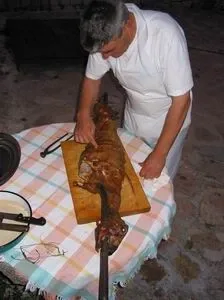
Pasticada - beef pre-fried and stewed in red wine with pork loin, vegetables and spices. Pršut - dry-cured pork ham. Paški sir - a delicacy sheep's milk cheese from the island of Pag, rubbed with olive oil. Maneštra - a thick vegetable soup. Visovačke begavice - a spicy dish of young lamb and sour sheep's milk. Vitalac - lamb intestine stuffed with lamb offal, roasted on a spit. Vis - flatbread with spit-roasted sardines. Neki - potato dumplings. Fuži - dumplings.
National drinks
Travarica - Croatian rakija is made from grapes with the addition, as a rule, of 15 types of herbs. Slivovica - a strong alcoholic drink made from plums.
Croatia has over 700 varieties of local wines, 76 of which are considered elite. Here are just a few wine brands worth paying attention to: red - Caberne, Teran, Dingac; white - Malvazia, Risling, Grasevina.
Croatian beer is much less popular, but to get an idea of it, try Staro Cesko, Ozujsko, Karlovacko.
By the way, if you go to a Croatian restaurant intending to try not the most ordinary dishes, be prepared to spend at least 200 kuna, that is, no less than $30.
_