
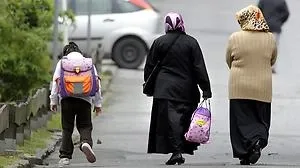
As the latest demographic statistics show, more than half of the population of the German capital could soon consist of people from other countries<\/em><\/p>
The quota of such residents of the capital is now 30 thousand higher than the figures of three years ago. True, only 458 thousand of them are "real foreigners," and 414 thousand have a German ID card.<\/p>
"The city is undergoing fundamental demographic changes, during which the minority becomes the majority," notes Senate Commissioner for Integration Günter Pinning, commenting on the statistics. Indeed, if in terms of the ratio of "foreigners" to the total population (25.7%), Berlin still lags behind other major German metropolises – Frankfurt am Main (40%) or Stuttgart (38%), then in the number of migrants under the age of 15 (45%), the capital has no competition. In certain quarters of the Neuklln and Wedding districts, the quota of non-German youth exceeds 70%. As Pinning notes, the future of Berlin will be determined not by native Germans, but by people from migrant families.<\/p>
Foreigners are extremely unevenly "distributed" across the city's districts. This situation directly reflects the recent division of Berlin, when most migrants lived in the west of the city. For example, in the "border quarters" near the Wall, the quota of Turkish or Arab population was traditionally high. But after reunification, these areas ended up in the center of new Berlin, and rent is rising here, so an outflow of the poor is already being felt.<\/p>
Most people from the former USSR settle in the eastern districts of the capital. Thus, every third person in the Helle Mitte quarter of the Hellersdorf district is a migrant from the CIS, and in the Charlottenburg-Wilmersdorf district, only every 25th.<\/p>
According to statistics, in the Mitte district, 44.8% of the population are migrants, in Neuklln – 39.5%, in Fridrichshain-Kreuzberg – 35.9%, while in Treptow-Kpenick only 7.4%, in Marzahn-Hellersdorf – 10.9%, in Pankow – 11.7%. In total, representatives of 199 nations live in the city. Most of them are from Turkey – almost 20% (170 thousand), followed by the Polish ethnic group – 10.6% (90 thousand), and another 60 thousand people of Arab origin. Interesting statistical data on individual quarters: the number of migrants among residents living near Askanischer Platz – 68.9%, near Mehringplatz – 66.6%, and in Neukllner Rollberg – 65.1%.<\/p>
Günter Pinning does not see a connection between the "problem" districts of the city and the high quota of migrants living there. In his opinion, one should rather speak of the weak social infrastructure of individual quarters. At the same time, the politician once again confirmed the need for a deeper and more thoughtful integration policy of the capital's Senate.<\/p>
Vladimir Gushchin.
 <\/strong><\/p>