
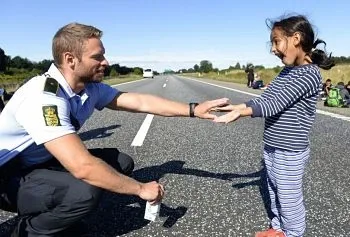
The experience of Swedish scientists in determining the age of refugees may also interest neighboring European countries
As Novye Izvestia writes, the upcoming changes in the verification method have significant political significance, intended to reduce social tension in society. Sweden is the multiple champion of Europe in immigration. With a population of just under ten million, the country has about two million residents born abroad. That is almost one in five.
Another record is the number of asylum seekers relative to Sweden's total population. As of today, there are more than 100,000 such persons. Sweden also holds first place in the Old World for the number of unaccompanied children applying for asylum. The lion's share of them are from Afghanistan.
The category of "children" includes persons under 18 years of age. They have significant advantages over adult refugees. It is easier for them to obtain a residence permit, they have the right to family reunification, and they cannot be deported from the country or imprisoned even if they commit a serious crime. The latter circumstance provokes the most heated public debate in Sweden.
The government long tried to hide the crimes of refugees from the people, ordering the police to conceal them under a meaningless code R291. Information about this leaked to the press, the veil of secrecy was lifted, and then another unpleasant circumstance came to light. Many offenses, including murders and rapes, were committed by foreign children, against whom the law enforcement system is powerless.
At the same time, both police and doctors admit that behind the guise of "children" there are often fully mature individuals well over twenty. Nevertheless, it is impossible to prove their true age in many cases. Almost all "minors" arrive in Sweden and other European countries without identity documents.
Experienced travelers recommend forgetting about the toilet on flights from some third-world countries to European Union airports. Immediately after takeoff, a queue of natives forms at the "thinking corner," for whom it is vitally important to go there. No, it is not about collective stomach upset: the passengers simply need to tear their passports into pieces and scatter them in the wind at an altitude of three thousand meters. Asylum seekers behind the walls of "Fortress Europe" know well that a "person from nowhere" finds it much easier to latch onto a world of prosperity than someone with identity documents. The hardened European Union deports virtually all refugees without further ado, even those riddled with bullets and disfigured by torture scars.
It's a different matter for passportless seekers of European mercy, who fall into the "dead zone" of the bureaucratic machine. To send a person back, you need to know exactly where. And while the refugee stubbornly repeats, "I remember a palm tree grew near the house, I forgot everything else," immigration officials, gritting their teeth, are forced to tolerate the trickster on European territory. If lucky, in a year or two the government will declare an amnesty, and the refugee, having received a "humanitarian status," will become a full-fledged European resident.
A "person from nowhere" who declares himself a minor feels even more secure in his new homeland. Getting rid of him, even if he terrorizes the entire neighborhood and has blood on his hands, is practically impossible.
"Age assessment using analysis of tooth tissue and hand bones is very unreliable. Although they usually complete development by the age of 18, the probability of error reaches 12%. Therefore, doctors often refuse to conduct such an examination, fearing to recognize a child as an adult, especially if it involves a serious offense he committed," comments Karl-Erik Flodmark, an associate professor at Lund University, one of the initiators of the new method for assessing the age of refugees. "Bone tissue in the area of the knees and ankles completes development by the age of 24, so the risk of error is significantly reduced. For boys it is 3%, for girls 7%. Of course, with this method the probability increases that a 19-year-old could be recognized as an 18-year-old, but a 25-year-old will no longer be able to pass for a child. The medical community is ready to undertake such an examination without risking an erroneous conclusion."
The first "test run" is expected to take place next month. Experts from the Swedish National Board of Forensic Medicine will determine the age of several thousand "children" from a list provided by the Swedish Migration Agency.