
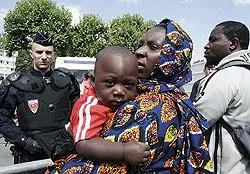
French police are always ready to send illegal immigrants back to their homeland
The tragedy that shook Europe three weeks ago, when it became known about the death of 73 illegal migrants in the Mediterranean Sea near the Italian coast, added edge to the current debates. Five survivors said that their vessel was seen by crews of a dozen fishing boats that passed by. They threw water and food, but refused to take even dying people on board. This had never happened before.
According to the new Italian law, illegal immigration is a criminal offense, and fishermen are afraid to 'get involved.' This was recently reported by Laura Boldrini, a representative of the Office of the UN High Commissioner for Refugees. In Italy itself, the problem of migrants, linked to rising crime, has caused an unprecedented rise of far-right forces. And in response to criticism of his immigration policy from the European Commission, Silvio Berlusconi caused a scandal: he demanded the dismissal of officials who allowed themselves such criticism, or even to block the work of the EU.
In addition, Berlusconi proposed to include on the agenda of the next EU summit in October the issue of opening a special migration office in one of the Mediterranean African countries, which would not only screen potential guests from the 'third world,' but also distribute them among all EU countries. Note that in the first half of this year alone, 6,760 illegal immigrants arrived on the Apennine Peninsula.
In addition, disagreements between the European Commission and France on one side, and Great Britain on the other, have come to the fore regarding the closure of the temporary detention camp in Calais. It is commonly called the 'Jungle' because of the order that reigns there. Hundreds of migrants from Afghanistan, Iraq, Nigeria and other troubled countries are waiting there for a convenient moment to cross the English Channel. In England, they have more chances to settle (language, large communities of compatriots).
Meanwhile, even UN representatives have expressed concern over Paris's decision to close the 'Jungle.' Nevertheless, according to French Minister of Immigration Eric Besson, the police will begin demolishing the cardboard huts at the end of this week. This decision was not spontaneous and had been prepared for at least six months. Suffice it to say that, according to French authorities, of the 700 camp inhabitants who were there last spring, now fewer than 300 remain. Moreover, 170 of them want to stay in France, rather than go to Great Britain.
But officials from Paris cite the terrible unsanitary conditions and criminal mores that reign in the 'Jungle.' One of the main goals of closing the camp is to stop the thriving activities of numerous gangs that secretly smuggle immigrants across the English Channel. The mayor of Calais, Natacha Bouchart, also accuses the camp's inhabitants of numerous crimes that they commit against local residents.
In any case, the same Besson, during a visit to Greece last week, proposed to his European colleagues an action plan to strengthen the Frontex agency. This pan-European EU body, headquartered in Warsaw, coordinates the control of the Union's external borders. Besson's doctrine is to enhance cooperation among EU police forces in intercepting and expelling illegal migrants, establish an exchange of border guards, conduct joint operations, and deploy the agency's operational headquarters in the Mediterranean Sea. Frontex has been operating since 2005. It is tasked with controlling 42,000 km of maritime and 8,800 km of land borders of the EU. This year, it has been allocated a budget of €71 million, with 60% for maritime operations.