
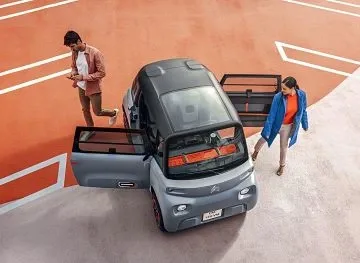
The miniature electric car Citroën Ami can be driven without a license in France and charged from a regular outlet
Thanks to a low-power engine and a low top speed (45 km/h), the car can be driven without a license from the age of 14, and the Ami is to be sold in electronics stores. The publication RFI tries to understand whether the "electric car for millennials," available by subscription for 20 euros per month, can find its place on the streets of Paris.
The promotional videos for the Citroën Ami resemble an ad for a smartphone or scooter more than a car. The manufacturer emphasizes that the new model can be charged from a regular outlet and contrasts it with a skateboard rather than conventional cars.
"Cars that pollute the air are being banned in our cities. Conventional electric cars are too expensive, and the new generation demands solutions," says the promotional video.
The universal "solution" can be taken on a long-term lease for 20 euros per month. However, the first payment will be significantly higher – 2,644 euros. The car's price will be 6,900 euros, and it can be purchased at FNAC and Darty electronics chain stores or online.
The car can also be rented for short periods – one minute of rental will cost 0.26 euros in addition to the subscription fee (10 euros per month).
The dimensions of the Citroën Ami are even smaller than the popular miniature Smart Forvo among the French. The electric car is 2.41 meters long and 1.36 meters wide.
With proper parking, the small size would allow two cars to park in one parking space, but in reality, this is unlikely to happen. Under French law, the Citroën Ami is considered not a car but a "light quadricycle." Because of this, no license is required, and the electric car can be driven from the age of 14. Drivers will probably not have all the skills necessary for parallel parking on narrow French streets.
"No joke, maybe this car is a glimpse of what our mobility will be like in the future," writes the American publication Techcrunch. But although the concept and design of the Citroën Ami indeed resemble leading concept cars, some details drew criticism from journalists. The car lacks a trunk, and the windows only lower halfway.
Additionally, the car's doors open backward rather than forward, like some elite sports cars. However, you won't be able to accelerate in the Citroën Ami – its top speed does not exceed 45 km/h. As the manufacturer promises, the electric car can travel 70 kilometers on a single charge.
Whether the car will be successful among the French is not yet clear. The Citroën Ami enters a growing and competitive electric car market: due to air quality problems, rising fuel costs, and new bans on overly "dirty" diesel and gasoline cars, this type of transport is becoming increasingly popular.
According to research, about 2% of all new cars in France are electric. In 2019, dealers managed to sell more than 70,000 electric cars. However, their average price remains unaffordable for most French motorists. One of the most popular models on the market – the Renault Zoe – can be purchased for 17,900 euros, but you have to pay extra for battery rental. The cost of five-door cars that run without fuel starts at about 25,000 euros.
Against the backdrop of other cars, the cheap Citroën Ami looks attractive. But even at a low price, it cannot completely replace a conventional car: you cannot drive the slow electric car on highways, and it only seats two people. Citroën does not say how heating, which will be needed in winter in any region of France, will affect the range, and the car lacks air conditioning, which provides relief during the almost annual heatwave in France.
In Paris, the electric car, which the creators believe could replace scooters, will face the same difficulties as conventional cars. Parking spaces on city streets are often scarce, and the cost of paid underground parking can reach several hundred euros per month. The Ami won't save you from traffic jams either.
Charging the car from a regular outlet looks attractive for residents of the French provinces who live in their own homes or own a garage. In Paris, such a situation is hard to imagine, and the electric car would have to be plugged into one of the 1,000 charging stations. The annual subscription fee for this is 120 euros.
The launch of car-sharing with miniature electric cars also gave French journalists a sense of déjà vu. In 2011, a similar service, Autolib', was created in Paris, but it closed seven years later due to unprofitability. The media cited insufficient infrastructure and high subscription costs as the reasons for the "fiasco." However, even before the launch, car-sharing with the Citroën Ami has advantages over the unsuccessful Autolib': you can rent the car without a license and from the age of 16 via an app.