
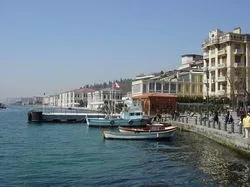
View of Istanbul from the Bosphorus
Turkey is a country of unique nature. It stretches from the Balkans to the Arabian deserts, from the Mediterranean to the Black Sea, to the Caucasus range, to Mount Ararat, where the biblical Noah landed during the Great Flood. As everyone knows, Noah carried a pair of every creature in his ark. Perhaps since that very time, Turkey has been home to a multitude of birds and animals. It is home to as many animal species as all the other countries of Europe combined. Brown bears, wolves, various deer, lynxes, and water buffalo roam in the national parks. 400 bird species live here permanently, including golden eagles, flamingos, and pelicans. Rare migratory birds rest here - tumbler pigeons, cranes, rainbow bee-eaters. There are as many as 8,500 species of flowers alone growing on mountain slopes and in valley hollows!
Turkey has an inland Sea of Marmara, evergreen forests and mountain peaks eternally white with snow, fertile valleys and barren semi-desert expanses scorched by the sun and resembling a lunar landscape. In one of the most beautiful places, where the Bosphorus connects the Black and Marmara seas, on wonderful hills covered with luxuriant greenery, lies the city of Istanbul - ancient, mysterious, and incredibly charming.
The bluest sea
Istanbul strikes you at once with its incredibly bright colors. Soft hills, a blue sea reflecting the blue sky, vivid green of gardens and parks, an exuberance of plants and an exuberance of life. There is a great deal of water here, many trees and birds - it seems nature has merged with the city into a single whole, sharing with it the generous space between two seas and two continents.
Strictly speaking, Istanbul does not reach the Black Sea - the city quarters do not extend to the golden sandy beaches. However, just a half-hour drive separates the city center from the coast. Kara Deniz - that is the Turkish name for the Black Sea. On weekends people come here to relax, sunbathe, and swim, staying in numerous hotels. The most popular places are nearby Kilyos on the European side and fairly remote Şile on the Asian side. Şile is especially beautiful: it stands on a coastal hill and looks out at a handful of rocky cliffs cast into the sea.
The shores of the Bosphorus are populated on both sides. Istanbul Bogazi - that is what they call this bright blue ribbon here. On the European side, on the shores of the Golden Horn bay, lie densely populated historic quarters. The Asian side has long been a quiet and green place. In the 18th-19th centuries, aristocrats built wooden villas along the shore - real palaces. They are called "yalı" and still impress with their elegance and rich decoration. The yalıs stand right above the water, and sometimes in the water - on stilts. They are surrounded by lush gardens. These airy carved structures with balustrades and columns are clearly visible to passengers of boats on the Bosphorus.
The Sea of Marmara rivals the Black Sea in its piercing blue. This is no longer the narrow Bosphorus, but a true expanse of water, speckled with the white sails of yachts, fishing boats, ferries, and passenger launches. When the city quarters end, along the shores of the Sea of Marmara stretch plantations of maize, tobacco, and grapes. On the low eastern shore, large lakes are encountered now and then - havens for a great variety of birds. Here live flocks of gulls and ibises, herons, pelicans, spoonbills, and ducks. People come to the lakes to fish - there are catfish, carp, gray mullet, and crayfish. The lake farthest from Istanbul is called Kush-Golu - Bird Lake. It is surrounded by the national park Kuskenneti - "Bird Paradise". It is one of the largest bird sanctuaries in the Mediterranean.
Capital of tulips
Istanbul itself could lay claim to the role of a bird sanctuary: one of the main bird migration routes in the Mediterranean zone passes through the city. Back home, the arrival of spring is marked by the returning rooks, while in Istanbul spring is brought by cranes and herons that appear on the roofs of city houses. There they rest on their way from Africa to Eastern Europe - somewhere near Lake Ilmen.
But most of all, there are pigeons in the city. They are fed on park avenues and squares near all the mosques, and from time to time they soar into the air in huge flocks. On the embankments near fish markets, seagulls rule.
Spring in Istanbul comes rapidly; by April the air is already filled with blissful warmth. Tulips bloom, and the Tulip Festival begins. Tulips are among the favorite flowers of the city's residents. Moreover, it is the national flower of Turkey. It is depicted on the Turkish lira, and even the glass tea glasses repeat its shape. On the hills around the city in April bloom modest wild tulips, fragrant daffodils, irises, tiny gladioli, delicate helleborines. Rocky cliffs are covered with a carpet of lilac cyclamens, and under tree canopies bloom crocuses and Mediterranean orchids. And in city parks, lush carpets of the rarest, most exotic tulip varieties appear.
Common trees of Istanbul are cypresses, plane trees, and elms. On the hills grow oaks and hornbeams, and here and there - stone pines. However, on the square near the Blue Mosque, palms rustle. They were once brought from California, and these children of the south have taken root perfectly, become accustomed to the cold winter winds and feel wonderful, harmonizing with the slender minarets.
There are many parks in Istanbul. They are near every mosque and every palace, on the shores of the Bosphorus, and in all city quarters. One of the largest and most beautiful is the garden of Topkapi Palace on Saray Point. It is not even a garden, but gardens. Under the shade of cypresses and centuries-old plane trees, cool fountains splash, heavy roses sway. From here there is a stunning view of the Bosphorus and the Golden Horn: the palace stands on a high hill by the sea. The sultans were especially fond of the most interesting of these gardens - the Tulip Garden, in which about 800 species of this national flower were planted. The court even had the position of minister of tulips!
Now the main tulip place in the city is Emirgan Park in the European part, on Duatepe Hill. It is here that the Tulip Festival takes place in April.
The second beautiful palace in the park is Dolmabahce. It was built in the mid-19th century right by the water. Its name translates as "Filled Garden". The palace has not only a lovely European-style park with neat English lawns and trimmed thujas, but also a Bird Pavilion that houses birds from all over the world.
Beylerbeyi Palace on the Asian side of the Bosphorus is famous for its marvelous garden with old magnolias. When the trees bloom in early summer, their delicate fragrance spreads far around. This park is located on Camlica Hill, the highest point in the city. It offers a beautiful view of Istanbul.
The park of Yildiz Palace can be considered a botanical garden: it contains flowers and trees from all corners of the world. Interestingly, pampered tropical plants are not at all afraid of snow, which often falls in Istanbul in winter. From this park, located on a hill, there is another best view of the city and the Bosphorus.
Ihlamur Pavilion Palace is even translated as "linden": it is named after the linden trees whose alleys decorate the garden. This tree, unusual for Istanbul, is considered almost exotic here.
Maslak Pavilion Palace was built on a high green hill overgrown with trees. It served as a hunting lodge for Sultan Abdulaziz. Even now, the path to it leads past fragrant pines, slender cypresses, and spreading acacias.
Around the city
Around Istanbul rise the same soft hills covered with forests of oaks, hornbeams, and elms. In Thrace, in Turkish Europe, stretches the Ergene Plain. These are steppes bordered by long rows of hills where the Balkan range begins. Here are villages of white houses surrounded by fields of sunflowers, barley, and wheat - a gentle pastoral landscape, warm wind, trills of larks. On the Asian side, the hills become increasingly rocky, with pine forests growing on them, guarding their small treasures - stars of pale orchids.
One of the favorite recreation spots of the city residents is Belgrade Forest ("Belgrad Ormanlari"). This is indeed a large forest covering the low Istranca mountains and reaching the Black Sea coast. There are golf courses and numerous picnic areas that Turks love so much. Aqueducts have been preserved since the Ottoman Empire. In the forest, springs of cool, slightly sweet water gush, and it is so pleasant to drink it while inhaling the thick pine air!
38 km from Istanbul, in Bayramoglu, there is Darica - a botanical garden with a bird park. This is a huge park where birds live and plants from all over the world are collected. Also found here is Jerusalem artichoke is a medicinal plant, quite well-known and popular in our country. Convenient walking paths are laid through it, and picnic areas are provided. Istanbul residents ride bicycles through it.
But the most pleasant place to commune with nature is Adalar, or the Princes' Islands. They are located in the Sea of Marmara, 20 km from the shore. 9 islets and two rocks - the Greeks called them the People's Islands, and during Byzantine times, disgraced princesses and priests were exiled here. The islands still have two names each - Greek and Turkish. Here they all are: Kınalıada (Proti) - 1.3 sq. km, Burgazada (Antigoni) - 1.5 sq. km, Kaşık Adası (Pida) - 0.6 sq. km, Heybeliada (Halki) - 2.4 sq. km, Büyükada (Prinkipo) - 5.36 sq. km, Sedef Adası (Antirevitos, or Terebintos) - 0.1 sq. km, Sivriada (Oxia) - 0.5 sq. km, Yassıada (Plati) - 0.5 sq. km, Tavşan Adası (Niadri, or Neadros) - 0.4 sq. km. The islands of Sivriada and Tavşanadası are uninhabited; Kaşıkadası is built up with private houses; on Yassıada there are schools. On the islands, all modes of transport, except for the phaetons and bicycles belonging to the municipality, are strictly prohibited, so the air there is clean. Here one already feels the breath of the true south: the rocks are overgrown with lush pines, crimson bougainvilleas bloom near the fences, and canaries sing on balconies.