
We were flying home on a radiant summer morning. At Olbia airport I bought honey. “Cardo,” was written on the jar. “This is real Sardinian honey,” explained the saleswoman. “It is made from cardo - these are white flowers that grow only in Sardinia.” I wasn’t even surprised - on this island every day we discovered something that exists only in Sardinia. On the plateau of Giara di Gesturi we saw wild horses - small, shaggy chestnut ponies. In the mountains of Arci, black wild boars jumped out from the thickets of holm oak, and on the islet of Asinara wild white donkeys roamed. Why be surprised at strange white flowers that grow only here? And I remembered our first day in Sardinia, when we first saw this amazing world, and the second day, when miracles continued and multiplied, and all the other days, filled with sunlight and the childish delight of endless discoveries.
Chia
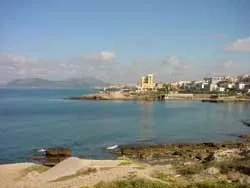
Actually, first there was night. I went out onto the balcony and saw the black silhouette of a mountain and a watchtower lit by the moon. A moonlit path shimmered on the silver sea, stock flowers smelled sweet, and a chorus of tree frogs voiced the scene. In the morning everything was different. Swallows darted around their nests on the balcony, birds sang in every way. We walked along a country road to the sea - and found ourselves on the shore of a lake where flamingos were dancing. They lifted their thin legs, raised their wings, and the wind ruffled their delicate pink feathers, making the birds look like flowers. A narrow strip of snow-white sand separated the lake from the sea, and the stone tower of Chia guarded the silence of the bay.
The landscape was festive and bright, like a postcard. The water in the bay shone emerald, like in the Caribbean; rounded basalt boulders rose from it, like in the Seychelles; fragrant Crimean junipers clung to the rocks, and the blue Mediterranean sky set off the whiteness of dunes overgrown with timid tamarisks. We entered the clear water and swam, and black cormorants watched us from the rocks.
“Chia beach is among the hundred most beautiful beaches on Earth,” the porter told us in the evening. And we immediately agreed with him. We did not yet know that in Sardinia all beaches are the most beautiful on Earth. In the south, the coast of Costa del Sud stretches with whimsical coves, the cliffs of Cape Teulada drop into the sea, and islets and rocks stick out of the azure water.
On the western coast, clouds float across the serene mirrors of lagoons and lakes, and pink islands of flamingos migrate from cloud to cloud. There, fishermen catch cod from reed boats, pull fat green eels and toothy mullet out of the water - “molto aggressivo!” From Portoscuso, ferries depart to the island of San Pietro, to its wild cliffs and the white cubes of Tunisian houses, and “tonnara” seiners cross their path, chasing schools of tuna.
North of Oristano, all roads are marked on the map in green - the panoramic, scenic roads of the Riviera del Corallo. They lead to Alghero with its Catalan streets, Catalan flags and old Catalan fort, and then on to Cape Caccia to the majestic cliffs that hide the most beautiful beaches, grottoes and caves in the world. To the Neptune’s Grotto, 654 steps of the Escala del Cabirol ascend - the Goat’s Staircase. There, deep in the earth, a large salt lake hides, and giant columns of stalactites rise from ghostly depths.
On the eastern coast, the Levantine wind sharpens the ridges of mountain ranges plunging into the sea, paints lunar landscapes of rocky plateaus, and waves lick vertical cliffs almost a kilometer high. The most beautiful road in the world leads from the fishing bay of Arbatax to Orosei, skirting the protected Gulf of Orosei, and the most beautiful beaches in the world with snow-white sand bask in the coves near the small town of Cala Gonone.
And the northern coast is even considered the most beautiful place on Earth - there lies the Emerald Coast Costa Smeralda and the heavenly Costa Paradiso.
But first we went to Nora. We simply got on a regular bus and asked to stop in the village of Pula. “Prego,” the stern mustachioed driver waved his hand to us, refusing the fare. We headed to the watchtower of Nora, visible on the hill.
Medieval towers adorn the coastal hills on all Sardinian shores. Once they warned of pirate raids. If pirate ships appeared on the horizon, a bonfire was lit on the tower, its smoke was noticed by sentinels on other towers, they also lit a fire, and this relay was passed along the entire coast. Village residents went into the mountains and hid in caves. However, the Sardinians never trusted the sea. Only newcomers settled on the shore: Phoenicians, Carthaginians, ancient Greeks, Romans, Catalans, Ligurians, and Piedmontese.
We walked along a narrow road between elegant villas and modest houses with vegetable gardens, where tomatoes and artichokes grew in the beds, and instead of fences stood prickly opuntias with yellow flowers. Suddenly, a tall thin old man called out to us from behind a gate. “Hey,” he shouted, “tourists! Why are you walking there on the dusty road? Better come into my place! My cherries are ripe, and the loquats are already falling from the branches, and the peaches are about to drop into the grass. Come in, it’s cool here. We’ll have a glass of wine - I have the best wine in the village. My old woman has already lit the stove, the bread will be ready soon, and Nora will wait for you - she has been standing for many years, somehow she’ll stand until evening...”
We looked at the distant tower, at the little house painted ochre, at the dense shade of the garden - and entered. Old Pietro was overjoyed. He called his old woman Maria, looking like a ruddy pie, and hoisted a pot of water onto the hearth to treat us to laregitas - a Sardinian pasta made of coarse gray dough. And fragrant thick wine glowed in glasses, and neighbor Giovanni brought fresh cheese, and laregitas were covered with a thick tomato sauce, and a fluffy country bread with a crusty edge - delightful "pane carasau" - was ready. The owner's son Giuseppe, as tall as his father, shouted from the threshold: "I brought carta musica! Madre, get the olive oil!" "Musical paper" also turned out to be bread - thin crispy flatbreads baked with rosemary. We drizzled them with oil and washed them down with wine, and nothing in the world was tastier than this wine and country bread, and pecorino sheep cheese.
We came to Nora at sunset. Long blue shadows stretched from the palms to the church of Sant'Efisio, which has stood on the seashore for eight hundred years. From there the road went to the hill with the ruins of the ancient city and to the tower on a high rocky promontory. The whole turbulent history of the island is written on the stones of Nora, founded by the Phoenicians in the 8th century BC. A Phoenician road polished by time leads to a bay where colorful fishing boats sleep; near the Carthaginian ruins a Greek theater rises, mosaics of Roman villas stand next to the temple of Asclepius, and remains of an aqueduct stretch toward the baths. We climbed a steep path to the watchtower. Below, black rocks bristled, and a tiny rocky islet with a lighthouse seemed to float on the waves. Gulls, cormorants, and herons reigned here. The tower remained a watchtower: sentinel gulls kept watch on it. They shrieked piercingly, and immediately we were surrounded by huge white birds rising from the rocks. We stood in this celestial height among the cries of birds, breathed the fragrant wormwood wind, and watched the sun set behind the distant mountains. In the transparent air the shore was visible far away, all the way to Cagliari, to the lakes with pink flamingos, to the next watchtowers, near which gulls also circled.
Emerald Coast
A journey from the south to the north of the island seems like a trip around the world. Landscapes change continuously, just as dialects of the Sardinian language change from village to village. There are a hundred dialects, and the Sardinians cannot decide which Sardinian language should be taught in school. So they teach none.
The road goes through the only flat place on the island - the Campidano plain, where wheat has been grown since Phoenician times. Then through the Giara di Gesturi plateau, where wild horses roam and the ruins of Baron Zapata's castle stick out on the strange cone of the Las Passas hill. Near the baronial village of Barumini there are even stranger structures - mysterious stone towers, the nuraghi. They were built 3,500 years ago by unknown people for incomprehensible purposes. Scientists know nothing about the inhabitants of the nuraghi, argue about the purpose of the towers, and rack their brains over their construction. Who could have stacked stones weighing three to four tons each into regular towers 20 meters high with windows, galleries, and internal courtyards? Scientists agree on one thing: this was a powerful civilization that suddenly ceased to exist. And its representatives are called Nuragics.
There are more than seven thousand nuraghi on Sardinia. They stand among flowering hills and on bare mountain peaks, marking roads and shepherd trails. The road climbs higher and higher into the mountains, their slopes are lined with rows of olive trees, and sheep hide from the sun under the trees. They lie motionless like stones. Then the sheep disappear, and only stones remain. Huge white boulders, giant blocks polished by the wind - a lunar landscape, the first day of creation, cosmic chaos. Mountain spurs bristle like dragon backs, and eagles circle above them. One more turn - and the sea appears before us. The mountains divide it into whimsical bays, the water shimmers with emerald, and snow-white yachts hover above their own shadows.
This is the Costa Smeralda. It appeared on maps thanks to a prince, as in a fairy tale. Prince Karim Aga Khan was returning on his yacht from the French Riviera and suddenly saw in the magical blue of the Tyrrhenian Sea the whimsical bays of Sardinia. He immediately realized that this was the best place on Earth. And then the prince bought part of the coast and named it Costa Smeralda - the Emerald Coast. There were not even fishing villages here, and Aga Khan began to build villas and hotels, golf courses and yacht harbors on the Costa Smeralda. The world's best architects brought Aga Khan's dream to life, having first learned from Sardinian peasants.
The first resort was Porto Cervo - the Deer Port. It turned out incredibly elegant: no straight lines, no concrete boxes, only handcrafted work. Above the yacht marina, above the bay branching like antlers, hovers a small white church of the Virgin Mary, "Stella Maris." Its portal is propped up by wild stones, a stone serves as the altar, and holy water streams into a huge seashell. On the wall is El Greco's "Madonna Dolorosa." A bell rings on the church. Before falling into the sea, the sun tints the Emerald Coast with sunset colors, and it seems that everything best in the world is gathered on this island in the middle of the Mediterranean Sea, in the bay of Porto Cervo and in the bay of Chia, and in thousands of its other bays.