
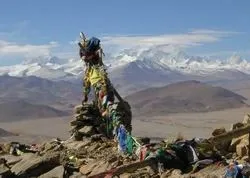
You can slowly get used to the status of an ordinary person. Spit on everything, have a beer, watch the heartbreaking program “Okna,” spin the kids a tale about how strong, smart, and handsome dad once was, and keep suffering. Or you can do it differently: not calm down and keep searching for your own. There are plenty of such seekers of the meaning of life in the north of India, in a small mountain village of Dharamsala, lost at the foot of the Himalayas.
The choice of place for the trip was not accidental. Dharamsala is the heart of modern Tibet. The residence of the 14th Dalai Lama himself is located here, the air is saturated with mysticism and mystery, and the local flavor is “stuffed” with all sorts of trinkets that together barely fit into one word “Buddhism.” It is a land of colorful religious festivals, where lamas in masks perform ritual dances to the beat of drums, hermits seclude themselves in inaccessible caves, and countless monasteries and stupas rise among the rocks and valleys. Many people from different countries come here each year for meaning, a miracle, a thrill—everyone calls it what they want. They come for vacation and stay forever. Among them are many of our compatriots.
ANYONE CAN BECOME A BUDDHA
Describing the impressions of a trip to the Indian Himalayas is an empty business. Although emptiness is one of the main concepts of Buddhism. In Tibet they say that a mind seeking Buddha outside is foolishness at the very heart of foolishness. With all the natural, architectural, and ritual beauties of these journeys, their main meaning is internal. As in any other pilgrimage. But a rare pilgrim of another confession travels his path so calmly and joyfully.
People are driven by a simple principle—anyone can become a Buddha. And the spiritual leader of modern Buddhism, the 14th Dalai Lama, constantly emphasizes that there is no separate Buddha, that Buddhas are just people like us, who once had defiled minds and gradually eliminated those defilements. Happiness for a Buddhist, both beginner and experienced, is quite achievable. Therefore, a pilgrimage to the Buddhist land is not a path of repentance, humility, and prayer, but a journey—joyful and enlightened.
BOUND BY ONE GOAL
India does not fit into a frame. It generally does not fit into any limits. When you arrive in Delhi, it embraces the guest in its sticky embrace, like a ragged beggar who suddenly caught you on the street. And you are stunned to realize that you can't get away from him. One way to escape from this intrusive and unbearable heat and stuffiness is to come to the Tibetan quarter of the city, buy a ticket on a “comfortable” Indian bus with the intriguing name “de luxe” and drive for fourteen hours towards the Himalayas. During the trip you are guaranteed all the pleasures of life—fear of falling into an abyss, aching joints, and meeting various, very strange characters.
Our bus was packed to the brim. The passengers turned out to be very diverse: serious and focused Buddhist monks coexist with curious citizens who are just trying to “try on” Buddhism and along the way “interrogate” the monks—like, what's what in Buddhism. Ardent hearts of different nationalities and ages go to Dharamsala with one goal—to see the living Buddha at least with one eye.
“If you're lucky and you get an audience with His Holiness, you definitely won't be reborn as a snake or an ant in your next life,” a cheerful Australian grandmother in a fashionable Hindu shirt and beads whispers conspiratorially to her neighbor. “One smile from the Dalai Lama in your direction—and you're guaranteed a human form in the next life.”
Most of the passengers, however, are ordinary tourists. There are couples in love who are eager to go to Tibet on their honeymoon. And just parents with children. At the back, young students from Denmark happily sing at the top of their lungs and smoke marijuana the whole way.
You get into such a bus—and all stereotypes collapse. You understand what a real journey means. We transfer ourselves by charter, convoy ourselves by bus to a booked hotel, attach a guide to ourselves and pay considerable money, getting in return a pale commercial copy of the country. Some witty tour operator invented a myth that you can't travel on your own, that stupid unsupervised tourists are only awaited by the police and marginals: to put them behind bars or tear them apart for donor organs. All these are fairy tales. Half the world has long lived without borders—here an elderly hippie from somewhere in Detroit is snoring. Here, having taken a drink, our compatriots argue and sing songs. Already here, on the bus, you understand what one of the main postulates of Buddhism means: our world is one whole.
WHAT IS TIBET?
Someone from the ancients invented that the Earth is structured like this: Africa and Australia are the legs, Antarctica is the bones of the skull, Central Russia is the liver and blood, Siberia is the lungs, Germany is the arms, France is the subcortex, Holland is the vagina, England and Japan are the hemispheres of the brain, Indochina is the intestines and genitourinary system, both Americas are the back, India is the heart, Tibet is the soul.
When it comes to where this very Tibet is located, people usually get confused. Well, yes, the soul of the world. Well, somewhere up there, high in the mountains, where insidious civilization has not yet reached. Especially “advanced” people know that somewhere in Tibet is Shambhala. But few are aware that Tibet today is going through not the best of times.
In 1950, Tibet was occupied by China and today is a Tibetan district in the PRC. During the “Cultural Revolution,” Tibetan culture and traditions were almost completely destroyed. Temples and monasteries were destroyed: of more than 6,000 monasteries, only 13 survived, and then only as decoration for foreign tourists. As a result, Tibet as an independent country was destroyed along with several million Tibetans. Chinese Tibet with its capital Lhasa has long turned into an ordinary commercial high-mountain resort, and tens of thousands of Tibetans sit in prisons just for storing an image of the Dalai Lama. There are casinos and brothels here. And the unique ecology of this region is under threat—a nuclear waste dump was set up in the high-mountain valleys.
There are a great many schools and traditions of Tibetan Buddhism, just as there are monasteries. You can seek enlightenment in Nepal, or in Bhutan. But today, pilgrims and the merely curious have a special fondness for the Indian Himalayas, where the Tibetan government-in-exile is located. Here Tibetan monks have begun building their lives anew: raising houses, monasteries, and schools. Here, as disenfranchised refugees, Tibetans are trying with all their might to preserve Tibet - the soul of the world.
PARADISE FOR DOGS AND COWS
The first thing that strikes you when you arrive in Dharamsala is that animals are pampered and cherished here almost more than people. It is not a city but an open-air zoo. The most common animals here are monkeys. They stroll the streets as freely as our cats do, just looking around for something to steal. But the most mythical animal is the cow. The sacred one, about which tourist guides spin tales of her wandering along highways and causing huge traffic jams. Indian cows are hopelessly infantile, imperturbable creatures that nothing and no one can probably frighten; they wander along busy streets and graze by day on local garbage dumps. Dogs also feel right at home. Understanding that no one in the next life is immune to becoming a stray dog, people show these quadrupeds every sign of respect. They feed them, do not chase them with sticks, and even cars yield the right of way to them. Buddhists know: while animals live among us, we must care for them and treat them like children. Often, over a dead animal, a lama performs a ceremony aimed at its attaining a human rebirth.
But after death, people here are not given such honors. After modest rituals, the body of the deceased is cut into pieces and thrown out to feed birds of prey. No one mourns the departed. And why mourn? In 47 days, the person will be born into the next life. Only the ashes of enlightened ones are treated with greater reverence; their bodies are cremated, and the ashes are placed in stupas. Stupas are amusing Buddhist structures: exactly like a church top stuck into the ground, with a little tower and spire. Stupas can be tiny, like a little toy tower in a kindergarten, or they can reach three hundred meters in diameter. What unites them is a secret: in each one, besides the ashes of a worthy lama, monks hide a mysterious sacred relic and precious stones. After that, the stupa is sealed, and no one can enter it again. It is terribly intriguing - what is inside. But not a single case of illegally opening a stupa has been recorded in the country.
WHAT BANANAS REALLY LOOK LIKE
Tibetans are shy people. They live by the principle: “Thank you for everything I have, and it is good that I never thought of having more.” There are no ostentatious mansions or fancy villas on this land. Everything is strictly functional. No columns, no red brick, no copper roofs. A Tibetan house is a remarkably simple and unpretentious structure. Everyone who comes here absorbs this spirit of asceticism. In Dharamsala, many foreign tourists live for six months right in caves. With their children, they bathe in waterfalls; to eat, they go down to the small restaurants, of which this place has a great many.
Our compatriots, however, still prefer more comfortable lodging. Somewhere deep in our half-Asian soul, no matter how much you temper it with minimalism, there sits someone who likes it to be rich, warm, fuzzy, bright, and with lots of sparkle. And so far, not one of us living in a cave has been spotted in Dharamsala.
All our compatriots here are looked after by the head of the Buddhist church of Mongolia, Bagdogegeen. Those who can afford it rent a hotel room and go to Bagdogegeen for classes. They study Buddhist philosophy and train in meditation skills. Others live right in his house - a large four-story building at the highest point of the mountain settlement. He is ready to take in anyone who comes to the lama for advice. People live here for years, completely free of charge. Bagdogegeen adores Russians. He says we are all very sincere and carry our feelings to the end. On the wall of his study is a portrait of one of his students - the actress Natalya Andreichenko, who visited Dharamsala more than once and stayed with Bagdogegeen.
Being absorbed in the bustle of our own deeds and intentions, it is rather hard to understand where we go wrong, whether we are on the right path, and what keeps us from moving closer to happiness. It is better to ask all this of an outsider who has come from another world. A Buddhist monk or lama is a very suitable conversationalist. True, at first everything the teacher says is not very clear. But there is no denying it - it is mesmerizing.
“What is Buddhism? - Bagdogegeen muses. - The Buddha himself used the best description. For all fifteen hundred years that the teaching existed in India, it was called ‘dharma,’ and for the last thousand years in Tibet it has been called ‘che.’ Both mean the same thing - it is a teaching about how things really are. And if you put it in Tibetan terms, both ‘dharma’ and ‘che’ are wondrous pictures made to show a hungry person what bananas actually look like.
MIRACLES IN A SIEVE
Bagdogegeen - don’t be afraid of the word - is a reincarnate. That is, one who has consciously returned to our sinful earth for a second time. “This is me in my past life. - The Buddhist teacher shows us an old photograph from the beginning of the last century depicting the former emperor of Mongolia. - Communists came to power in my country, and I was reborn in Tibet.”
The idea of rebirth—both past and future—permeates the air of Dharamsala. People here talk about past and future lives constantly and as a matter of course. They discuss the topic in passing. It is obvious to everyone here that this little stone lying on the road was once a person. But that person behaved badly—and was reborn as cold granite. To communicate with bodiless spirits (also representatives of lower worlds) who do not work on themselves or their enlightenment, mantras are hung on trees. People pray for sinful souls because they themselves have no say in this life.
But if we ordinary people are reborn chaotically, enlightened individuals can regulate this process. They themselves choose the body into which they will be reborn. All who have reached such a level of enlightenment receive the status of lama. They are also addressed as “rinpoche,” which translates from Tibetan as “precious one.”
Mongolian lama Bagdogegen, also a rinpoche, is friends with other lamas. Therefore, the friendship between reincarnates acquires a mystical hue. “I have a friend who is a lama,” says Bagdogegen. “He was much older than me and always taught me the dharma. But he grew old and died. Then he was reborn as a Tibetan boy. And we are still friends. True, now I am raising him.”
MYSTICISM IN THE SERVICE OF THE STATE
Mysticism is a common thing in the lives of Tibetans. What can I say, even the Tibetan state hierarchy is full of mysticism. It is hard to imagine and even harder to believe, but the Tibetan authorities do not need the Internet or the FSB to obtain information. To avoid mistakes in decision-making, the Dalai Lama turns to his assistant—the state oracle of Tibet, who also holds the rank of minister. In particular, during the Chinese conquest of Tibet, the oracle suggested to the young Dalai Lama a possible way out of the summer residence of Norbulinka, surrounded by Chinese troops. A few hours before the storming of the palace, the Dalai Lama, disguised in secular clothing, fled to India along exactly the route the oracle had drawn for him in a trance.
In Tibetan culture, no truly important question is resolved without an oracle's help. Clairvoyants actively participate in the search for the reincarnation of high lamas, and on the eve of the New Year they provide a forecast of events for the coming year.
Such ceremonies usually take place under strict secrecy. Outsiders are not admitted. However, it is known that the oracle's assistants place a helmet weighing about 20 kg on his head. A person can withstand the weight of this helmet only in a state of trance. The ceremony is accompanied by drumming and the piercing sound of trumpets made from human bones. The entire space around is filled with the aroma and smoke of special incense burned in large quantities. After a while, the oracle's eyes close, his face reddens, and his arms and legs begin to twitch: a deity enters his body. His breathing becomes labored, his face turns crimson and visibly swells, and foam appears on his lips. These are signs that the deity has fully taken possession of the oracle's body. The oracle's words, often given in veiled form, are first deciphered and then written down on an official form and sealed with a stamp.
Outside work, the state oracle is a most pleasant man named Nechung. He says that when the oracle leaves his body, he remembers absolutely nothing. And he bears no responsibility for anything said in trance. Just like our official.
RUSSIAN BUDDHISTS
Tantric practices are the highest level of Buddhist practice. At first, all who set out on the path to enlightenment must get rid of the poisons. There are three poisons that, according to Buddhist philosophy, prevent a person from being happy: ignorance, anger, and attachment.
The “oldest” Russian Buddhist in Dharamsala is Lena. Even the wise Tibetan lamas say she knows what she is doing. In Moscow she graduated from a theater school, then the Institute of Culture. She first came here as a tourist. At first, as is customary, she became interested in miracles. She began to dig deep and study. Then she realized that this path was hers. To be able to live independently in Dharamsala, she set up a company.
“For three years we sold dietary supplements,” says Lena. “The business was going briskly, and I lived here on a percentage of my company's income. But three years ago I sold my business and moved here for good. Maybe in a year I'll get tired of it all. And I'll realize that I want a family, children. But I'm not ready for that yet.”
Lena says it is impossible to combine business with Buddhist practices. A person can communicate directly with God only in solitude. In the city it won't work—you'll be reached by the doorbell, mobile phone, television news. She says that only in solitude do you become clairvoyant or stop being blind.
Muscovite Dima was an ordinary new Russian businessman; the police and extortionists were after him, to whom he was always in debt. The only thing that distinguished him from other businessmen was that he sometimes had dreams of military operations in the mountains of Tibet, where he, as a leader, leads Buddhist monks into caves. Soon he went to India with his girlfriend, from where he shipped semiprecious stones to Moscow and in the evenings smoked hashish. Then, unexpectedly, he sent his girlfriend home. He converted to Buddhism and is now about to become a monk soon.
"Tibetans say that the life of the worst monk is better, filled with more meaning and happiness, than the life of the most successful, prosperous and happy layman," says Dima. "I agree with that. When I hit thirty, I firmly decided that I would not get into anything serious anymore. Material prosperity cannot bring lasting happiness. The money I have saved will last me another three years. Here in Dharamsala, life is cheap. And then I'll think of something else. Maybe I'll go to a shop to sell souvenirs."
RETURN TO CHILDHOOD
The Diamond Vehicle is the name of the most popular and widespread path in Buddhism. The Diamond Vehicle teaches that the world is already perfect, that man is perfect, that he is already enlightened; the whole problem is clarity of mind - you just need to open up. There are four schools in the Diamond Vehicle, intended for different types of students. Different meditative practices. Gelukpa deals with people who constantly get tangled up in life; their main goal is to understand themselves, get rid of uncertainty and open their mind. Nyingma is for people whose main problem is pride and anger; they meditate to achieve love and openness. Sakya is for scholars. They engage in deeper knowledge of Buddhist theory. Finally, Kagyu is for people who have too many attachments in life. Kagyu students do everything at once, trying to get rid of stereotypes and illusions, open their mind and see the world as it is. But there are also more original practices.
Together with Dima - a former businessman and drug addict - we sit under a huge tree. He claims there is no better place for meditation: a tree with a powerful root system creates a strong energy column from which, with skill, you can draw nourishment. He himself spends three hours there every day. Dima does not hide his breathing and meditation techniques. One of the most unusual is working with solar energy. You need to clear your thoughts of excess, throw your head back, open your mouth wide and absorb the sun's rays with your whole being. Having felt their energy within yourself, you should hold it, mentally materialize it and direct it into the chakras.
I can't say I succeeded, but my mentor said it's just a matter of practice. One thing is clear: when you sit under a tree with your mouth open for three hours straight, you forget about everything in the world. And you catch sensations long forgotten. It is an unexpected joy. Huge, like the sky above your head, and completely causeless. And no wonder - somewhere far away and without you, the eternal wheel called "home - work" continues to spin. And you suddenly fall out of this whirlwind and sit here under a tree with your mouth open. You sit and are in no hurry. You feel such joy only in childhood, when there are no problems, and even those can only be created by a lack of candies and ice cream, whose doses are strictly fixed by parents. You had to comb half the globe to find it again...