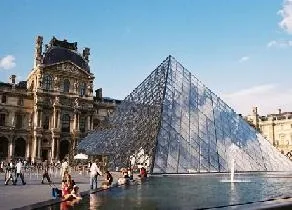
Millions of tourists from all over the world strive to get to the Louvre
Do you know the name of the most visited museum on our planet? Yes, it is one of the largest museums in the world, located in the heart of the French capital, on the right bank of the Seine. And it is called – LOUVRE<\/a>.<\/strong><\/p>
It is a pity that museum visitors never see all its treasures, because only slightly more than one tenth of the 300,000 exhibits make it to the display halls. The reason most exhibits are in storage is not that the museum lacks space, but to better preserve the masterpieces from the ravages of time.<\/p>
What was the Louvre before it turned into the most famous museum?<\/p>
It all began with a fortress built on the site of today's museum to defend against the Vikings, who attacked Parisians from the Seine. On the site of the Louvre Tower, built in 1190, a fortress wall was later erected. And when Paris was eventually encircled by a new fortress wall, the Louvre turned into a castle, where in 1317 King Charles V moved the treasury for safekeeping, and later moved the royal residence here as well.<\/p>
To the credit of the kings of that time, it should be noted that for the storage of the library moved to the Louvre, the king ordered the construction of a separate tower, which he did not do for the treasury. These very books became the basis of the National Library of France.<\/p>
The descendants of Charles V did not like the Louvre, so they chose Saint-Pol and Tournelles as residences, temporarily forgetting about the Louvre. The Louvre fortress lay in neglect until 1528. That year began a new history of the Louvre, the history of a palace. The old fortress was demolished and construction of royal chambers began. The architect Pierre Lescot started the construction of the new Louvre.<\/p>
Years passed, kings and architects changed, and the Louvre also changed, leaving unchanged the process of addition and reconstruction, which continues to this day.<\/p>
The latest architectural innovation was the construction of the pyramid in the museum's courtyard in 1989. The entrances to the building could no longer handle the flow of visitors wanting to experience the beautiful, so the entrance through the pyramid into a huge lobby below, from which one can enter the museum itself, relieved the historic doors.<\/p>
However, the pyramid sparked debate. Many French people felt that it disrupted the atmosphere of the Louvre and demanded its removal. But the pyramid was kept, considered an item of contemporary art.<\/p>
But let us return to 1793, the turbulent days of the French Revolution, when the Louvre was declared national property and turned into a museum. Unique items confiscated from noble Frenchmen were brought here, and all this luxury was shown to the poor. And they had plenty to see!<\/p>
The scale of this museum is hard to imagine, for just the names of its departments speak of the grandeur of the collection: Ancient Egypt, Ancient Near East, Islamic art, Ancient Greece, Sculptures, Graphic arts, Fine arts, and Decorative arts.<\/p>
The modern Louvre has become a world treasure and awaits you.<\/p>
Source: