
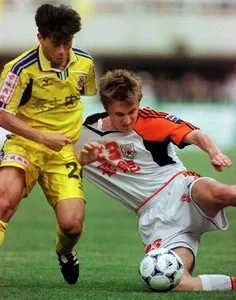
But there was an episode in his career that Sergei himself does not want to remember. But this episode radically changed his life. In the autumn of 1997, Nagornyak was accused of doping use. The Ukrainian federation, without waiting for the verdict of international organizations fighting against the use of prohibited substances, disqualified the footballer for one year. Sergei spent this time in Vinnytsia, where he began his path in big football. Here he again immersed himself in the world of amateur football, to which the disqualification did not apply.
At the end of '98, Nagornyak, returning from "exile", signed a contract with Donetsk "Shakhtar", and then played one match for the national team. But a year later, having received an offer from a Chinese club, after some deliberation he accepted it. And four years later he returned to his homeland and is currently training with Kyiv "Arsenal" under the leadership of Vyacheslav Grozny.
- Sergei, what wind blew you to China?
- My contract with the Donetsk side expired. But at that time there was a clause that obliged to pay compensation for the footballer to his former club even in case of contract expiration - according to the so-called age coefficients. The price that had to be paid to Shakhtar scared off most buyers. And then suddenly the Chinese appeared on the horizon. At first I was not eager to go to this godforsaken place. But after reviewing the financial terms of the contract and learning that the team's coach was Russian, I agreed. The representative of Shenyang - my new club - agreed with Shakhtar about my loan, I signed a personal contract for a year and set off.
- Why only a year?
- In China, the attitude of club leaders towards legionnaires is like towards expensive hired workers who, as a rule, do not stay for long. Why complicate life for yourself and others with long-term contracts? A year, by the way, is the maximum contract term for a foreigner. But if someone wants to stay in China for more than a year, nobody forbids him to sign a new contract. After the first season in Shenyang, my loan expired, but I liked it in China. I did not suffer from a lack of offers, and Shakhtar loaned me for another year to another local club - Shandong. At the end of the new season, I became a free agent and decided for myself with whom to sign an agreement - I twice extended a one-year contract with Shandong.
- There are the most incredible rumors about the requirements that are imposed on legionnaires in China...
- You mean the legendary winter tests? Yes, there were times when before the start of the championship all teams of one league gathered together in one city and after a month of intense work passed difficult tests. Each footballer was given three attempts. If his functional state did not fit their generally accepted canons, the club did not have the right to sign a contract with him. But this rule applied not only to legionnaires: the Chinese also took tests.
In 2001 this practice ceased. The authoritative specialist Bora Milutinovic, who at that time headed the China national team, managed to explain to the leadership of the national federation that in this way the Chinese championship is missing a number of good legionnaires who could bring considerable benefit to their football.
- Are there many legionnaires in China?
- On the field, no more than three foreigners could play in one team. Now the number of legionnaires has been cut to two. In our team in the last championship there were four - me, Russian striker Sergei Kiryakov, Slovenian defender Milinko Galič, and French forward Nicolas Ouédec. One of them had to sit on the bench. At the beginning of the season Ouédec was disqualified, so there were no problems. Galič cemented the defense, and Kiryakov and I played up front. Then Ouédec returned, and Galič sat on the bench, because Nicolas made a good company for us in attack. So we played.
- In the season before last, Shandong met with the team of the current player of Donetsk Shakhtar - the Bulgarian Predrag Pazhin...
- I remember these matches well. Beijing, for which Pazhin played, claimed the championship title, and also looked better than others in terms of play. But the Chinese have their own specifics - a team plays only when there is something to fight for. By that time we no longer claimed anything serious. Therefore, our victory over Pazhin's team is doubly valuable. Predrag, who even then showed a mature and skillful game, scored against us from a free kick, but we equalized, and at the end of the match I managed to score the winning goal.
- Didn't the teams you played for rank among the leaders of the local championship?
- Shenyang fought for survival for several years before my arrival. And only after the well-known Russian specialist Valery Nepomnyashchy took over the team, it moved into the category of mid-table teams. Shandong was stronger. In 2001 we took sixth place. In 2002 - fourth. And only in 2003 we failed, not even getting into the top ten strongest.
- The only thing that unites these two teams is that during your performance in their ranks, the coach was a specialist from Russia...
- The very fact of having a coach in the team who understands you because he himself has similar problems with adaptation in a new country is already a big plus. Moreover, working under the guidance of your own coaches seems always more convenient. At least for me this fact is not unimportant.
I decided to accept an invitation from an unknown Chinese team only when I learned that its coach was Valery Nepomnyashchy. I moved to Shandong under Boris Ignatiev. After Boris Petrovich left the club and I became a free agent, I thought about leaving. I was invited to Japan, but the financial terms of the contract did not suit me, and besides, Nepomnyashchy called me and said that he was taking over Shandong. So I stayed.
- The level of the Chinese championship is probably hard to call high?
- I wouldn't say it's weak. On the contrary. The intrigue in the championship is serious, and the stands are almost always full. Another thing is that the teams' play is determined 70-80 percent by foreign players. And the overall success depends on how successfully local footballers help the foreigners. For example, in the last championship we suffered greatly precisely because our Chinese players did not show the required level of play.
- Returning to the homeland means that...
- ...That I got tired and wanted to go home. My family and I had no reason to complain about the living conditions or the contract, but over several years fatigue accumulated from too narrow a circle of communication. The East is a delicate matter. Chinese people are too distant from us. Agree that it's one thing when there are dozens of native faces around, hundreds and thousands of acquaintances, and quite another when the circle of communication consists of fifteen or twenty people. And the children also need to study at our school.
We lived in the same house as Kiriakov, Nepomnyashchy, Galich, and the team doctor Andrei Pyatkin. Accordingly, we socialized with them and their families. We often went on excursions. And there is plenty to see in China. There are historical monuments everywhere. In the first year I went to see the Great Wall of China - the impressions, of course, are unforgettable. We went to restaurants, often inviting our Frenchman Uedek along. But for some reason he did not always agree. The Slovene Galich was like family, while Uedek kept somewhat apart. Although we were always happy to keep him company.
- Did you return to Ukraine long ago?
- On the first day of winter I already flew to Kiev. We bought an apartment here, but there was no time to move from Vinnitsa. Generally, I allowed myself a whole month to relax, to rest from everything. That had never happened before. So now at the training camp with Arsenal I need to work hard to earn a place in the lineup.
How did the option with Arsenal come about? Vyacheslav Grozny, with whom I worked at Vinnitsa's Niva, Moscow's Spartak, and Dnipropetrovsk's Dnipro, called and suggested trying my hand at his team. I agreed immediately.
- Don't you think about returning to the national team? Oleh Blokhin said the doors are open for everyone, and the level of play serves as a pass to the national team.
- For now, all my thoughts are about Arsenal. I need to establish myself in this team. If I succeed, we'll talk about the national team too. Unfortunately, in China I was cut off from the main team of the country. Leonid Buryak often called me up for games, but I was able to come only once. The match schedule in the Chinese championship differs significantly from the general European one. And the club's management after each call-up said: 'Go, we are not holding you back. But then you might not return.' And I could not sacrifice my contract and earnings. After all, football players go to China primarily to earn money.
- Many of our players in China talked about the peculiarities of the Chinese perception of football. For example, about the behavior of club presidents...
- I was lucky. I know about this only from hearsay. Although in the last year of playing there, our president changed, and a person far from football came to the helm. But problems with him arose mainly for the Chinese football players. Not least precisely because of this we performed so unsuccessfully.
But Sergei Kiriakov, in his previous team, indeed had a president - a most vivid personality. He could walk into the pre-match team talk, force the coach to fall silent, drink tea, smoke a cigarette while the whole team sat in silence in the room. Then he would get up and start giving instructions completely opposite to the coach's.
Also, I thought that in China there is a clear subordination of the younger, respect for those who are older. It turned out that this is the same myth as many other things. In Japan and Korea, the elders are indeed respected and revered. In China this is much rarer. And anyway, I saw a lot that is wild from our point of view. At first I could not understand what was what. But gradually I adapted. The most important thing is not to oppose yourself to local traditions and customs.
- Last year the whole world was closely watching China, which was hit by the SARS epidemic...
- Yes, it was scary. Scary to watch what was happening to people. By and large, the pneumonia did not cover the whole country - mainly Beijing and Hong Kong suffered. But the Chinese acted very quickly. They introduced large-scale isolation: at each checkpoint there was a mini-laboratory whose representatives conducted rapid examinations, and they built huge hospitals outside the cities. Those who ignored the warnings and advice of doctors were brought to trial. Many got several years in prison.
The pneumonia passed our city by. But it was somehow uneasy when you go outside - and there is no one. Everyone is sitting at home. Although life went on as usual, everyone went to work, but without particular need no one left their apartment. We were not too worried, because the pneumonia was only dangerous for Asians, who are predisposed to it. But no one wanted to risk themselves. It was not possible to leave the country immediately. And the club could not say for how long the national championship had taken a forced pause. Only when the epidemic began to subside, they let us go home for 10 days. And generally, from mid-April we rested until July 1. An unprecedented case. Of course, it's better when such things do not affect you.