
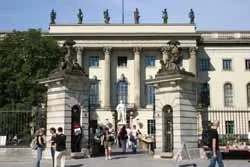
Based on the overall set of indicators, the publication recognized the Technical University of Munich as the best university in the country. It is followed by Ludwig Maximilian University of Munich. Focus also included in the group of higher education leaders the universities of Freiburg, Heidelberg, Konstanz, Humboldt University, and the universities of Mannheim, Tübingen, Stuttgart, Bonn and Karlsruhe.
By subject, the University of Freiburg (Albert Ludwig University) took first place in teaching law and history, the University of Mannheim in business administration and economics. In biology, physics and mathematics, Heidelberg University (Ruprecht Karl University) was recognized as first, in medicine and chemistry – the Technical University of Munich, in computer science – the University of Karlsruhe, in psychology – the University of Konstanz. In geography, the best university in the country was the University of Bonn (Friedrich Wilhelm University), in political science – the Free University of Berlin, in sociology and pedagogy – the University of Bielefeld. The journal named Humboldt University of Berlin the best in German studies, the University of Freiburg in history, and Ludwig Maximilian University of Munich in English studies.
Founded by the Habsburgs in 1457, the University of Freiburg (Albert Ludwig University) turned into a city university at the end of the 19th – beginning of the 20th century, and the number of students grew from 200 to 2,000. The University of Freiburg is a true forge of Nobel laureates. Within its walls studied or worked Friedrich von Hayek (economics, 1974), Paul Ehrlich (medicine, 1908), Robert Bárány (medicine, 1914), Adolf Windaus (medicine, 1928), Hans Spemann (medicine, 1935), Philip Hench (medicine, 1950), Hans Krebs (medicine, 1953), Georges Köhler (medicine, 1984), Heinrich Wieland (chemistry, 1927), George de Hevesy (chemistry, 1943), Hermann Staudinger (chemistry, 1953), Mario Molina (chemistry, 1995).
Currently, the university has 21,500 students and 11 faculties: theology, law, economics and behavioral sciences, medicine, philology, humanities, mathematics and physics, chemistry, pharmacy and earth sciences, biology, forestry and environmental science, and applied sciences. It is a classical university where the vast majority of academic disciplines can be studied. Students who participated in the survey additionally note their university for excellent service as well as its rich library holdings.
To enroll in law, applicants must have high scores in mathematics, German, and a foreign language. As alternative universities for studying law, Focus names the universities of Heidelberg, Munich (Ludwig Maximilian), Münster, Cologne, and Humboldt University of Berlin.
The Faculty of Construction and Environmental Protection at the University of Stuttgart is the smallest. Of the ten faculties (the university also has faculties of architecture and urban planning, chemistry, geo- and biosciences, computer science, electrical engineering and information technology, aerospace engineering and geodesy, mechanical engineering, mathematics and physics, humanities, management, economics and social sciences), only 2% of the total number of students (or just 400 people out of a 20,000 student body) study construction wisdom. It seems that the small size of the faculty determined the quality of teaching construction disciplines, and therefore every graduate knows what a digital level, an optical theodolite, or an electronic total station is.
Its closest competitors are the Karlsruhe Institute of Technology, the Technical University of Munich, and RWTH Aachen University.
Perhaps the reason why the University of Mannheim became the best in both business administration and economics lies in the fact that from its founding in 1778, the institution was conceived as a school of commerce for the children of merchants. Later it turned into a Higher School of Commerce, then into a Higher School of Economics, which obtained university status in 1967.
The University of Mannheim is considered a small university. Its five faculties – economics and law, business, social sciences, humanities, mathematics and computer science – have only 15,000 students. The German press compares Mannheim with such well-known universities as the London School of Economics, the International Institute for Management Development (IMD) in Lausanne, ESADE Business School in Barcelona, and HEC Paris.
Students highlight a strong mathematical component in teaching economics, as well as the availability of a large number of specializations in management. The admissions committee for these specialties prefers candidates with good grades in mathematics, German, as well as computer science and philosophy.
In the list of universities where management and economics are also well taught, Focus notes the universities of Munich, Münster and Cologne. The best in biology, physics and mathematics, Heidelberg University (Ruprecht Karl University) is the oldest and largest university in Germany. Founded in 1385, today it teaches over 26,000 students. In terms of the number of faculties, it also surpasses the vast majority of German universities – there are twelve of them. These are the faculties of theology, law, medicine and philosophy, which have existed since the very beginning of the university; the faculty of natural sciences opened in 1890, and later ones: philology, economics and social sciences, cultural and behavioral sciences, mathematics and computer science, chemistry and earth sciences, physics and astronomy, biological sciences.
In the list of Nobel laureates of Heidelberg University are 10 scientists: Albrecht Kossel (medicine, 1910), Otto Meyerhof (medicine, 1922), Otto Warburg (medicine, 1931), Bert Sakmann (medicine, 1991), Walther Bothe (physics, 1954), Hans Jensen (physics, 1963), Theodor Hänsch (physics, 2005), Richard Kuhn (chemistry, 1938), Georg Wittig (chemistry, 1979).
Biological sciences are a particular strong point of the university. In addition to the faculty, the university hosts the Center for Molecular Biology and the Center for Biochemical Research, which conduct scientific research known to specialists around the world. Accordingly, to become a student of the Faculty of Natural Sciences at Heidelberg University, one must have excellent knowledge of biology, chemistry, and mathematics, as well as experience in laboratory work, which is checked during the admissions process.
Its direct competitors in biology are the universities of Tübingen, Munich, Freiburg, and Würzburg; in physics and mathematics – the Technical University of Munich, the universities of Konstanz and Jena. And among foreign universities – the University of Fribourg in Switzerland, Harvard, the Massachusetts Institute of Technology, Cambridge, and the Sorbonne.
The Technical University of Munich is noted as the best in the study of medicine, chemistry, and electrical engineering. It is relatively young and was opened in 1868 by Ludwig II of Bavaria as a polytechnic school. Later it developed into a Technical University, and since 1970 it has had university status.
As befits a technical university, this university clearly has a predominance of faculties related to industry and its service. These include the faculties of mechanical engineering, electrical equipment and information technology, mathematics, physics, computer science, chemistry, civil engineering and safety engineering, architecture, business administration, sports, and medicine.
The main specialization of future doctors studying here is oncology, neurology, and cardiovascular medicine. For the right to be named first in teaching medical disciplines, it competes with the universities of Heidelberg, Munich, Freiburg, and Berlin; in chemistry, the Technical University of Aachen is added; and in electrical engineering, alongside Aachen, the Technical University of Dresden, the Universities of Stuttgart and Darmstadt.
Focus believes that psychology is best taught at the University of Konstanz. It was opened in 1965, when Germany was able to overcome the devastating consequences of the Second World War. In size, it is even smaller than the University of Mannheim. Its student population barely exceeds 10,000 people. Konstanz has three faculties: natural sciences, humanities, and law, economics, and politics. As an alternative for studying psychology in Germany, the publication names the universities of Bochum, Würzburg, Jena, and Tübingen.
Graduates of the mechanical engineering faculty of the Technical University of Aachen, as well as other universities, who have received engineering degrees, are not threatened by unemployment in the near future. According to the Association of German Engineers, this year there is a shortage of 20,000 engineers of various specialties, including construction.
Founded in 1870, the Rheinisch-Westfälische Technische Hochschule Aachen (the full name of the university) was originally conceived as a university training engineers for Prussian industry. However, over time it became known not only as an engineering school but also as a strong research center. Five researchers who worked in its laboratories received the Nobel Prize. Three scientists – Philipp von Lenard, Wilhelm Wien, and Johannes Stark – became Nobel laureates in physics in 1905, 1911, and 1919. Peter Debye and Karl Ziegler received the Nobel Prize in chemistry in 1936 and 1963.
With 28,000 students, the Technical University of Aachen is the largest technical university in the country. The university consists of ten faculties: mathematics, computer science and natural sciences; architecture; civil engineering; mechanical engineering; georesources and materials science; electrical engineering and information technology; humanities and arts; business and economics; and medicine. It is its faculties of mechanical engineering and electrical engineering that were chosen as an experimental platform by such giants of German industry as BMW, Siemens, and MAN.
As an alternative for studying mechanical engineering disciplines, Focus names the University of Karlsruhe and the Technical University of Darmstadt.
The Rhenish University of the city of Bonn bears the name of its founder, the Prussian King Frederick William III, who opened the university in 1818. Despite the fact that in the Focus ranking it appears as the best in teaching geography, the publication also notes that it has very good indicators in mathematics, natural sciences, management, and economics. It is perhaps the only university in Germany where theology is taught in two separate faculties – Catholic and Protestant theology. In addition, the University of Bonn has faculties of law and economics, medicine, arts, mathematics and natural sciences, and agriculture. It has over 27,000 students.
The history of the university includes two Nobel laureates – Wolfgang Paul (1989, physics) and Reinhard Selten (1994, economics).
As an alternative to Bonn for teaching geography, Focus names Humboldt University of Berlin and Heidelberg University.
It is symbolic that political science is best studied at the Free University of Berlin, which emerged in 1948 as an alternative to the Humboldt University of Berlin, which remained in the zone of responsibility of Soviet troops and later became the main university of the GDR. The resulting competition continues to this day, and they are not inferior to each other in terms of student numbers. The Free University has 35,000 students, and Humboldt University has 35,400. The Free University has 12 faculties: physics, biology, physics and pharmaceuticals, business and economics, earth sciences, education and psychology, history and cultural studies, law, mathematics and informatics, medicine, philosophy and humanities, political and social sciences, veterinary medicine. Humboldt University has 11 faculties: law, agriculture and horticulture, two faculties of mathematics and natural sciences, medicine, four faculties of arts and humanities, theology, economics and business administration.
Political science at the Free University of Berlin is taught at the institute named after Otto Suhr, the former mayor of West Berlin. Its alternatives are the Universities of Heidelberg, Munich and Tübingen.
Bielefeld University is new. It was founded in 1969 on the basis of the Higher Pedagogical School. And in the rating, it won in the categories 'pedagogy' and 'social sciences'. With 18,000 students, it has 13 faculties: biology, chemistry, historical sciences, philosophy and theology, health sciences, linguistics and literary studies, mathematics, pedagogy, physics, psychology and sports sciences, law, sociology, technology, management and economics. It is one of the few German universities with separate faculties of sociology and pedagogy. The latter, according to experts, is the best not only in Germany but also in all of Europe.
Despite its relative youth, Bielefeld University boasts its own Nobel laureate. In the 1990s, Reinhard Selten, who received the Nobel Prize in Economics in 1994, conducted research at the university's Institute of Mathematical Economics.
The closest competitors of Bielefeld in pedagogy and sociology are the Universities of Munich, Freiburg, Humboldt, and Konstanz.
Founded in 1825, Karlsruhe University is the oldest technical university in Germany and the fourth oldest in Europe after the École Polytechnique in Paris, the Czech Technical University in Prague (CVUT Prag), and the Vienna University of Technology (TU Wien). The university has 11 faculties: mathematics, physics, chemistry and biosciences, humanities and social sciences, architecture, civil engineering, geosciences and environmental sciences, mechanical engineering, chemical engineering and technology, electrical and information engineering, informatics, management and economics.
The Faculty of Informatics, which won the 'Focus' ranking, is one of the largest in the country. Out of 18,000 students, over 2,000 study here. The faculty also employs 200 researchers and 27 professors. Among the Nobel laureates associated with this university are: Fritz Haber (chemistry, 1918), Jean-Marie Lehn (chemistry, 1987), Lavoslav Ružička (medicine, 1950), Hermann Staudinger (chemistry, 1953), Ferdinand Braun (physics, 1909).
The publication names the Technical University of Munich, the Technical University of Darmstadt, RWTH Aachen University, and Saarland University as direct competitors of Karlsruhe University in informatics.
Where else to study German studies if not at the Berlin University, founded by the great humanist Humboldt, which for the first time in world history combined student education and faculty research under one roof. Actually opened in 1810, the Berlin University, later named after its ideological inspirer, served as a model for the creation of classical universities worldwide, and in Germany it is called the 'mother (in German, university is feminine) of all modern universities'.
The list of Nobel laureates of Humboldt University is more than impressive. It is headed by university professor Jacobus Henricus van 't Hoff, who received the Nobel Prize in Chemistry in 1901, the first year of the awards. The following year, Theodor Mommsen was awarded, becoming the first German laureate in Literature. In Medicine, Robert Koch (1905) is noted, in Chemistry, Emil Fischer (1902), Walther Nernst (1920) and Otto Hahn (1944). Most Nobel laureates – 29 – received the prize for achievements in Physics. Among them are Albert Einstein and Max Planck.
Ludwig Maximilian University of Munich, noted by the magazine for its teaching of English studies, is much older than its famous counterpart. It was founded in 1472 and bears the names of its founders.
It is the largest university not only by German standards but also in Europe. There are 46,000 students and 700 professors. The university has 18 faculties: Catholic and Evangelical theology, law, management, economics, medicine, veterinary medicine, history and art history, philosophy, philosophy of science, religious studies, psychology and pedagogy, cultural studies, foreign languages and literary studies, social sciences, mathematics, informatics and statistics, physics, chemistry and pharmacy, biology, geosciences.
The list of Nobel laureates who studied or worked at the university includes 26 names. The last one is Theodor Hänsch. He received the prize in 2005 together with American John Hall 'for the development of precision laser spectroscopy, in particular for the methods of comb laser spectroscopy in the optical range'. In general, physicists, chemists, and medical doctors dominate the list.
As rivals of Munich University in teaching English studies, 'Focus' names the universities of Freiburg, Giessen, Erlangen, Nuremberg and the Free University of Berlin.
Based on materials from CMK 'Parta'