
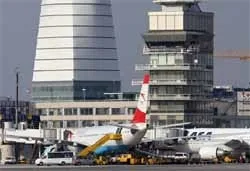
"Offen fur neue Horizonte" – that's how the airport's official slogan sounds in German. It is also called the "gateway to Eastern Europe" – in the terminal building, every now and then you'll see a colorful billboard with an image of matryoshka dolls. Thanks to the airport's favorable geographic location, it is from here that the main traffic flows from the western part of the Old World to the east.
Today, 69 airlines operate flights from Vienna Airport to 176 destinations. The five most popular regular routes include London, Frankfurt, Zurich, Paris, and Dusseldorf. Moscow is recognized as the key destination in Eastern Europe, while New York, Bangkok, and Washington are in highest demand among long-haul routes, and Antalya leads among charter flights. Last year, the airport served about 16 million passengers. The year's record came on July 1 and totaled 61,666 passengers (thus, at the peak of the season, there are 4.5 passengers per airport employee – the staff numbers about 13,000 people). According to official data, the dynamics of Vienna Airport's development exceeded the European average – the number of passengers carried grew by 7.3% (while the average for European airports was 7%).
However, Schwechat is not stopping at what has been achieved: the airport plans to expand Terminal 2 – they want to reach a total capacity of 23 million passengers per year.
Despite the fact that the airport is formally located outside Vienna, getting from it to the capital and back is easy and simple – both by private car and by public transport. For €6, a bus will take you to any of the five offered points in the capital: Schwedenplatz, Sudtiroler Platz, or UNO-City, as well as to the Sudbahnhof and Westbahnhof railway stations (travel time 20-35 minutes). To the northern part of the city, you can go for €3 on the S-Bahn train, which runs every half hour. And finally, the fastest way is the CAT express train. It runs from half past five in the morning to half past eleven at night and will take you in just 16 minutes to the City Air Terminal, located in the center of Vienna, near St. Stephen's Cathedral, at the intersection of all the city's transport routes. In addition, from the airport you can take buses to dozens of cities in Slovakia and Hungary, including Bratislava and Budapest.
According to the airport's management, Schwechat can boast one of the shortest transfer intervals in Europe – this is the time a transit passenger needs to switch from one flight to another. In Vienna, it is 25 minutes for flights by airlines that are members of the Star Alliance (as is the airport's home carrier, Austrian Airlines), and half an hour for all other flights. In addition, according to official data, the minimum guaranteed check-in is just 20 minutes – meaning that in this time a passenger theoretically manages to check in, drop off baggage, go through border and passport control, and board the plane.
In practice, Schwechat, like most major world airports, really does try to solve the problem of queues at check-in – if there are any at the registration counters, an employee in the signature red uniform will definitely approach you and offer to use the quick check-in service (i.e., fast registration). The service is free: all you need to do is go to a special machine, put your ticket in it, press a few buttons, and get a boarding pass with your seat assignment. But since interacting with the machine requires a certain amount of concentration, as well as at least a minimal knowledge of German or English, not all passengers want to learn this new science.
As an incentive, they even offer (again, completely free) lottery tickets, with which you can win souvenirs and get them right there at the airport. The correspondent of "Aeroport", for example, got a pack of hard candies – a very necessary thing during takeoff. There's just one problem: something got stuck in the machine, the boarding pass remained inside, and I had to go through registration again – the usual way. True, I was directed to the business-class counter, but there was already a line of the same unlucky people, so I couldn't save time. However, compensation came in the form of unobtrusive border control – here it is not yet fashionable to pester passengers with enhanced security measures, they don't force you to open your suitcases, and you don't even always need to take off your shoes.
The terminal building consists of three terminals (1, 1a, and 2) and occupies four floors. The underground floor has a supermarket and the CAT railway station, the ground floor is the arrivals area, the first floor is the departures area, and the second floor is given over to numerous restaurants, cafes, and ten VIP lounges. Don't spare time before departure – set aside at least half an hour for local shopping. More than 6,000 square meters are allocated for selling all sorts of things at the airport – that's 55 Duty Free outlets (in the departures area) and 19 regular stores. Here you can buy everything – from a hairpin to a coat. True, prices can't be called low, but the selection is decent.
Two famous Austrian "features" deserve special attention: Mozart candies and Swarovski jewelry. Moreover, if sweets with the portrait of the musical genius cost about the same here as in the city, then jewelry made of cut glass can be bought for ridiculously little money (especially if they are made "from Swarovski materials", i.e., from the same crystals but without the famous swan logo) – almost half as cheap as in the capital. Fakes are excluded – real Austrian quality!
And lastly: if you have time, you can take a ride around the airport on a special bus. Even with a guide! The bus stop is located on the basement floor. The bus can also be ordered in the departure area, at the tax free refund counter, if, of course, you have all your receipts, purchased goods, and the desire to get money right at the airport (for this you will have to take a short bus trip). If you are short on time for bureaucracy, it is better to leave your bank details, and the money will be transferred to your account.