
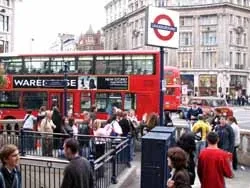
Be that as it may, every person in London ends up in the camera lens about three hundred (!) times a day on average. And now this reality show about the life of a big city can be watched without leaving the couch, on a special TV channel. And not just watched. The television keyhole is designed to help fight crime: citizens will be able to report all incidents and suspicious individuals captured by the cameras to the proper authorities.
Your Own Detective
Residents of the London district of Shoreditch and its surroundings will be the first to appreciate the advantages of the new video surveillance system. DigitalBridge, a company providing Internet access and satellite TV services, with the assistance of municipal authorities, established a new local TV channel, Shoreditch TV. Information from twelve outdoor surveillance cameras feeds into it. They are placed on buildings, parking lots, and simply on streets in the eastern part of London. Images from different cameras change on the screen every 30 seconds. "These cameras will allow people to see what is happening around their homes and on the roads, as well as to record possible crimes," the project organizers say.
The experiment was conceived specifically for fighting crime, not as another entertainment. It is carried out with the support of local residents and community organizations, as well as the police. Many are convinced: the all-seeing television eye will make life in the troubled area of the British capital safer.
"It's, you know, like having many windows in your house that you could look out of before going outside," says one of the channel's creators. "You can find out what the police are doing to ensure safety for you and your neighbors." And special interactive maps give people the opportunity to promptly report incidents, accidents, suspicious cars, and street incidents. Thus, viewers can compare the faces of observed people with portraits of those who, for example, are wanted or have recently been released from prison and are at large under police supervision. Having noticed something unusual, subscribers can send an anonymous email directly to the police using a wireless keyboard that comes with the set-top box and remote control for the TV.
For the first three months, using the channel's services is free; then you will have to pay from 3.5 to 15 pounds sterling per month, as for regular satellite or cable television. This, apparently, does not bother citizens. Moreover, the project's initiators expect that next year the experience of Shoreditch TV will be extended to the whole country.
"Big Brother" Is Resting
"Big Brother," a reality show whose each episode attracts up to seven million viewers in Britain, is already old hat," the Daily Telegraph newspaper said peremptorily, comparing it with the content of Shoreditch TV. According to the publication, this experiment promises to be no less exciting than peeping at the adventures and relationships of the heroes of the popular TV show known in Russia as "Behind the Glass."
In Britain, "neighborhood watch" programs supported by local authorities and the police have long existed. People can report to law enforcement all suspicious incidents on their street or in their house. An elderly woman named Marjorie, a resident of one of the houses on Rosary Gardens Street in the London district of South Kensington, told me that a television in one of the neighboring apartments had been working continuously for several days. When the old lady called the police and the officers arrived at the house, a dead woman was found in the apartment. The creators of Shoreditch TV are counting on exactly this kind of vigilance from ordinary citizens, and the citizens support this project.
57-year-old Jan Ashby, who lives in the Shoreditch area, tried the new channel even before its official launch. "I can't say I like spying on everyone, but it is interesting to watch what is happening," he says. "My wife is a fan of Big Brother, but seeing real life is much more interesting. I watch the channel every day... And look, this is the neighboring pub..."
Ken Hodgkinson, whose pub "Mary Lloyd" is right in the sights of one of the cameras, has already become a local TV star. "I can't say I'd like to appear on TV, but if it helps security in our area, why not?" he says. His colleague Kate Evercrombie adds that not far from her bar in Shoreditch, the day before there was a knife fight. "Maybe the cameras will help people calm down," the woman believes.
However, human rights activists hold a completely different point of view. Gareth Grossman from the organization Liberty predicts the emergence of "vigilance committees" and old women raising the alarm over every noisy commotion of teenagers on the street. "This idea may create an atmosphere of suspicion," representatives of the civil liberties organization Statewatch believe. The director of the Shoreditch TV project, Atul Hatwal, sees no cause for concern: "The cameras are installed in public places, not in private homes. As a result, you observe what you would see while walking down the street. People cannot move or zoom the camera onto objects. Moreover, the video stream frames are encoded so that they cannot be recorded."
It should be noted that in London video cameras have more than once helped prevent various incidents and detain criminals. The television eye provided an invaluable service to Scotland Yard officers in establishing the circumstances of the London terrorist attacks in July last year. The explosions in the underground and bus on 7 July claimed the lives of 56 people, and about 700 people were injured. In searching for data on the criminals, police reviewed tens of thousands of hours of video recordings. As a result, it was established that on 28 June three of the four terrorists - Mohammed Khan, Shehzad Tanweer and Germaine Lindsay - met at about 8:10 a.m. at Luton station, bought tickets for a commuter train to London and by about 8:55 a.m. were already at the capital's King's Cross station. The three men were then captured by cameras at Baker Street station, and later - around one o'clock in the afternoon - again at King's Cross station, where they again boarded a commuter train to Luton.
According to police, the terrorists thus carried out a reconnaissance sortie before the explosions on the morning of 7 July, when they were again caught by video cameras in Luton and at King's Cross. This made it possible to reconstruct the picture of the terrorists' movements literally minute by minute.
Exactly two weeks later, on 21 July, other criminals attempted to repeat the scenario with four explosions, but the bombs did not detonate, and no one was hurt. And already the next day, the British police, taught by bitter experience, released pictures of four suspects. The head of Scotland Yard's special operations unit, Andy Hayman, at a press conference in London, gave the suspects' descriptions and showed photographs obtained from CCTV recordings in transport.
Within a week, thanks to the efforts of the public and law enforcement agencies, all four unsuccessful terrorists were arrested in different parts of the United Kingdom, and one of them - in Italy, where he had managed to go.
And then more. Britain will become the first country in the world to record all movements of road vehicles. Using a network of cameras that automatically read the license plates of all passing cars, it is planned to create a huge database of vehicle movements so that police and security services can analyze any trip made by a driver over several years. The surveillance network will include already installed and new video cameras, which will be improved to read license plate information around the clock and without error on all major highways of the country, as well as on city streets, in ports, and at gas stations.
In the London district of Hendon, where the UK Police National Computer is already installed, a center will be set up to which information will flow. Its daily volume will be about 35 million license plates with an indication of the time and place where the movement of a particular car was recorded. The data will be stored in the system for at least two years, but this period may be extended to five years.
The initiative was supported by the road services and police of the United Kingdom. Police claim that in its accuracy and value in solving crimes, this system can be compared with DNA identification procedures. Vigilance above all.