
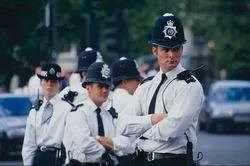
The last time I was in London was in May, when everything that happened here could only seem like a nightmare. Two months later, I did not recognize either the metropolis or its inhabitants. Perhaps London will never again be the city that, once entering your life, never lets you go. It is now a little different...
It would be unfair to claim that the terrorist attacks took Londoners by surprise. Alarming reports of supposedly discovered suspicious objects appeared even before July 7. Central television channels repeatedly reported on special services foiling attempts to carry out terrorist attacks. True, without going into detail: either a strange suitcase was found at Heathrow Airport, or all people were evacuated from the Canary Wharf business center without properly explaining the reasons for the commotion. Therefore, when the explosions went off, ordinary people, subway employees, bobbies, medics, and firefighters acted almost without panic, with a cold calculation that comes from unknown places in a critical situation. However, this is only a semblance of calm and order. In fact, few Londoners believe that their lives will be the same - with gatherings in pubs, jogs in Hyde Park, and toasts "To the Queen!" A primeval fear appeared in the eyes of the prim Britons, which I had not seen two months ago.
Other London
The plane arrived at Heathrow Airport without delay. I expected a total search, military patrols with dogs, metal detector gates. But... at the passport control counters it was calm, even fewer police than usual, no armored personnel carriers at the entrance, no machine guns on the roof. A pretty female employee behind the glass automatically, without looking at my face (unlike our border guards), stamped my visa. I decided to get from the airport to the center by underground. And here I saw a different London. Passengers in the carriages no longer read, do not listen to players, do not doze in the corner. They anxiously and intently observe each other. What was previously considered a sign of bad manners is now called vigilance.
Try to enter the subway with a bulky bag, or even more so rummage through it, looking around nervously. Dozens of people will immediately scan you with their eyes, and at the nearest station you are guaranteed a meeting with a policeman. Everyone remembers how a vigilant passenger at Marylebone station, smelling burning, called the police. As a result, the station was completely closed for more than five hours. And this is just one case. And several such reports are recorded daily. Because of their own vigilance, Londoners cannot get to work for hours: no one can know in advance which subway line will be closed.
Taking photographs at subway stations, in public places, and on the streets is now equivalent to an offense. Journalists need special permission from Scotland Yard to shoot. As soon as I took out a camera at Baker Street station, a policeman appeared behind me as if from out of the ground and ordered me to stop shooting immediately. Previously, it was even hard to imagine such a thing. On the contrary, policemen kindly posed for tourists photographing them. And people in uniform could rarely be encountered in the subway. Now at least two representatives of the law are constantly on duty on the platform.
At night, even in London's Soho, there are unusually few people: fashionable discos, Chinese eateries, bars, and Thai transvestite shows yearn for customers. At any time of the day, the wail of sirens is heard here and there - the police are rushing to check another report. Bobbies walk the streets with notebooks in their hands and carefully write something down. In the famous double-decker red buses, agents in plain clothes ride around pretending to be tourists. They are easy to recognize - dressed in baggy gray suits, as if bought at a sale at Marks & Spencer, they sit bored for hours on the rear platform.
I traveled around London on bus route 30. The very one that was blown up on Tavistock Square. The driver, Nick Sailensar, is sure that the situation will only get worse: "Londoners have lost their support in the government. It hurts me to look at the frightened faces of passengers." Fear has seized London. A representative of the travel agency IVS honestly told me: "London as a tourist object can be safely written off. How can you be in a city where every person watches you?"
Londoners, having lost trust in public transport, immediately switched to their own cars. Because of their huge influx, multi-kilometer traffic jams immediately arose in the city. As a result, the city authorities raised the tax for entering the center from six to eight pounds. Such is the price for fear.
But there are, of course, tourists in London. Mainly Japanese, Chinese, Americans. However, if previously it was problematic to get on the open tourist double-decker buses due to the influx of visitors from different parts of the world, now lines of vehicles stand idle for hours near Hyde Park.
Terror has even hit London's famous department stores. Thus, the legendary Harrods announced a drop in sales of 20%.
Tourists, naturally, are aware of what city they have come to. At Knightsbridge underground station, I observed such a scene. A noisy group of Chinese people settled on the lawn. Suddenly there was a loud bang. The Chinese threw themselves face down on the grass. The only one who remained unfazed was a little girl whose huge balloon had burst.
Unsurprisingly, fear has already claimed its first victims. The whole world heard about the 27-year-old Brazilian Jean Charles de Menezes, shot dead by Scotland Yard agents. Residents of the British capital cannot recall a case of police using weapons in broad daylight. Usually they do not carry pistols at all, only special means, tightly covered so as not to traumatize people's psyches. However, after the first wave of terrorist attacks, the head of the London police, Sir Ian Blair, issued an order to use weapons if a specific person is suspected of committing terrorist acts. After the death of the unfortunate Brazilian, a dark joke appeared: “Anyone who is late for work and runs into a subway car will be shot point-blank with five shots.” Funny?..
Or here is another joke. Since both series of explosions occurred on Thursdays, Londoners immediately came up with a quip: “Tomorrow is Thursday. Have you already written your will?” Jokes aside, insurance companies cannot keep up with clients who want to insure their lives.
Welcome to Londonistan!
The country's Prime Minister Tony Blair rashly called Muslim fanatics the organizers of the attacks. The head of the London police, Sir Ian Blair, hastened to state that no religious or national community can be blamed for what happened, as this could turn London into a battlefield along racial and religious lines. It must be taken into account that currently in the country, according to the press secretary of the Muslim Council of Britain, Inayat Bunglawala, more than one and a half million Muslims live, and native residents of the capital have long called their city Londonistan. In the British capital, Lebanese shawarma is sold on every corner, Oxford Street is full of ladies in hijabs, Arabic speech is heard everywhere, and near the hotel where I stayed there was an internet cafe opened by “people of Caucasian nationality.” “And what, exactly, is wrong with that?” say Londoners. “This world belongs to everyone.”
However, the genie is out of the bottle. Mosque walls are already covered with offensive graffiti, Pakistanis are being beaten up for no reason in working-class neighborhoods, and a new pastime has appeared among British teenagers: running up to a Muslim woman in a burqa on the street, lifting her veil and spitting... A wave of xenophobia is uniting Britain's Muslim community. I personally witnessed such a scene. In a subway car, an elderly Pakistani took a seat next to me. Seeing a fellow countryman entering, he greeted him loudly with defiance and pomp clearly intended for those around him: “Salaam aleikum!”
At Marble Arch underground station, I got to talking with a seller of Islamic literature named Yashin.
“I have lived in London since 1987,” he told me, “and I have never been so scared before. Right after the explosions and Blair's statements offensive to me and my people that Muslims were to blame for everything, I cannot feel at ease in this country. I constantly see angry looks and hear reproaches directed at me from native English people. Why is everyone so sure that it was Muslims who bombed the subway? As far as I know, many of my co-religionists died during the attacks. Do you really think that people of the same faith would kill each other? That's nonsense! My opinion: all these explosions were organized by American Freemasons!”
And the day before, I wandered through the Muslim quarter of the city of Leeds, which became famous throughout the world for the fact that, according to the authorities, three of the four suicide bombers who carried out the explosions on July 7 lived here.
The house in Beeston, a suburb of Leeds, where 22-year-old Shehzad Tanweer, who blew himself up at Aldgate underground station, lived, was difficult to find. The son of the owner of a local restaurant “Fish and Chips”, he lived in the house with his parents, younger brother and sister. However, after the London nightmare, the family left the house, closing the metal doors and boarding up the windows with metal sheets. Their neighbor, seemingly scared to death, talked to me through a crack in the door: “This family was the most positive in the area. If we ran out of money, we could always come to Shehzad's father and get food. And Shehzad himself often helped us. Lately he had made new friends, also Muslims, but not from our area. They say he traveled with them to Afghanistan and changed greatly after that trip. He became even more devout and attended the mosque every day. But I still do not believe that he could have blown himself up. It seems to me that the guys, including Shehzad, simply did not know that there were bombs in the backpacks. Maybe someone asked them just to ride with the backpacks on the subway and on the bus? He could not have done this.”
Everything is under control
Many are trying to find an answer to the question “Who is to blame?” today. But so far to no avail. The data from a sociological survey conducted among Londoners is striking. So, the majority of the surveyed residents are sure that the explosions were orchestrated... by British intelligence services. Where does this come from? It is known that for about six months, British society has been actively discussing the introduction of the so-called new generation identification cards (ID card). These documents will contain biometric data of their owners. A special microchip inserted under the skin will record information about the retina, fingerprints, etc. Police officers will thus be able to obtain information about a person at a distance of five kilometers.
Human rights activists oppose the introduction of these cards, saying they will lead to total control over citizens. The authorities, for their part, hope that this is the only way to protect the country from terrorism. There is no longer any doubt that the cards will now be adopted. After all, dozens of victims – isn't that a reason to start monitoring every citizen of the country from cradle to grave? Among Britons, rumors persist that some in the British government have taken a strong liking to the ideas Orwell set out in the novel "1984". There is a suspicion that the grim Orwellian dystopia may soon find real-life application – and in the very same country, the very same city, albeit more than twenty years late. And then there is this: it is surely no coincidence that the television idiocy called "Big Brother" enjoys immense popularity in this country. The parallels are hard to miss: Big Brother is watching you. But not all that vigilantly yet. How else to explain the fact that all four terrorists who tried to bomb the London Underground on 21 July managed to get away? How did they do it, given that today every tube station is crammed with CCTV cameras, fitted with automatic ticket gates, and exiting the Underground requires entering a "travel card" into the terminal?