
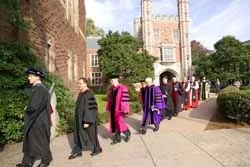
The Ivy League is an association of eight elite American universities. It also includes Dartmouth College, Columbia University and Cornell University. This informal association owes its name to the ivy shoots that entwine the old buildings of these universities. By entering any of them, you will receive a quality education and catch a sense of superiority over students of other universities. The positions of the "Ivies" never fall below the fifteenth line in the ranking of U.S. News and World Report magazine.
HARVARD UNIVERSITY
The oldest private university in the United States with a worldwide reputation. Harvard professors like to emphasize that in admitting students they are guided solely by the applicants' abilities, not their ability to pay for tuition. Expenses are fully or partially covered by targeted scholarships and financial loans. For example, law school students can apply for the Academician Sakharov scholarship. And the John F. Kennedy School of Government (at the university) provides scholarships for obtaining a master's degree in public administration.
The university has nine faculties: medicine, arts, theology, law, business, design, education, public health, and management. Each of them is the best in its field.
The most popular bachelor's programs: programming (includes creating and auditing websites, web design), microelectronics, and robotics. Among master's programs – economics and finance. But medical and law faculties are considered the most inaccessible: it is difficult to get in even for very talented applicants.
About 70% of Harvard students receive direct financial aid from the university. Among them are international students. The amount of the scholarship is determined individually, but the average amount is $23,000 per year. To get this money, you just need to indicate in the application that you need financial assistance.
PRINCETON UNIVERSITY
Princeton has established itself as one of the best US universities in teaching engineering physics, mechanics and mathematics. The most popular fields are technical: engineering, aerospace systems, mechanics, and plasma physics. The university includes about 20 departments that prepare students in 57 fields.
However, all Princeton students receive a diverse education: they must study two subjects from each of four areas (natural sciences; social sciences; art and literature; history, philosophy, religion). In the first year, compulsory study of literature is provided, which, according to the program's creators, promotes the development of public speaking skills and general literacy of students.
All written exams at Princeton University are conducted under the "honor system": students take full responsibility for honest behavior during exams, so the teacher does not monitor the completion of the work. He only distributes exam sheets, quickly answers questions, and leaves the room to return later and collect the papers. Each student, when signing the test, adds a note: "I pledge my honor that during the exam I have not violated the Honor Code."
An important role in the educational process of Princeton University is played by orientation sessions. They take place in small groups and are intended not so much to give students knowledge as to awaken their interest in the subject. This form of learning is especially often used in the study of the humanities and social sciences.
YALE UNIVERSITY
Founded in 1701 in New Haven, Connecticut. According to the charter of the colonial General Assembly, its purpose was to educate "exemplary men". The university still fulfills its task excellently today.
The university has ten faculties that graduate lawyers, economists, doctors, managers, ecologists, theologians, and architects. There is great competition for the arts faculties, which train musicians, artists, and actors. The most popular and prestigious among undergraduate and graduate applicants are the departments of biology, chemistry and biochemistry, physics, astronomy, mathematics, and environmental protection. In graduate school, the following specializations are very popular: biomedicine, applied chemistry, engineering sciences, computer science, geology and geophysics, molecular biophysics.
Yale University is famous for its numerous research centers. The most famous is the Center for Biodiversity Conservation and Science. The university also runs the Yale Russian Archive Project.
BROWN UNIVERSITY
Brown University is located in Providence, Rhode Island. First of all, it is famous for its unusual curriculum – the so-called "New Curriculum", which started in 1969. According to it, students have the right to freely choose subjects (there are no required courses at all) and receive a pass or fail instead of a grade for any of them.
The development of the principles underlying the New Curriculum was begun by Francis Wayland. In 1850 he wrote: "The educational process should be organized in such a way that the student has the opportunity to study what he has chosen, everything he has chosen, and nothing but what he has chosen." And the choice is rich: a bachelor of science or arts degree is awarded in more than 50 fields. This university is the only one in the US that has departments of Egyptology and history of mathematics. But there is no law school or business school. People go to Brown for a quality liberal arts education. The departments of history, literature, and international relations are highly regarded.
You can get into any US university with a sports scholarship. Brown University differs from others in that it mainly accepts women for sports. Information about this can be obtained on the university's website.
UNIVERSITY OF PENNSYLVANIA
Pennsylvania University (or University of Pennsylvania) was the first higher education institution in the US to be officially called a university. It is a private university founded by Benjamin Franklin, and it should not be confused with Pennsylvania State University.
The main feature of the university is that the educational and research processes are not separate. Students who come here to study start working in laboratories and institutes from the second year. Most of the research is conducted in the interests of defense, but in the last ten years scholarships have also been awarded to humanities scholars.
Pennsylvania University is known for its strict requirements regarding the quality of applicants' knowledge. The most competitive faculties are art, sociology, and law. The university has a Center for Undergraduate Research and Fellowship, which gives undergraduate students the opportunity to participate in the university's scientific life. Cooperation with the center is an additional chance for those wishing to enter graduate school and receive a scholarship.
HOW TO APPLY
To apply to a US university, an applicant must have the following documents.
* Application form (completed questionnaire of the chosen university) and application fee (fee for reviewing and processing documents). Each university has its own application form, which can be found on the university's website. It must be filled out exactly following all instructions. It must be accompanied by a check (application fee) for an amount from $20 to $200 (depending on the institution).
* Transcript (list of subjects for the last three years with grades) and copies of the education document (certificate, diploma). The transcript is usually formatted as a table. The domestic version of the transcript is certified with a seal not by a notary but at the school or dean's office. In addition, you need to prepare a similar table in English. Also required is a copy of the school certificate or diploma (for applicants to graduate level) in the native language and English.
* Three letters of recommendation (from teachers or academic advisors of the applicant). The standard length of a recommendation is no more than one page. Ideally, all letters complement rather than repeat each other. Each recommendation must be signed by the teacher and contain their contact information. The translation of the letter into English, like the translation of the transcript, must be certified by a notary.
* Personal statement (essay). An essay of one to two pages in the form of a composition about yourself. Answer the questions: 'What do I expect from studying at the university?', 'Why do I want to study abroad?' Write about what attracts you to the university: name a professor conducting research in your field, a famous local laboratory... Even if the university does not require samples of written work, it is better to provide them (portfolio in the field of fine arts, architectural projects).
* Exam results. Still in their home country, applicants must take tests at specialized testing centers. School graduates take TOEFL and/or SAT, university graduates take TOEFL, GRE or GMAT. Testing is always paid and costs from $60 to $250. All foreigners applying to US universities must take the TOEFL (English language exam for non-native speakers). Other exams are as required by the institution.
* Financial form. As a rule, in the application form the prospective student indicates how much they can pay for each academic year. The applicant's financial solvency must be confirmed by information about their bank account.
Some universities are willing to provide financial aid to international students. Such sponsorship support can range from 5 to 100% of the total cost of tuition. The main role is played by the applicant's academic performance, scientific and creative activity. In addition, there are scholarship and grant programs for foreigners funded by the US government and various foundations.